



Divisibility by 6 support notes
Using the divisible by 6 chart when one correct check is not enough
Why divisibility by 6 needs two yes answers
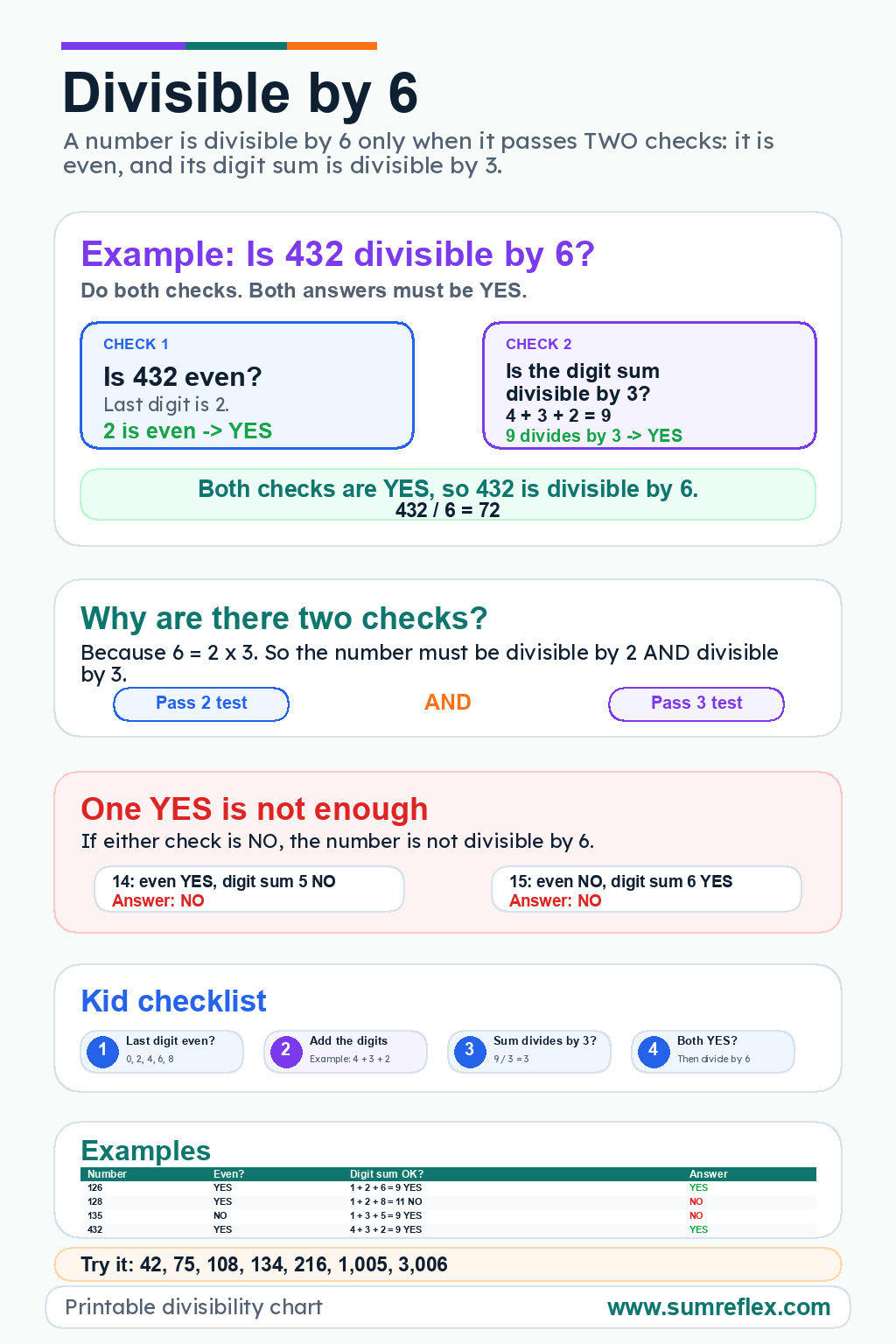
The divisible by 6 chart should be introduced as a combined rule, not as a new ending pattern. A whole number is divisible by 6 only when it is divisible by 2 and divisible by 3. That means students need one check for evenness and one check for the digit sum. A number like 246 passes because the last digit is even and 2 + 4 + 6 = 12, which is divisible by 3. A number like 248 fails because the ending is even but the digit sum is 14.
This makes the page a natural meeting point for two earlier charts. If the even-ending step is weak, review the divisible by 2 chart. If students can spot even endings but forget the sum, send them back to the divisible by 3 chart. The 6 rule depends on both habits working together.
A smooth order for applying both checks
A consistent order reduces careless work. Start with the final digit because it is the fastest screen. If the number is odd, the test stops immediately; the number cannot be divisible by 6. If the final digit is even, students move to the digit sum and test divisibility by 3. This saves time without hiding the reasoning. For 5,814, the final digit 4 passes the first check, and 5 + 8 + 1 + 4 = 18 passes the second check.
The divisible by 6 lesson can use the same order for written practice. Ask students to label the two checks as 2-test and 3-test. The labels keep the answer from becoming a vague yes or no. When both boxes show yes, the number passes. When either box shows no, the number fails.
What one-passed test tells you
The most useful teaching moments happen when a number passes only one part. For 57, the digit sum is 12, so the number is divisible by 3, but the number is odd, so it is not divisible by 6. For 82, the ending is even, but the digit sum is 10, so it is not divisible by 6. These examples show students that a single success is information, not the final answer.
This also helps students understand factors more deeply. Since 6 is built from 2 and 3, the rule asks for both smaller factors to appear. When that idea is ready for a fuller comparison, the Prime Factorization Calculator can show how 2 and 3 combine inside a factorization. The chart gives the mental shortcut; the calculator can confirm the structure after the attempt.
Practice paths that reinforce the compound rule
For warm-ups, give three groups of numbers instead of one long list. The first group should fail the even check, the second should pass evenness but fail the digit sum, and the third should pass both. Students can then explain why each group belongs where it does. This type of sorting is stronger than isolated yes-or-no questions because it forces them to notice the exact reason a number failed.
The chart also supports later work with common multiples. If students are comparing schedules, fraction denominators, or repeated patterns, a number divisible by 6 often becomes a useful candidate. The Least Common Multiple Calculator can help with a complete shared-multiple problem, while this printable keeps the 6-specific test visible for mental checking before the larger calculation begins.