



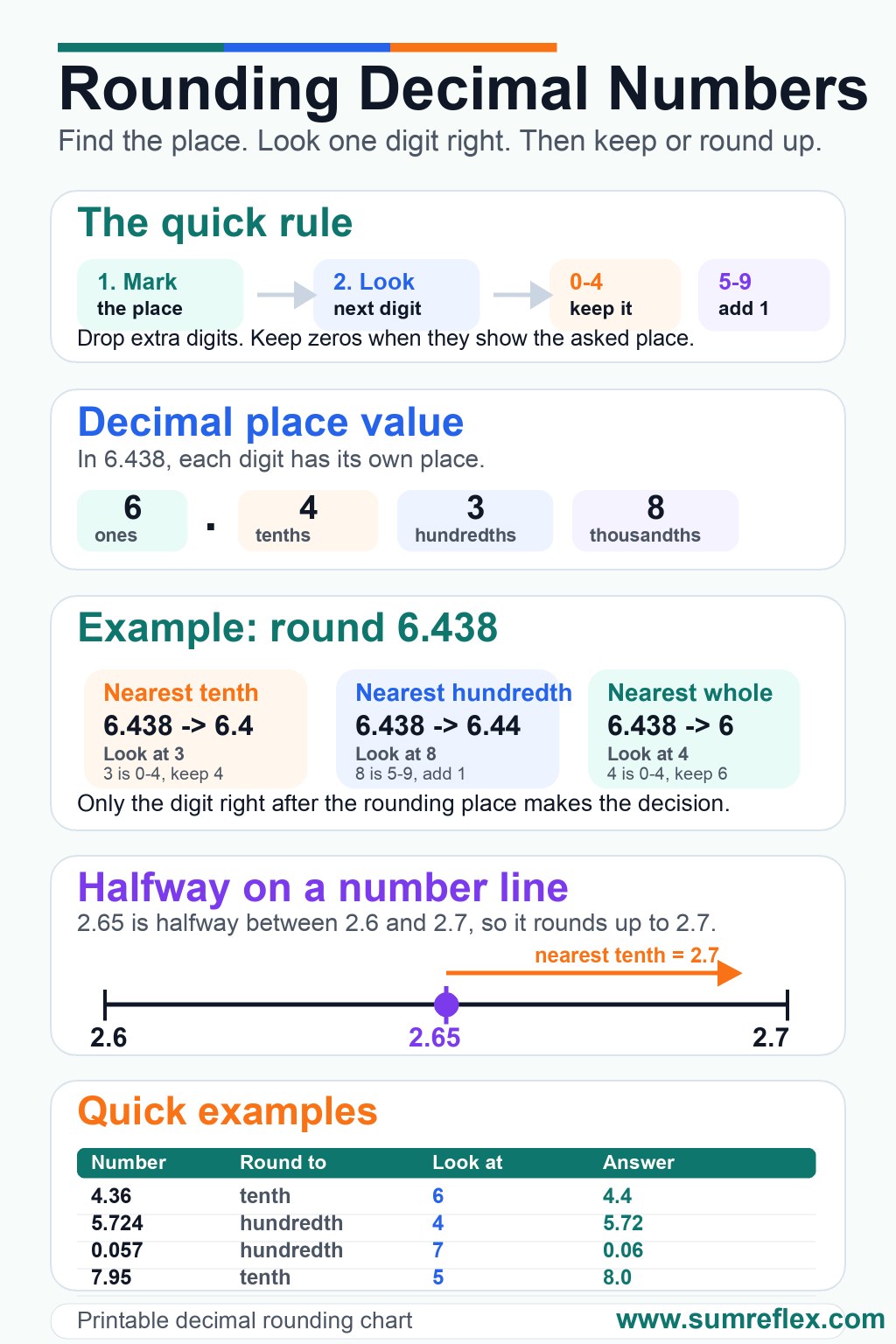
Decimal rounding guide
Rounding decimals by place value instead of guessing from the whole number
The target place must be named first
Decimal rounding starts with the place being rounded. A number can round differently depending on whether the question asks for the nearest whole number, tenth, hundredth, or thousandth. In 6.438, rounding to the nearest tenth focuses on the 4, while rounding to the nearest hundredth focuses on the 3. The chart helps students mark that place before they make any decision.
This step prevents a common mistake: always looking at the first decimal digit no matter what the question asks. The digit that matters for the decision is the one immediately to the right of the target place. If students mark the target place first, the checking digit becomes easier to find.
One digit gives the rounding instruction
After the target place is marked, students look one digit to the right. If that digit is 0, 1, 2, 3, or 4, the target digit stays the same. If that digit is 5, 6, 7, 8, or 9, the target digit increases by 1. Digits beyond the checking digit do not change the decision. For rounding to hundredths, 4.276 and 4.279 both look at the thousandths digit.
The chart should be used with written markings. Underline the target digit and circle the checking digit. That small routine makes the process visible and helps teachers see whether an error came from choosing the wrong place or applying the 0-4 and 5-9 rule incorrectly.
Number lines explain the halfway point
The rounding rule is faster, but a number line explains why it works. A decimal such as 2.65 sits exactly halfway between 2.6 and 2.7. By the usual school rule, halfway values round up to the next tenth. A number such as 2.63 is closer to 2.6, while 2.68 is closer to 2.7. The chart connects the digit rule to distance on a line.
This is useful for students who memorize "5 or more, raise the score" without understanding closeness. Pair this page with the number line chart when learners need to see rounding as a nearest-value decision rather than a chant.
Zeros sometimes need to remain
Decimal rounding can require zeros that students are tempted to drop. If a problem asks for a value rounded to the nearest hundredth, the answer should show two decimal places. For example, 3.996 rounded to the nearest hundredth becomes 4.00, not just 4, when the place-value format matters. The zeros show the requested precision.
Money and measurement examples make this clear. A price rounded to the nearest cent needs two decimal places. A measurement rounded to the nearest tenth may need one decimal place even if the final digit is zero. The chart reminds students that rounding is not only about the size of the number; it is also about the place requested.
Where to practice after the chart
Decimal rounding depends on decimal place value, so the place value chart is useful when students need to review how positions work. For a full lesson path with worked examples, the Rounding Decimal Numbers lesson gives a longer explanation.
For checking answers after students mark the target and checking digit by hand, the Rounding Calculator can confirm the final value. The printed chart remains the better guide for building the habit: mark the place, inspect the next digit, decide, and keep the required decimal format.