



Divisibility by 3 teaching guide
Helping students trust the digit-sum test for divisibility by 3
Turning a long number into a small sum
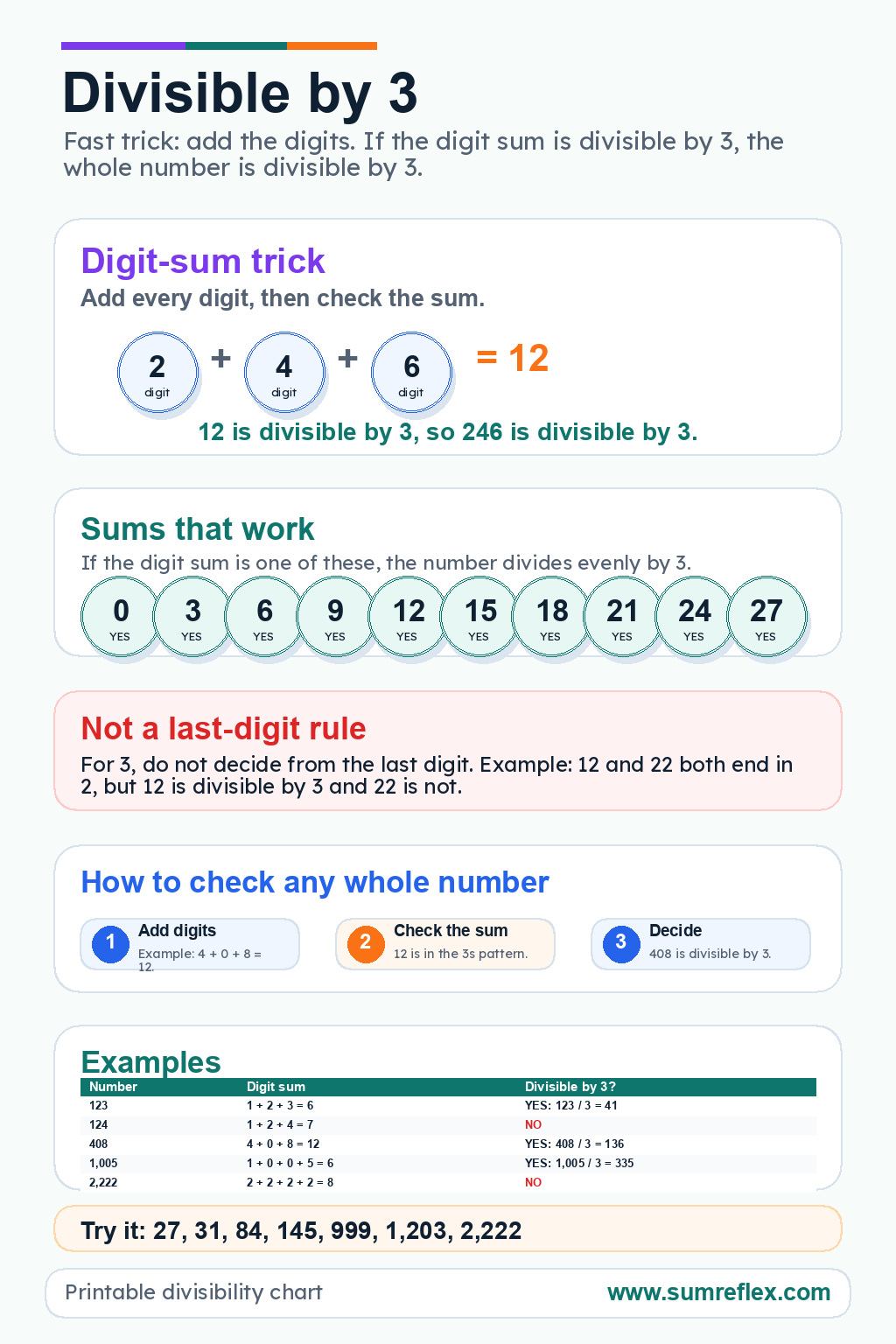
The divisible by 3 chart is useful because it gives students a way to shrink a large number before making a decision. A number like 4,572 may look too big for quick mental checking, but the digit sum is only 4 + 5 + 7 + 2 = 18. Since 18 is divisible by 3, the original number is divisible by 3 too. The chart makes that process visible: copy the digits carefully, add them, and test the smaller total instead of trying to divide the full number at once.
This rule feels different from the ending-digit rules. For 2, 5, and 10, the last digit is enough. For 3, every digit matters, which is why the page should be introduced slowly. After a few examples, learners can compare it with the divisible by 2 chart to see why one rule watches the end while the other gathers the whole number into a sum.
How to teach the digit-sum habit
A strong lesson routine begins with copying the number into spaced digits. Students then add from left to right and write the digit sum under the original number. The last step is not to say yes too quickly; they need to decide whether the sum belongs to the 3-times pattern. For example, 726 becomes 7 + 2 + 6 = 15, and 15 is a multiple of 3, so 726 passes. A number like 724 becomes 13, so it fails even though it is close to the passing example.
When this chart is paired with the divisible by 3 lesson, students can move from the visual rule to written explanations. Ask them to complete one sentence for each answer: the digit sum is blank, and blank is or is not divisible by 3. That format helps the teacher see whether an error came from addition or from the final divisibility choice.
When the answer feels surprising
Students often expect the last digit to matter because several earlier rules work that way. The chart is a good place to break that habit. A number ending in 8 can pass the divisible by 3 test, and a number ending in 3 can fail it. The ending only gives a hint for some divisors; here the total of all digits controls the answer. This is also why guessing from the size of the number is unreliable. A huge number can pass if its digits add to a multiple of 3.
Another useful moment is the connection between 3 and 9. Every number divisible by 9 is also divisible by 3, but not every number divisible by 3 is divisible by 9. Students can test that idea by using this page beside the divisible by 9 chart. The comparison makes the stricter rule for 9 easier to understand without turning it into a separate memorized fact.
Good follow-up work after the chart
Once the digit-sum test is comfortable, it can become part of factor checking. Students can use it before factor trees, prime and composite sorting, and multi-digit division practice. For calculator-supported review, the Factor Calculator can show whether 3 appears in a full factor list, while the Prime Factorization Calculator shows how repeated 3s appear in a number breakdown.
The printable is also a good mental-math warm-up. Put five numbers on the board and ask learners to find only the ones divisible by 3. The goal is not speed first; it is clean evidence. If students can show the digit sum and explain the final yes or no, they are ready to use the rule inside longer work instead of treating it as an isolated trick.