



Grade 4 number sense lesson
Divisible by 3: Digit Sum Trick, Examples, Chart, and Practice
A whole number is divisible by 3 when it can be divided into three equal groups with no remainder. The fastest trick is to add the digits.
What does divisible by 3 mean?
A number is divisible by 3 if you can divide it by 3 evenly.
Evenly means there is no remainder.
For example, 18 is divisible by 3 because 18 / 3 = 6 with no remainder.
But 20 is not divisible by 3 because 20 / 3 leaves 2 left over.
You can also think of it as making three equal groups. If the groups come out equal with nothing left over, the number is divisible by 3.
Printable Divisible by 3 trick chart
Use this SumReflex chart to remember the digit-sum trick for divisibility by 3.
The same chart is also available in the Printable Number Reference Charts section with print and download buttons.
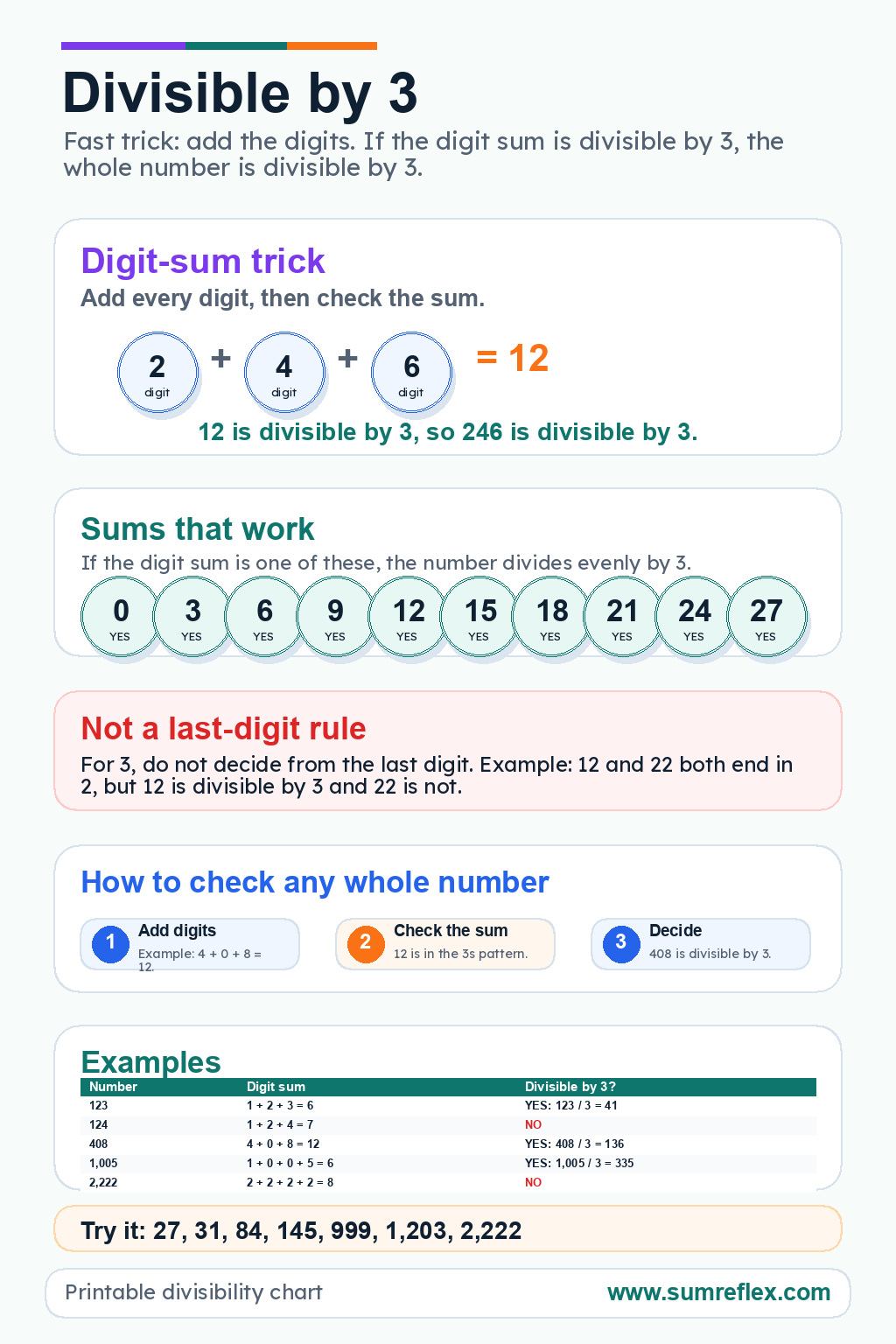
The digit-sum trick
To check if a whole number is divisible by 3, add all of its digits.
If the digit sum is divisible by 3, the original number is divisible by 3.
If the digit sum is not divisible by 3, the original number is not divisible by 3.
For example, 246 has the digit sum 2 + 4 + 6 = 12. Since 12 is divisible by 3, 246 is divisible by 3.
This is not a last-digit rule
A common mistake is to check only the last digit. That does not work for divisibility by 3.
The last digit trick works for divisibility by 2 because even numbers end in 0, 2, 4, 6, or 8.
For divisibility by 3, you must use the sum of all digits.
Example: 123 ends in 3 and is divisible by 3, but 103 also ends in 3 and is not divisible by 3. The last digit alone cannot decide.
Sums that show divisibility by 3
If the digit sum is 0, 3, 6, 9, 12, 15, 18, 21, 24, 27, 30, and so on, the number is divisible by 3.
These are multiples of 3.
You do not always need to divide the original number. You only need to check whether the digit sum is on the multiples-of-3 pattern.
If the digit sum is large, add its digits again. For example, 9,876 gives 9 + 8 + 7 + 6 = 30, and 3 + 0 = 3. So 9,876 is divisible by 3.
Why does the trick work?
The trick works because each place value follows the same remainder pattern when divided by 3.
10 is 1 more than 9, and 9 is divisible by 3.
100 is 1 more than 99, and 99 is divisible by 3.
1,000 is 1 more than 999, and 999 is divisible by 3.
So the digits of the number carry the important part of the divisibility check. Adding the digits keeps the same divide-by-3 result.
Step-by-step method
Step 1: Write the number clearly.
Step 2: Add every digit in the number.
Step 3: Check whether the digit sum is divisible by 3.
Step 4: If the sum is divisible by 3, the original number is divisible by 3.
Step 5: If the sum is not divisible by 3, the original number is not divisible by 3.
Example: 1,203 gives 1 + 2 + 0 + 3 = 6. Since 6 is divisible by 3, 1,203 is divisible by 3.
Examples with solutions
Example 1: Is 123 divisible by 3? Add the digits: 1 + 2 + 3 = 6. Since 6 is divisible by 3, 123 is divisible by 3. 123 / 3 = 41.
Example 2: Is 124 divisible by 3? Add the digits: 1 + 2 + 4 = 7. Since 7 is not divisible by 3, 124 is not divisible by 3.
Example 3: Is 408 divisible by 3? Add the digits: 4 + 0 + 8 = 12. Since 12 is divisible by 3, 408 is divisible by 3. 408 / 3 = 136.
Example 4: Is 1,005 divisible by 3? Add the digits: 1 + 0 + 0 + 5 = 6. Since 6 is divisible by 3, 1,005 is divisible by 3. 1,005 / 3 = 335.
Example 5: Is 2,222 divisible by 3? Add the digits: 2 + 2 + 2 + 2 = 8. Since 8 is not divisible by 3, 2,222 is not divisible by 3.
Example 6: Is 999 divisible by 3? Add the digits: 9 + 9 + 9 = 27. Since 27 is divisible by 3, 999 is divisible by 3. 999 / 3 = 333.
Tougher examples
Example: Is 18,642 divisible by 3? Add the digits: 1 + 8 + 6 + 4 + 2 = 21. Since 21 is divisible by 3, 18,642 is divisible by 3.
Example: Is 54,319 divisible by 3? Add the digits: 5 + 4 + 3 + 1 + 9 = 22. Since 22 is not divisible by 3, 54,319 is not divisible by 3.
Example: Is 7,650 divisible by 3? Add the digits: 7 + 6 + 5 + 0 = 18. Since 18 is divisible by 3, 7,650 is divisible by 3.
Example: Is 100,002 divisible by 3? Add the digits: 1 + 0 + 0 + 0 + 0 + 2 = 3. Since 3 is divisible by 3, 100,002 is divisible by 3.
Word problem examples
Example: A teacher has 126 counters and wants to split them equally into 3 boxes. Can she do it? Add 1 + 2 + 6 = 9. Since 9 is divisible by 3, yes. Each box gets 42 counters.
Example: There are 145 stickers. Can 3 students share them equally with none left over? Add 1 + 4 + 5 = 10. Since 10 is not divisible by 3, no.
Example: A game has 321 points to divide equally among 3 teams. Add 3 + 2 + 1 = 6. Since 6 is divisible by 3, each team gets 107 points.
Common mistakes
Do not check only the last digit. The last digit rule is for 2, not for 3.
Do not decide just because the number has a 3 in it. The number 31 has a 3, but 3 + 1 = 4, so 31 is not divisible by 3.
Do not forget zeros. Zeros add nothing, but they still belong in the number. For 1,020, the sum is 1 + 0 + 2 + 0 = 3.
Do not confuse divisibility by 3 with divisibility by 9. Both use digit sums, but the final sum must match the divisor you are checking.
Quick practice
1. Is 72 divisible by 3? Answer: yes, because 7 + 2 = 9.
2. Is 85 divisible by 3? Answer: no, because 8 + 5 = 13.
3. Is 204 divisible by 3? Answer: yes, because 2 + 0 + 4 = 6.
4. Is 1,111 divisible by 3? Answer: no, because 1 + 1 + 1 + 1 = 4.
5. Is 3,006 divisible by 3? Answer: yes, because 3 + 0 + 0 + 6 = 9.
6. Is 7,321 divisible by 3? Answer: no, because 7 + 3 + 2 + 1 = 13.
7. Is 44,442 divisible by 3? Answer: yes, because 4 + 4 + 4 + 4 + 2 = 18.
The big idea
Divisibility by 3 is a digit-sum rule.
Add the digits first. Then check whether that sum is divisible by 3.
If the sum works, the original number works. If the sum does not work, the original number does not work.
Remember the difference: divisibility by 2 uses the last digit, but divisibility by 3 uses the sum of all digits.