



Divisibility by 9 classroom article
Using the divisible by 9 chart to make digit sums more precise
The digit-sum rule at its cleanest
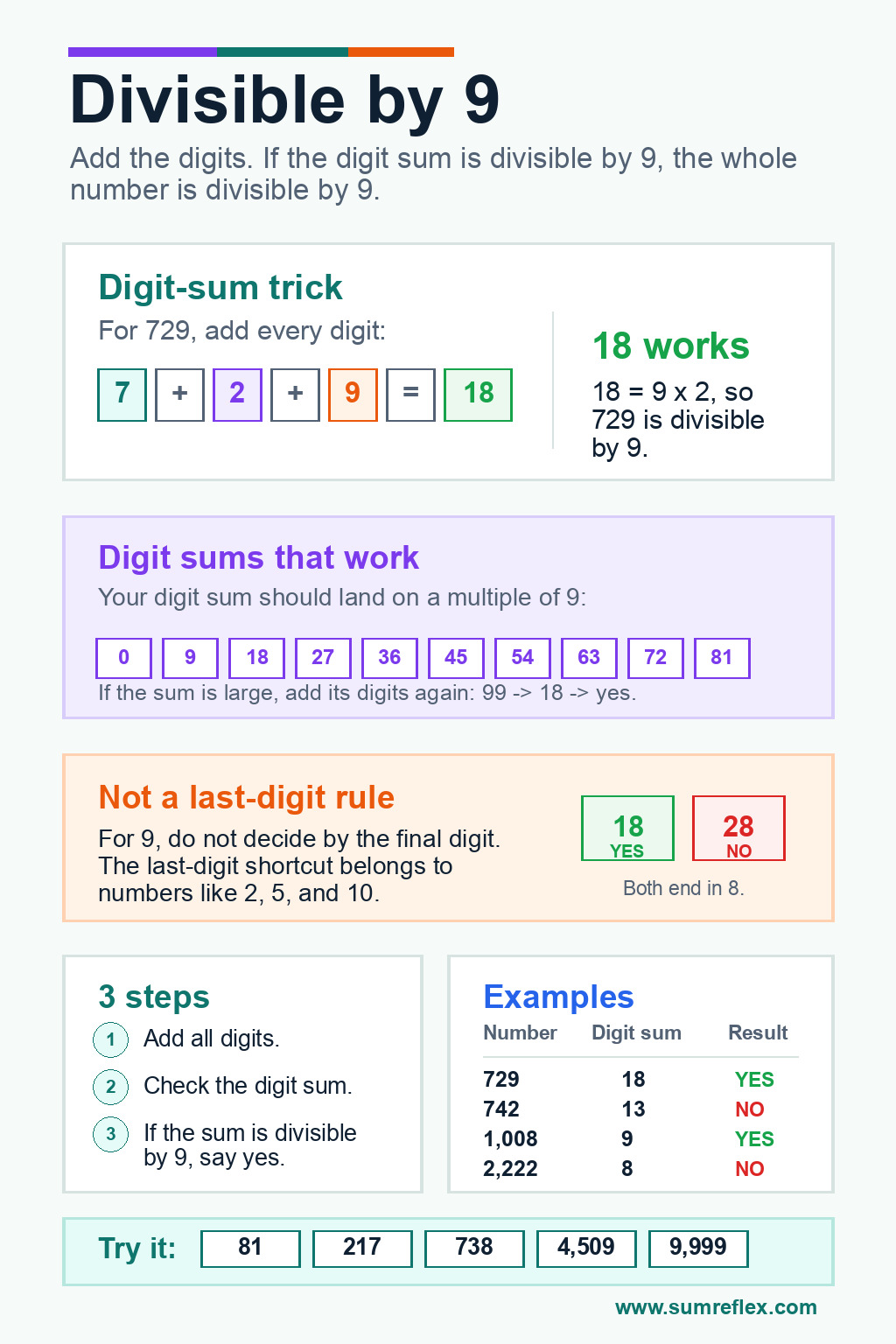
The divisible by 9 chart gives students a compact way to test numbers that would otherwise require long division. Add every digit, then check whether the sum is divisible by 9. For 6,372, the sum is 6 + 3 + 7 + 2 = 18, and 18 is divisible by 9, so the original number passes. For 6,374, the sum is 20, so the original number fails. The chart keeps the attention on the sum rather than the size of the original number.
This rule is powerful because it can reduce a large number to a small one quickly. If the first digit sum is still large, students can add the digits of the sum again. A number with a digit sum of 36 passes because 3 + 6 = 9. The printable can show that repeated reduction without turning the process into guesswork.
A reliable routine for checking messy numbers
Messy numbers need a careful copying habit. Ask students to write spaced digits, add slowly, and then mark the final sum. Missing one digit is the easiest way to ruin this rule, especially with numbers that include zeros in the middle. A zero does not change the sum, but it still needs to be seen so students do not skip a place or copy the number incorrectly.
The divisible by 9 lesson can turn that habit into a written explanation. A useful answer format is: the digit sum is blank; blank is a multiple of 9; therefore the number is divisible by 9. For a no answer, students should still state the digit sum. The evidence matters even when the number fails.
How this chart separates 9 from 3
Students who already know the 3 rule may overuse it here. The relationship is close, but the 9 test is stricter. A number with digit sum 12 is divisible by 3, but it is not divisible by 9. A number with digit sum 27 passes both. That distinction is why the chart should not simply say add the digits and see if the result is nice. The result has to belong to the 9 pattern.
Use the divisible by 3 chart as a comparison page rather than a replacement. Students can test the same numbers on both charts and sort them into three groups: passes both rules, passes only the 3 rule, or passes neither. That sorting makes the factor relationship visible without a long lecture.
Where the 9 rule supports bigger work
The chart helps during multiplication review, divisibility practice, factor trees, and quick checks before multi-digit division. It is also useful when students review products from the 9 times table because every product in that table has a digit sum that reduces to 9. The printable can become a bridge between memorized facts and number-structure thinking.
For calculator-supported follow-up, the Factor Calculator can confirm whether 9 appears as a factor, while the Greatest Common Factor Calculator can use that information in comparisons. The chart should come first when the goal is mental recognition. The calculator fits after that, when the problem asks for a complete factor set or a shared factor answer.
Students can also use the chart to audit their own multiplication facts. If a claimed 9s product has digits that do not reduce to 9, the answer deserves another look.