



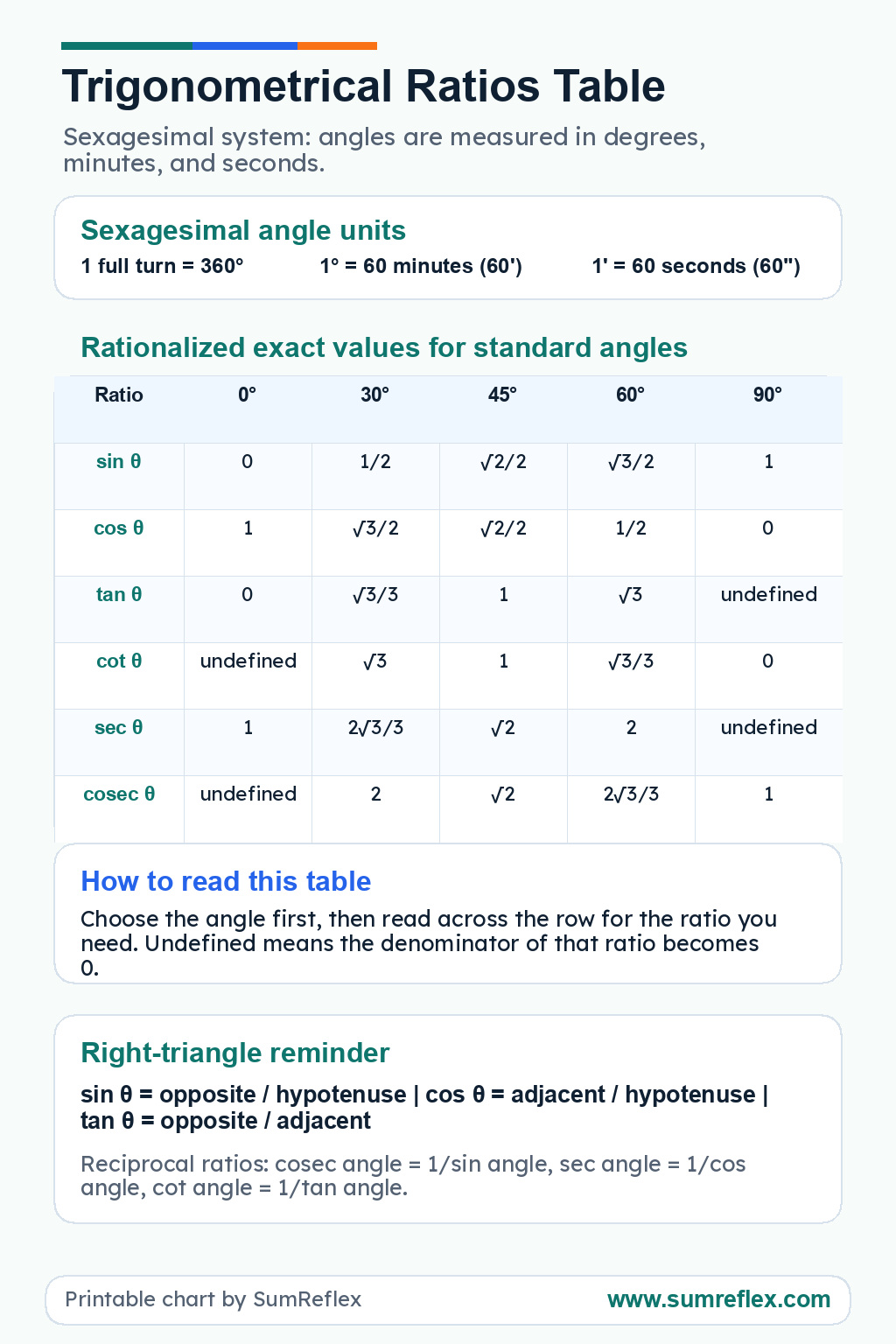
Degree-angle trig reference
Learning standard trigonometric values in the degree system
Why the degree table usually comes first
Many students meet trigonometric ratios through right triangles, and degrees are the angle measure they already recognize from geometry. That makes the sexagesimal table a practical starting point. The angles 0, 30, 45, 60, and 90 degrees are not random choices. They come from the special triangles and the unit circle positions that produce clean exact values. Seeing those angles together gives students a compact map of the values they will reuse in later lessons.
The chart should be used as a reference for exact relationships, not as a page of isolated answers. Sine grows from 0 to 1 across the first quadrant, while cosine moves from 1 down to 0. Tangent is built from sine divided by cosine. Cotangent, secant, and cosecant are reciprocal ratios. When students notice these movements, the table becomes easier to rebuild from understanding.
Read by angle first, then by ratio
A reliable routine is to choose the angle before choosing the ratio. If the problem asks for sine of 30 degrees, students find the 30-degree column or row first, then read the sine entry. If the problem asks for secant of 60 degrees, they locate 60 degrees first and then read secant. This order matters because students often mix values from neighboring angles when they scan too quickly.
Have learners speak complete statements during practice: "tangent of 45 degrees equals 1" or "cosine of 60 degrees equals one half." Saying the angle, ratio, and value together keeps the table entry attached to its meaning. It also reduces the habit of copying a square-root expression without knowing which trigonometric ratio it belongs to.
Special triangles are hiding behind the values
The entries for 30 degrees and 60 degrees come from the 30-60-90 triangle. The entries for 45 degrees come from the 45-45-90 triangle. Those triangles explain why square roots appear in the table. Students who understand the triangle sources can recover many values even if they forget a specific entry. That is much stronger than pure memorization.
Use the chart with a quick sketch routine. Before reading a 30-degree or 60-degree value, students draw a small 30-60-90 triangle and label the side relationship. Before reading a 45-degree value, they draw an isosceles right triangle. The chart then confirms the ratio rather than replacing the reasoning.
Handling zero and undefined values
The end angles, 0 degrees and 90 degrees, are where students most often make mistakes. Some values are zero, while others are undefined. Undefined does not mean the value is unknown; it means the ratio would require division by zero. This is especially important for tangent, cotangent, secant, and cosecant because those ratios depend on reciprocal or quotient relationships.
Ask students to compare sine with cosecant and cosine with secant. If sine is zero, cosecant is undefined because it would be one divided by zero. If cosine is zero, secant is undefined. These paired checks make the table feel logical and keep undefined entries from becoming memorized exceptions.
Moving from degrees to other trig references
After students are comfortable with degree labels, the trig ratios circular system chart shows the same special-angle values in radian notation. The angle systems conversion chart can sit between the two pages when learners need to translate 30 degrees into pi over 6 or 90 degrees into pi over 2.
For calculation checks, the Scientific Calculator can confirm decimal approximations. The printed chart still has a different job: it keeps exact values visible. Exact values are what students need for simplifying expressions, proving identities, and recognizing standard answers without rounding.