



Radian trigonometry reference
Reading exact trigonometric values when angles are written in radians
Radians change how the table is read
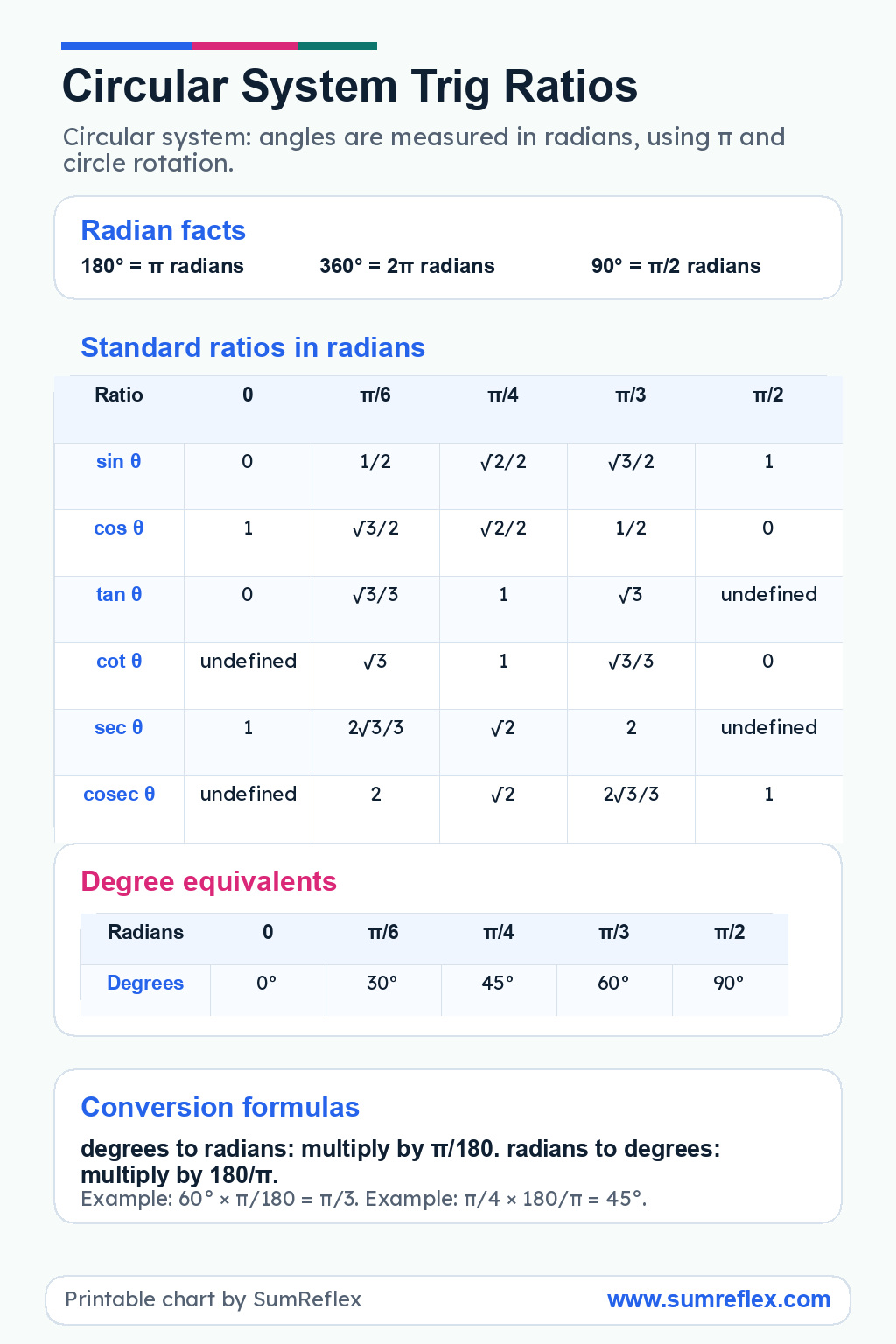
Students often learn exact trigonometric values first with degree labels such as 30 degrees, 45 degrees, and 60 degrees. When the same angles appear as pi over 6, pi over 4, and pi over 3, the problem can feel unfamiliar even though the geometry is the same. This chart helps bridge that moment. It shows the radian label and the degree label beside the same exact ratio values, so students can connect the new notation to the angle relationships they already know.
The circular system matters because radians come from the circle itself. A full turn measures 2 pi radians, a half turn measures pi radians, and a quarter turn measures pi over 2 radians. Once those anchor points are understood, the special angles in the table become fractions of a turn rather than arbitrary symbols. That shift makes radian notation easier to remember and more useful in later trigonometry.
Use degree names as a bridge, not a crutch
It is reasonable for students to look at pi over 6 and think 30 degrees at first. That conversion can help them locate the value. The goal, though, is to gradually recognize the radian names directly. A good practice routine is to cover the degree column, read a radian angle, predict its degree match, and then read the sine or cosine value. After several rounds, students can cover the degree column completely and use only radians.
The angle systems conversion chart is useful beside this page when students need to rebuild those equivalences. This ratio chart should then become the page they use once the angle name is known and the exact trigonometric value is needed.
Exact values belong before decimal shortcuts
The circular-system table is strongest when students read values such as square root of 3 over 2 or square root of 2 over 2 as exact values. Decimal approximations can be helpful for estimation, but they hide the clean structure of the special triangles and unit circle. Exact values also keep answers consistent across algebraic simplification, identities, and proof-style work.
Ask students to say the ratio name, angle, and value as one statement: "cosine of pi over 3 equals one half" or "tangent of pi over 4 equals one." That full sentence prevents the table from becoming a search grid. It also prepares students to substitute exact values into equations without losing the angle attached to the ratio.
Undefined entries are warnings, not blanks
Some rows in trigonometric tables contain undefined values. Those entries are not missing information. They tell students that a division would require zero in the denominator. For example, tangent depends on sine divided by cosine, so tangent is undefined when cosine is zero. Secant depends on one over cosine, so it also becomes undefined in that situation.
The chart can be used to compare reciprocal pairs. Sine and cosecant move together, cosine and secant move together, and tangent and cotangent are paired. Reading those pairs in radians helps students understand that the table is organized by relationships, not just memorized facts.
Where this chart sits in trigonometry practice
Use this printable after students have met degree-based exact values and before they work heavily with radian equations, graphs, or identities. It also pairs naturally with the trig ratios sexagesimal chart, because the two pages show the same special-angle values in different angle systems.
For right-triangle questions, students can still use a tool such as the Right Triangle Calculator to check a result after the setup is complete. The chart, however, gives the exact-value memory support that a calculator answer may not explain. Keep it near notes on radians, unit-circle introductions, and standard-angle simplification.