



Angle conversion notes
Comparing angle systems through one complete rotation
A full turn anchors every conversion
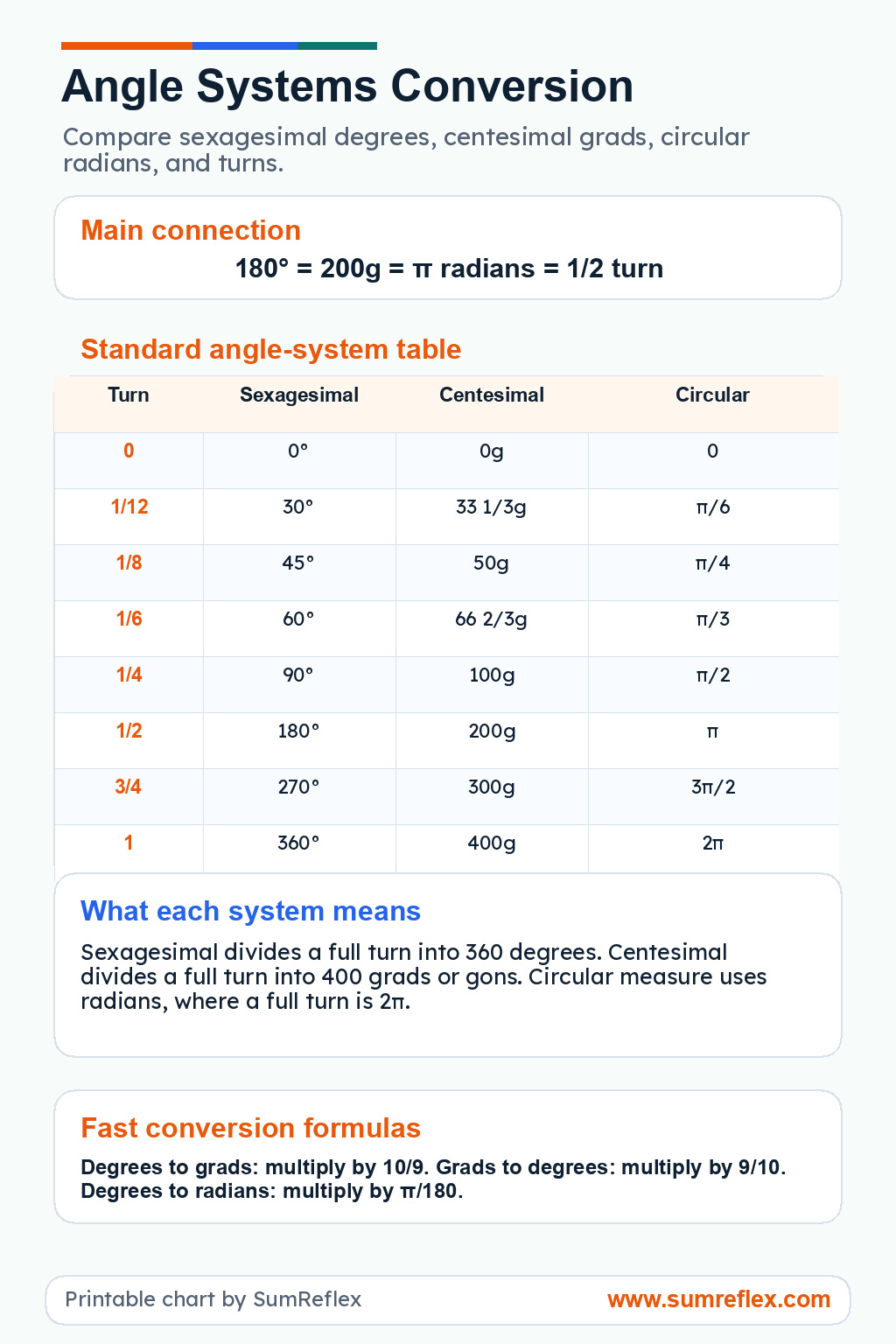
The cleanest way to compare angle systems is to begin with one complete turn. A full rotation is 360 degrees, 2 pi radians, 400 grads, and 1 turn. Once students know those equivalent full-turn values, the smaller conversions become easier to reason through. A half turn is half of each full-turn value. A quarter turn is one fourth. A right angle is therefore 90 degrees, pi over 2 radians, 100 grads, or one quarter turn.
This chart is useful because it keeps those relationships visible instead of making students memorize isolated pairs. If 180 degrees equals pi radians, then 90 degrees equals pi over 2 radians and 45 degrees equals pi over 4 radians. The values are not random; they are fractions of the same rotation.
Degrees and radians do different jobs
Degrees are familiar because they divide a circle into 360 parts. They appear in school geometry, protractors, navigation, bearings, and many everyday angle descriptions. Radians feel less familiar at first because they come from the relationship between radius length and arc length. In trigonometry and calculus, radians become powerful because they connect angle measure directly to the circle itself.
Students do not need to abandon degrees when radians appear. They need to learn how the two systems describe the same rotation. This printable lets them compare special angles across systems before using them in unit-circle values, graphing trigonometric functions, or solving right-triangle problems.
Where grads and turns fit
Grads, also called gons in some contexts, divide a full rotation into 400 parts. They are less common in many school courses, but seeing them on the chart helps students understand that an angle system is a chosen way to divide a turn. Turns are even more direct: one complete rotation is 1 turn, a half rotation is 0.5 turn, and a quarter rotation is 0.25 turn.
Including these systems can make angle measure more flexible. Instead of thinking that degrees are the angle and every other notation is strange, students see that all systems are names for rotation. The context decides which name is most convenient.
How to prevent unit confusion
The biggest mistake with angle conversion is dropping the unit label. A value of 90 means something different from 90 radians or 90 grads. The chart should be used with written labels every time. Students can circle the starting unit, write the target unit, and then choose the conversion relationship. This visible setup prevents them from copying a number into a new system without changing its meaning.
When working with trigonometric ratios, pair this page with the trig ratios sexagesimal chart for degree-based special angles and the trig ratios circular system chart for radian-based values. The two ratio charts show why knowing both degree and radian labels matters.
Connect the chart to trigonometry work
After students compare the systems, give them small translation tasks. Ask for the radian name of a half turn, the degree name of one quarter turn, or the grad measure of a straight angle. Then place those values on a circle sketch. That extra drawing step keeps conversion tied to rotation instead of turning it into a table-copying exercise.
For right-triangle review, students can use this chart to make sure the angle unit matches the reference they are reading. If they later use the Right Triangle Calculator, the same care with angle units still matters. A correct number entered with the wrong unit system can send the solution in the wrong direction.