



Exact value form guide
Recognizing trigonometric values before and after rationalizing
The value stays the same while the form changes
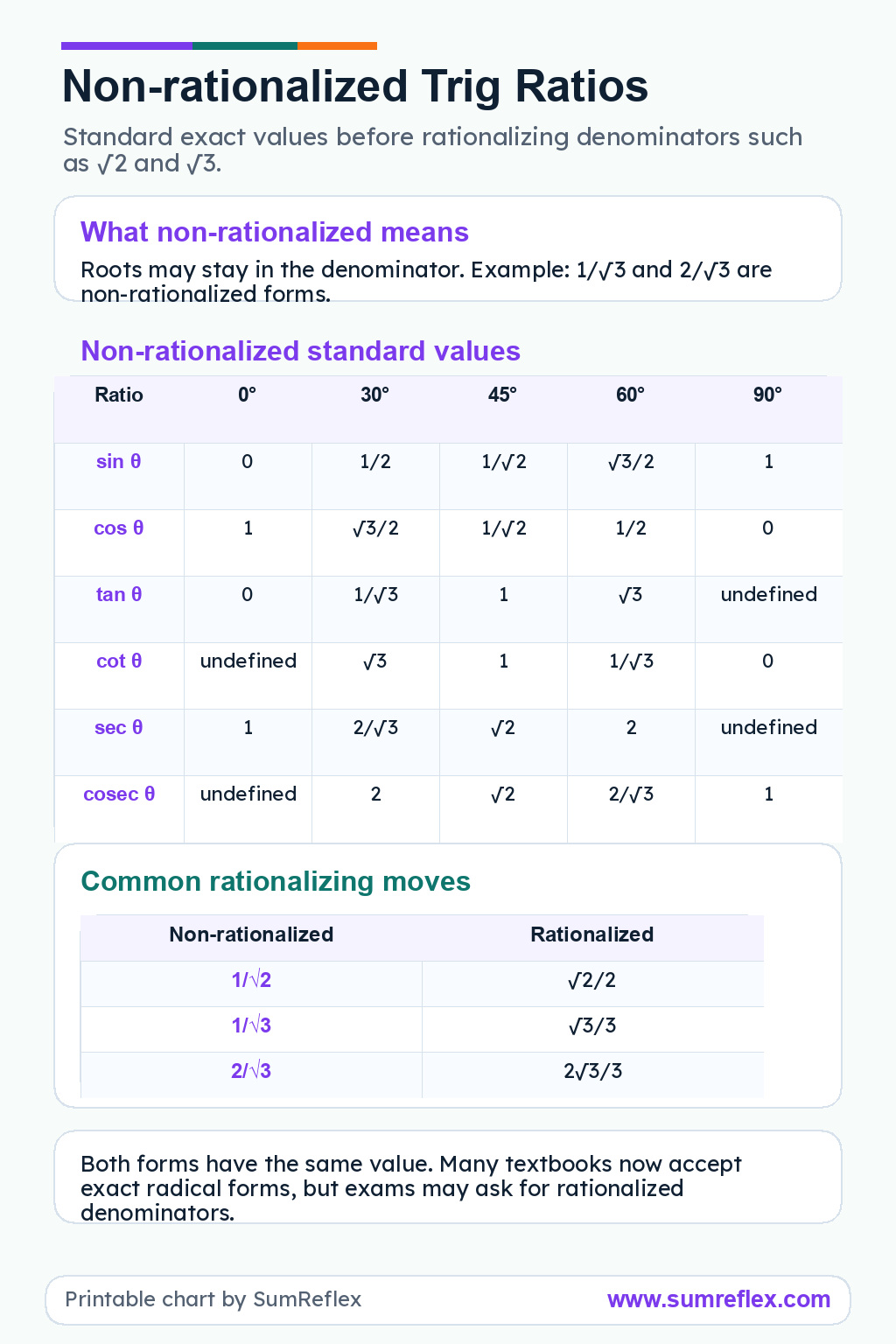
Rationalizing a denominator changes the written form of a number, not its value. That distinction is the whole reason this chart is helpful. A student may see one over square root of 3 in a table, then see square root of 3 over 3 in an answer key and think one of them must be wrong. They are the same value written differently. The chart places those forms close together so the equivalence becomes visible.
This matters in trigonometry because exact values appear in several acceptable forms. Some courses ask students to leave values in the form produced by a triangle ratio. Other courses require rationalized denominators. A learner who recognizes both forms can read the problem source correctly, write the expected version, and still understand that the underlying ratio has not changed.
Why non-rationalized forms appear naturally
Non-rationalized values often appear directly from special triangles. In a 30-60-90 triangle, a side relationship may produce a ratio with square root of 3 in the denominator. In a 45-45-90 triangle, a ratio may produce one over square root of 2. Those forms are not mistakes. They are the immediate result of comparing side lengths before any algebraic cleanup happens.
The cleanup step multiplies by a matching square-root expression so the denominator becomes a whole number. That process is algebra, not new trigonometry. The ratio is already known; rationalizing only changes the way the answer is presented. This chart helps students separate the trig fact from the algebraic formatting step.
When the chart is better than a decimal
A decimal value can confirm that two forms are close, but it does not show why they are equal. Exact forms keep the square-root structure intact. That structure is important when students simplify expressions, compare identities, or substitute values into equations. If every exact value is turned into a decimal too early, the pattern among special angles becomes harder to see.
Use the chart during exact-value practice by asking students to match each non-rationalized entry with its rationalized partner. Then ask them to explain what multiplication was used to change the denominator. That explanation connects the table to the broader skill of simplifying radicals. If students need to check radical arithmetic separately, the Root Calculator can help after they have written their own transformation.
Connecting this table to the standard angle pages
This page is not a replacement for the regular trig ratio charts. It is a companion for form recognition. The trig ratios sexagesimal chart organizes exact values by degree measure, while the trig ratios circular system chart organizes related values by radian measure. This non-rationalized chart answers a different question: what if the same value is written with a square root in the denominator?
That makes it useful during review. Students can choose an angle and ratio from one chart, then come here to compare alternate forms. Over time they learn to read both forms without panic, which is important when class notes, textbooks, and online explanations do not all use the same convention.
A careful way to teach rationalizing
Do not begin by telling students that one form is good and the other is bad. Begin by proving equality. Let them multiply one over square root of 3 by square root of 3 over square root of 3, then show that the denominator becomes 3 while the value remains unchanged. The multiplication uses a form of 1, so the number is rewritten rather than altered.
After that, students can decide which form a question expects. Some answer keys accept either exact form; others require the rationalized denominator. The chart gives learners enough confidence to move between both without treating them as separate memorized facts.