



First quadrant graphing guide
Helping beginners plot ordered pairs without rushing the coordinate order
Start at the origin every time
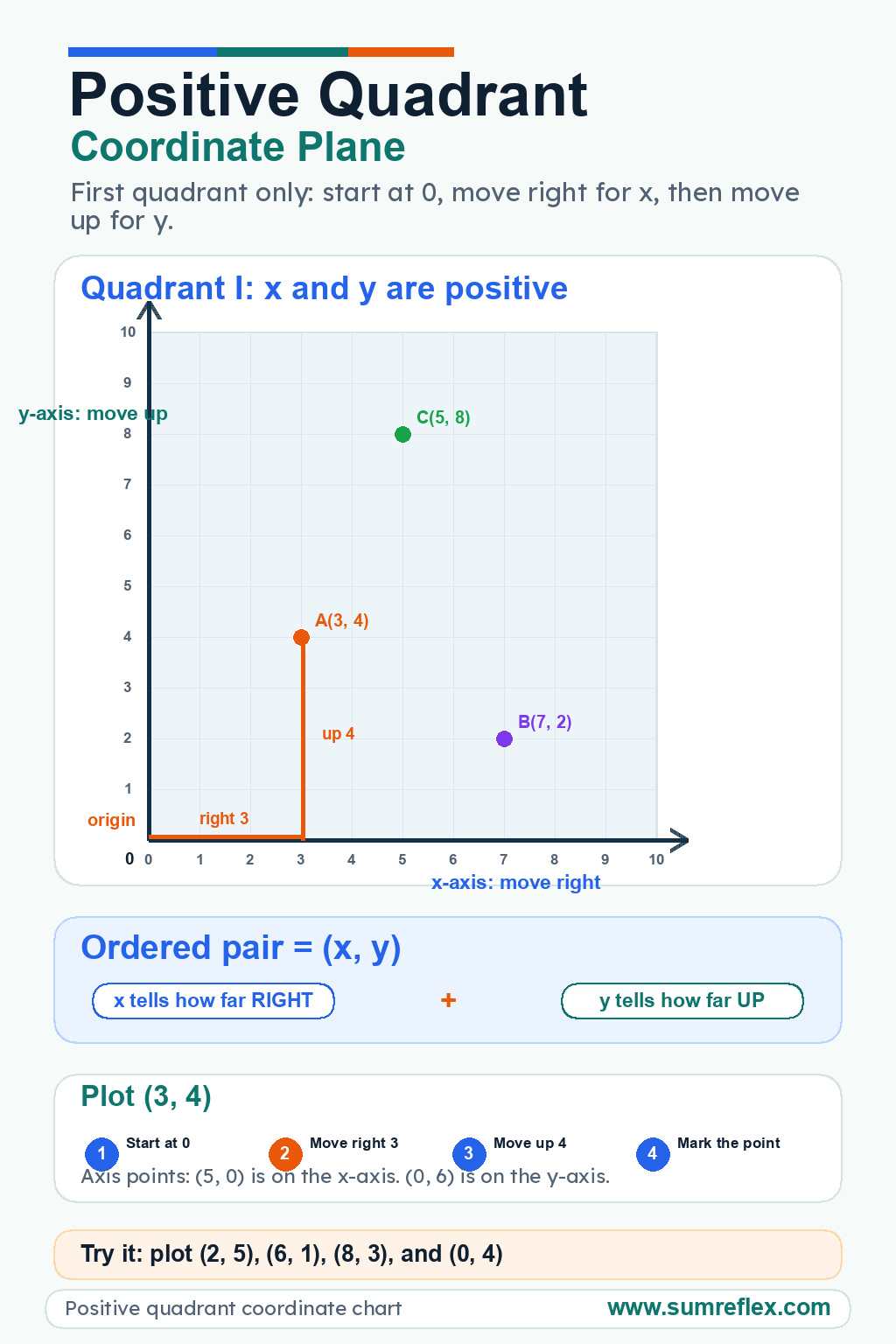
The origin is the anchor of the coordinate plane. On a first-quadrant chart, it sits at the lower-left meeting point of the x-axis and y-axis. Students should return to that point mentally before every ordered pair. This habit prevents them from plotting the next point relative to the previous point, which is a common beginner mistake during graphing practice.
The chart keeps the origin visible so students can say the movement sequence clearly: start at zero, move along the x-axis, then move in the y direction. Because every value is positive, the motion is right and up. That limited movement is not a weakness. It gives learners a stable graphing routine before they have to decide between left, right, up, and down.
Right then up is more than a chant
Many students learn to say "across then up," but the words only help if they understand which coordinate controls each movement. The first number in an ordered pair is the x-coordinate. It tells how far to move horizontally. The second number is the y-coordinate. It tells how far to move vertically. The chart reinforces this by placing the x-axis and y-axis labels beside the grid.
Ask students to cover the y-coordinate with a finger, move right for x, then uncover y and move up. That physical pause keeps the coordinate order from collapsing. It also makes points such as (2, 5) and (5, 2) feel different, even though they use the same two numbers.
Preparing students for negative coordinates
A first-quadrant chart should be used as a foundation, not as the whole coordinate plane. Once students can plot positive ordered pairs accurately, the next question is what changes when a coordinate becomes negative. The movement routine stays the same, but the direction can change. Negative x-values move left from the origin. Negative y-values move down from the origin.
That transition is smoother when this page is paired with the all four quadrants chart. Students can compare the two grids and notice that Quadrant I is only one part of the larger plane. The first chart builds confidence; the full chart expands the map.
Using the grid with patterns
After students can plot individual points, use the grid for simple patterns. Give ordered pairs such as (1, 2), (2, 3), (3, 4), and (4, 5), then ask what is changing. Students can see that both coordinates increase by one and that the points form a diagonal trend. This prepares them for function tables without requiring formal algebra vocabulary yet.
When a rule is introduced, the graphs of simple functions chart becomes the next reference. It shows how a rule creates table values, how table values become ordered pairs, and how those pairs appear on a graph. The first-quadrant chart gives the plotting skill that makes that later algebra page easier to read.
For extra practice, ask students to plot two points with the same x-value and describe the vertical line they create. Then repeat with the same y-value. Those small comparisons help students see coordinates as positions, not just paired numbers.