


Coordinate plane reference
Using quadrant signs to make full-plane graphing predictable
The sign pattern is a map
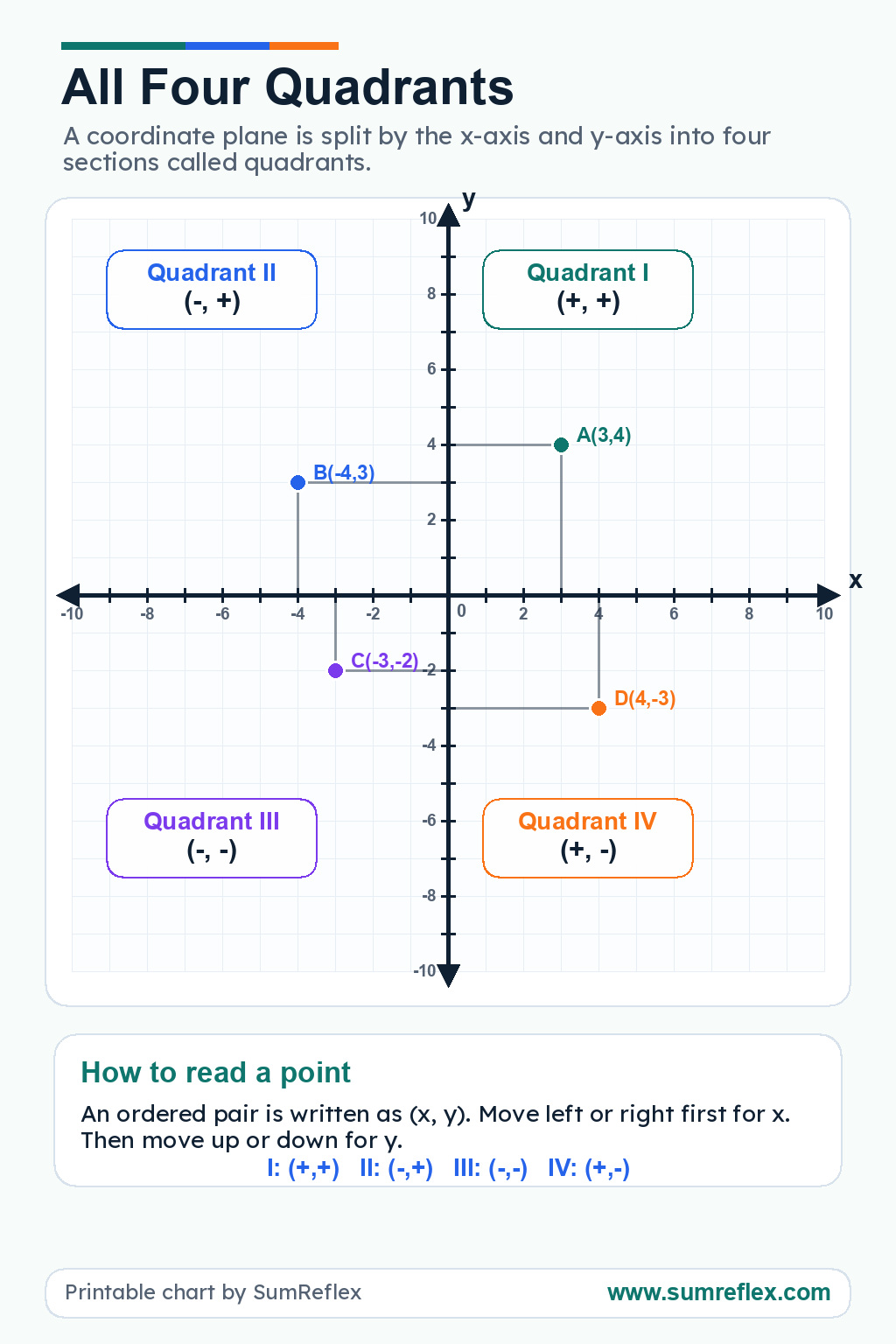
The four-quadrant coordinate plane can feel like a new topic even for students who already plot points in the first quadrant. The movement is familiar, but the signs now matter in every direction. This chart turns the signs into a map. Quadrant I has positive x and positive y. Quadrant II has negative x and positive y. Quadrant III has negative x and negative y. Quadrant IV has positive x and negative y. When students memorize only the quadrant names, they often forget the meaning. When they read the signs as directions, the grid becomes more predictable.
Use the chart to build a short habit before plotting: read the ordered pair, identify the sign of x, identify the sign of y, then choose the quadrant. After students choose the quadrant, they can move from the origin. Negative x means left. Positive x means right. Positive y means up. Negative y means down. The chart keeps that directional language connected to the quadrant labels.
Axis points need their own category
A common mistake is placing every ordered pair into one of the four quadrants. Points on the axes do not belong inside a quadrant. If y is zero, the point lies on the x-axis. If x is zero, the point lies on the y-axis. The origin has both coordinates equal to zero. This matters because students who force axis points into quadrants often misunderstand the boundary lines of the plane.
During practice, include points such as (4, 0), (-6, 0), (0, 3), and (0, -5) alongside ordinary quadrant points. Ask students to sort them into five groups: Quadrant I, Quadrant II, Quadrant III, Quadrant IV, and axes. The extra category makes the coordinate plane more precise.
Practice that makes ordered pairs less fragile
Students who reverse coordinates may plot the correct numbers but in the wrong order. The chart can help by keeping the x-axis and y-axis labels in view. Have learners cover the y-value, move horizontally for x, then uncover the y-value and move vertically. That physical pause between the two coordinates is useful. It makes (2, -5) feel different from (-5, 2) before the point is drawn.
Another strong activity is quadrant prediction without graphing. Give a list of ordered pairs and ask students to name the quadrant or axis location using signs only. After predictions are written, they can plot a few points to confirm. This separates sign reasoning from counting grid squares and prevents the graph from doing all the thinking for them.
When students are ready to move beyond plotting
The chart supports more than isolated points. Once students understand the sign map, they can reflect shapes across axes, read coordinates from a graph, compare points, and begin graphing relationships that cross more than one quadrant. It also prepares students for slope because moving left, right, up, and down must be understood before rise and run can make sense.
For students who still need a gentler start, the positive quadrant coordinate plane chart keeps all coordinates positive. When they are ready for algebra rules that produce points, the graphs of simple functions chart shows how a table of values becomes plotted points and a line.
Links between graphing and algebra
A full coordinate plane is not just a geometry grid. It becomes the workspace for equations, inequalities, transformations, data displays, and function graphs. Keeping this chart near algebra notebooks helps students remember that every ordered pair still follows the same movement rules. The numbers may come from a rule or a data table, but the point is placed by reading x first and y second.