


Function graphing notes
Reading a function chart from rule to visible pattern
From rule to picture
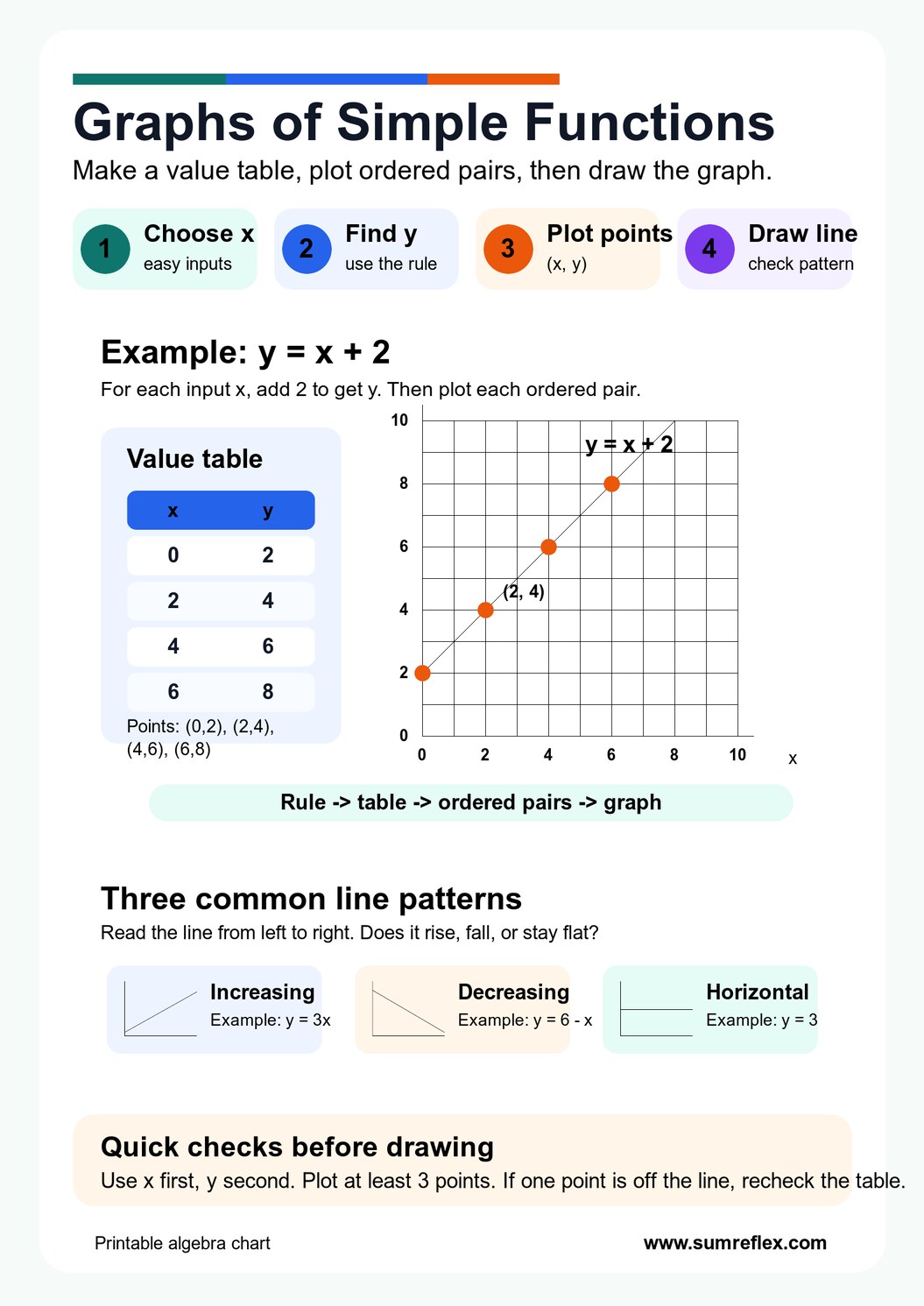
A simple function can look abstract when students meet it only as y = x + 2 or another short rule. The chart slows that rule down. First, a chosen x-value enters the table. Next, the rule tells the matching y-value. Then both numbers are written as one ordered pair. Only after those pieces are named does the point land on the grid. That sequence is important because many graphing mistakes happen when students jump straight from the rule to the graph without recording the middle steps.
The chart is useful for students who can substitute numbers correctly but do not yet understand why the plotted points form a line. Keeping the table beside the graph lets them compare each row with the corresponding dot. If x increases by one and y also changes by a steady amount, the points begin to show structure. The graph is no longer a drawing task; it becomes evidence of how the rule behaves.
A slow routine that prevents swapped coordinates
The most reliable classroom routine is to say the jobs out loud: choose x, calculate y, write the pair, move across, then move up or down. That wording helps students avoid reversing the order of the coordinates. A learner who writes (5, 2) when the table says x = 2 and y = 5 usually has not connected the table columns to the axes. This printable keeps x on the horizontal idea and y on the vertical idea so the visual cue stays nearby.
When the grid itself is the weak point, use this chart with the positive quadrant coordinate plane chart. Students can practice moving from the origin before they graph a function rule. After that, the all four quadrants chart is the natural next step, especially once negative x-values or negative y-values appear in the table.
Reading the line after the points appear
The finished graph should not be treated as decoration. Ask students what the line is doing. Is it climbing from left to right, dropping, or staying level? Does each row of the table change by the same amount? Does the line cross the y-axis at a point that matches the rule when x is zero? These questions train students to read a graph as information. They also prepare them for slope, intercepts, proportional relationships, and later linear functions.
A good follow-up is to cover the rule and leave only the table and the plotted points visible. Students can describe the pattern before seeing the equation again. Another option is to cover the graph and ask them to predict whether the line will rise, fall, or stay flat. The chart becomes a reasoning tool when students use one representation to predict another.
Where this reference fits beside other pages
Keep this printable near early algebra work, not only near graphing homework. It supports function tables, ordered-pair practice, coordinate-grid review, and the first conversations about rate of change. If students are checking a line from two points, the Slope Calculator can confirm their calculation after they have already identified the coordinates. The calculator should be a checker, while the chart remains the guide that shows why the coordinates matter.
For independent practice, have students make a fresh table from a new rule, plot three or four points, and then compare their page with this chart. The goal is not to memorize the example rule. The goal is to copy the process: organize values, keep coordinate order steady, place points carefully, and read the graph as a statement about the function.