

Calculus integration guide
Using an integration rules chart with the right method
Read the integrand before choosing a rule
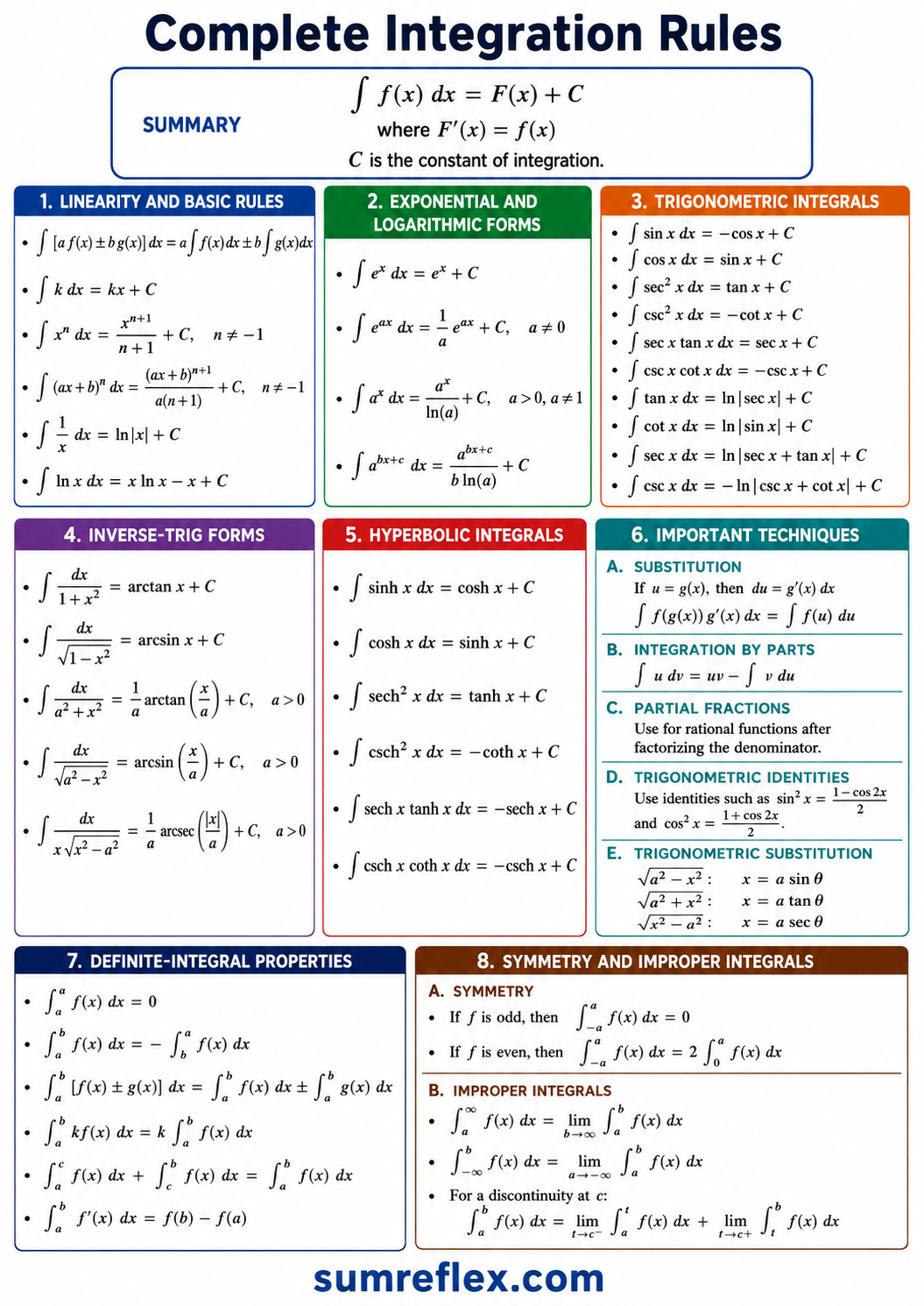
An integration chart is most useful after the expression has been classified. A polynomial points toward the power rule and linearity. A reciprocal expression points toward a logarithm. A product may need substitution or integration by parts depending on whether one factor is the derivative of an inside expression.
The chart groups formulas by family so students can scan with purpose. Instead of hunting randomly, first ask what kind of expression is present: power, exponential, logarithmic, trigonometric, inverse-trig pattern, definite integral, symmetry pattern, or improper integral.
The constant of integration is not optional
For indefinite integrals, the answer represents a family of antiderivatives. That is why the constant \(C\) appears. If \(F^{\prime}(x)=f(x)\), then \((F(x)+7)^{\prime}\), \((F(x)-3)^{\prime}\), and \((F(x)+C)^{\prime}\) all return the same integrand.
This chart keeps \(+C\) visible in the main antiderivative formulas. Definite integrals are different: after endpoint substitution, the constant cancels, so the final answer is a number instead of a family of functions.
Do not skip the specialized formula rows
The inverse-trig and hyperbolic rows are included because they save time when a problem has a recognizable shape. A denominator such as \(a^2+x^2\) often points to arctangent, while a square root such as \(\sqrt{a^2-x^2}\) often points to arcsine.
Hyperbolic formulas work the same way: they are antiderivatives that reverse derivative patterns for \(\sinh x\), \(\cosh x\), \(\tanh x\), \(\operatorname{sech}x\), and related functions. They may appear less often in a first review session, but they belong on a complete calculus reference.
Substitution and parts are decision tools
The techniques section is important because not every integral is solved by matching one line of a formula list. Substitution is helpful when the integrand contains an inside expression and its derivative. Integration by parts is helpful when a product becomes easier after differentiating one factor and integrating the other.
The full integration rules lesson shows these choices in worked examples. Use the chart to remember the formula, then use the lesson to see the setup and checking process.
Technique rows tell you how to transform the problem
Partial fractions are for rational functions after factoring the denominator. Trigonometric identities are useful when powers such as \(\sin^2 x\) or \(\cos^2 x\) need to be rewritten before integration.
Trigonometric substitution is different from ordinary substitution. It is chosen when a radical matches \(\sqrt{a^2-x^2}\), \(\sqrt{a^2+x^2}\), or \(\sqrt{x^2-a^2}\). Those shapes connect directly to the Pythagorean identities shown in the chart.
Definite integrals need interval thinking
The definite-integral section includes properties that prevent unnecessary work. Reversing bounds changes the sign. Splitting an interval lets students break one integral into two pieces. Constants can move outside the integral, and sums can be separated when the terms are easier to integrate alone.
Symmetry is a major time saver. An odd function over \([-a,a]\) integrates to zero when the positive and negative areas cancel. An even function over the same symmetric interval can be doubled from \(0\) to \(a\). These shortcuts work because of graph behavior, not because of memorized decoration.
Check every antiderivative by differentiating
The fastest way to catch most integration mistakes is to differentiate the answer. If the derivative returns the original integrand, the antiderivative is correct. If a factor is missing, the issue often comes from a substitution step where the inside derivative was not handled.
This checking habit connects naturally with the derivative rules lesson. Integration and differentiation should support each other: the chart helps choose an antiderivative, and derivative rules confirm that the answer actually works.