

Grade 11 calculus lesson
Derivative Rules: Formulas, Examples, Chart, and Common Mistakes
Derivative rules are shortcuts for finding rates of change without rebuilding the limit definition every time.
What is a derivative?
A derivative measures how fast a function changes at a particular input. On a graph, it gives the slope of the tangent line at that point. In an application, it can describe speed, growth rate, cooling rate, cost change, or any situation where one quantity changes with another.
If \( f(x) \) is a function, its derivative can be written in several common ways:
\[ f'(x),\quad \frac{dy}{dx},\quad \frac{d}{dx}[f(x)] \]
All three notations point to the same idea: find the rate of change of the output with respect to the input \( x \).
Why derivative rules exist
The limit definition of the derivative is the foundation:
\[ f'(x)=\lim_{h\to 0}\frac{f(x+h)-f(x)}{h} \]
That definition explains what a derivative means, but using it for every problem would be slow. Derivative rules are proven shortcuts. They let you differentiate constants, powers, sums, products, quotients, compositions, exponential functions, logarithms, and trigonometric functions more efficiently.
The rules are not random memorized lines. Each one protects a particular structure. The product rule is for multiplication of functions. The quotient rule is for division. The chain rule is for a function inside another function.
Derivative rules chart
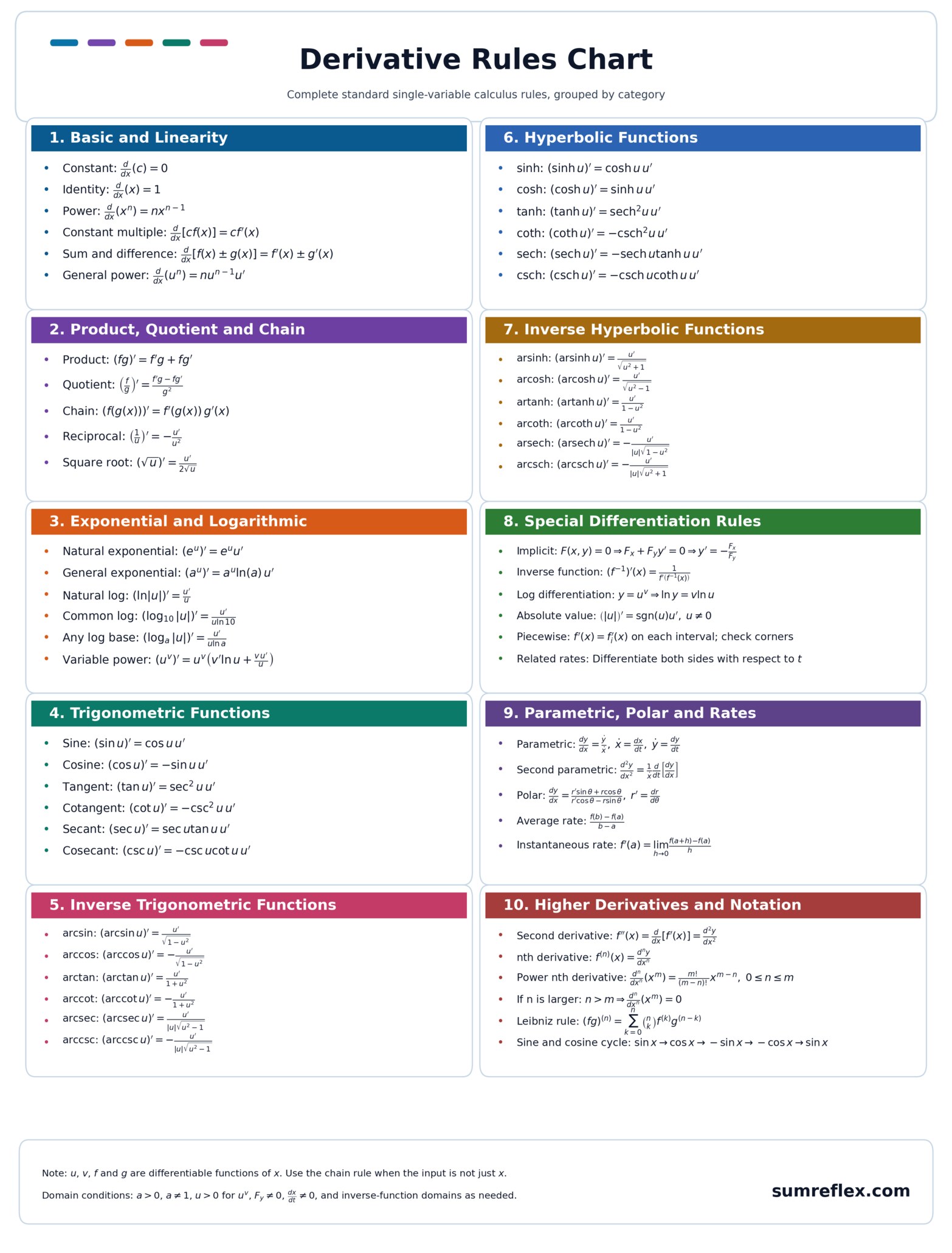
Use this chart as a compact reference after you understand what each rule is doing. It groups the standard single-variable derivative rules by category, including basic rules, product and quotient rules, chain rule, exponential and logarithmic rules, trigonometric rules, inverse trig rules, hyperbolic rules, parametric and polar rules, and higher derivative notation.
The same chart is also available in the printable calculus chart section with print and download buttons.
Basic derivative rules
The constant rule says that the derivative of a constant is zero:
\[ \frac{d}{dx}(c)=0 \]
The identity rule says that the derivative of \( x \) is one:
\[ \frac{d}{dx}(x)=1 \]
The power rule is the rule students use most often at the start:
\[ \frac{d}{dx}(x^n)=nx^{n-1} \]
The general power rule adds the chain rule when the base expression is not just \(x\):
\[ \frac{d}{dx}(u^n)=nu^{n-1}u' \]
The constant multiple rule lets a number stay in front of the derivative:
\[ \frac{d}{dx}[cf(x)]=cf'(x) \]
The sum and difference rule lets you differentiate term by term:
\[ \frac{d}{dx}[f(x)\pm g(x)]=f'(x)\pm g'(x) \]
Example 1: use the power rule term by term
Differentiate:
\[ f(x)=7x^5-4x^3+9x-12 \]
Step 1: Differentiate each term separately.
\[ \frac{d}{dx}(7x^5)=35x^4 \]
\[ \frac{d}{dx}(-4x^3)=-12x^2 \]
\[ \frac{d}{dx}(9x)=9 \]
\[ \frac{d}{dx}(-12)=0 \]
The \(9x\) term uses the identity rule because \( \frac{d}{dx}(x)=1 \), so \( \frac{d}{dx}(9x)=9\cdot 1=9 \).
Step 2: Combine the results.
\[ f'(x)=35x^4-12x^2+9 \]
Check: The degree dropped from \(5\) to \(4\), and the constant disappeared. That matches the power and constant rules.
Example 1B: general power rule
Differentiate:
\[ y=(2x^3-7)^4 \]
Step 1: Let the inside expression be \(u=2x^3-7\).
\[ y=u^4 \]
Step 2: Differentiate the outside power and multiply by the inside derivative.
\[ \frac{d}{dx}(u^4)=4u^3u' \]
Step 3: Find \(u'\).
\[ u'=6x^2 \]
Step 4: Substitute back.
\[ y'=4(2x^3-7)^3(6x^2)=24x^2(2x^3-7)^3 \]
Check: If the inside had been only \(x\), there would be no extra \(6x^2\). Since the inside is \(2x^3-7\), the chain factor must appear.
Product rule
Use the product rule when two changing expressions are multiplied. If both factors contain \(x\), do not simply multiply the derivatives.
\[ \frac{d}{dx}[f(x)g(x)]=f'(x)g(x)+f(x)g'(x) \]
A short memory phrase is: derivative of the first times the second, plus the first times derivative of the second.
Example 2: product rule
Differentiate:
\[ y=(x^2+3x)(5x-1) \]
Step 1: Name the two factors.
\[ f(x)=x^2+3x,\quad g(x)=5x-1 \]
Step 2: Differentiate each factor.
\[ f'(x)=2x+3,\quad g'(x)=5 \]
Step 3: Apply the product rule.
\[ y'=(2x+3)(5x-1)+(x^2+3x)(5) \]
Step 4: Simplify if needed.
\[ y'=10x^2+13x-3+5x^2+15x=15x^2+28x-3 \]
Check: You can expand the original function first: \( (x^2+3x)(5x-1)=5x^3+14x^2-3x \). Differentiating gives \(15x^2+28x-3\), so the answer is confirmed.
Quotient rule
Use the quotient rule when one changing expression is divided by another. The order matters.
\[ \frac{d}{dx}\left(\frac{f(x)}{g(x)}\right)=\frac{f'(x)g(x)-f(x)g'(x)}{[g(x)]^2} \]
The denominator is squared. The numerator is not symmetric; reversing the subtraction changes the sign of the answer.
Example 3: quotient rule
Differentiate:
\[ y=\frac{x^2+1}{x-2} \]
Step 1: Name the top and bottom functions.
\[ f(x)=x^2+1,\quad g(x)=x-2 \]
Step 2: Differentiate them.
\[ f'(x)=2x,\quad g'(x)=1 \]
Step 3: Use the quotient rule.
\[ y'=\frac{(2x)(x-2)-(x^2+1)(1)}{(x-2)^2} \]
Step 4: Simplify the numerator.
\[ y'=\frac{2x^2-4x-x^2-1}{(x-2)^2}=\frac{x^2-4x-1}{(x-2)^2} \]
Check: The derivative is not defined at \(x=2\), which matches the original function because the original denominator is zero there.
Chain rule
Use the chain rule when one function is inside another. It is the rule behind most longer derivative problems.
\[ \frac{d}{dx}[f(g(x))]=f'(g(x))g'(x) \]
For a power of an inside expression, the chain rule often looks like this:
\[ \frac{d}{dx}[u^n]=nu^{n-1}u' \]
The last factor \(u'\) is easy to forget. It is what accounts for the inside function changing.
Example 4: chain rule with a power
Differentiate:
\[ y=(3x^2-5x+4)^6 \]
Step 1: Identify the inside expression.
\[ u=3x^2-5x+4 \]
Step 2: Differentiate the outside power, keeping the inside expression.
\[ \frac{d}{dx}(u^6)=6u^5u' \]
Step 3: Find the inside derivative.
\[ u'=6x-5 \]
Step 4: Substitute back.
\[ y'=6(3x^2-5x+4)^5(6x-5) \]
Check: The answer should still contain the inside expression raised to the fifth power, and it should include the derivative of the inside expression.
Reciprocal and square root rules
The reciprocal rule is a chain-rule shortcut for \( \frac{1}{u} \):
\[ \frac{d}{dx}\left(\frac{1}{u}\right)=-\frac{u'}{u^2} \]
The square root rule is also a chain-rule shortcut:
\[ \frac{d}{dx}\left(\sqrt{u}\right)=\frac{u'}{2\sqrt{u}} \]
Both rules are useful because they keep the derivative clean without rewriting the expression as a negative or fractional exponent first.
Example 4B: reciprocal and square root rules
Differentiate the reciprocal expression:
\[ y=\frac{1}{3x^2+5} \]
Here \(u=3x^2+5\), so \(u'=6x\).
\[ y'=-\frac{6x}{(3x^2+5)^2} \]
Now differentiate the square root expression:
\[ y=\sqrt{4x^3-1} \]
Here \(u=4x^3-1\), so \(u'=12x^2\).
\[ y'=\frac{12x^2}{2\sqrt{4x^3-1}}=\frac{6x^2}{\sqrt{4x^3-1}} \]
Check: Both answers contain the derivative of the inside expression. That is the sign that the chain rule was not forgotten.
Exponential and logarithmic derivative rules
The natural exponential function keeps its own shape under differentiation:
\[ \frac{d}{dx}(e^x)=e^x \]
With an inside function, use the chain rule:
\[ \frac{d}{dx}(e^u)=e^u u' \]
For a general exponential function:
\[ \frac{d}{dx}(a^u)=a^u\ln(a)u' \]
The natural logarithm rule is:
\[ \frac{d}{dx}[\ln|u|]=\frac{u'}{u} \]
The common logarithm rule is:
\[ \frac{d}{dx}[\log_{10}|u|]=\frac{u'}{u\ln 10} \]
The logarithm rule for any valid base \(a\) is:
\[ \frac{d}{dx}[\log_a|u|]=\frac{u'}{u\ln a} \]
A variable power such as \(u^v\) needs logarithmic differentiation:
\[ \frac{d}{dx}(u^v)=u^v\left(v'\ln u+\frac{vu'}{u}\right) \]
The absolute value in \( \ln|u| \) matters when \(u\) can be negative. If you need the algebra behind logarithms before differentiating them, review the logarithm rules lesson.
Example 5: exponential and logarithmic rules
Differentiate:
\[ y=e^{4x^3}+\ln(2x^2+1) \]
Step 1: Differentiate \(e^{4x^3}\) with the chain rule.
\[ \frac{d}{dx}(e^{4x^3})=e^{4x^3}(12x^2) \]
Step 2: Differentiate the logarithm.
\[ \frac{d}{dx}[\ln(2x^2+1)]=\frac{4x}{2x^2+1} \]
Step 3: Combine the terms.
\[ y'=12x^2e^{4x^3}+\frac{4x}{2x^2+1} \]
Check: Both terms used the chain rule because both had an inside expression more complicated than \(x\).
Example 5B: common log, any-base log, and variable power
Differentiate a common log:
\[ y=\log_{10}(x^2+4) \]
\[ y'=\frac{2x}{(x^2+4)\ln 10} \]
Differentiate a logarithm with base \(3\):
\[ y=\log_3(5x-1) \]
\[ y'=\frac{5}{(5x-1)\ln 3} \]
Differentiate a general exponential expression:
\[ y=5^{x^2} \]
\[ y'=5^{x^2}\ln(5)(2x)=2x\ln(5)\,5^{x^2} \]
Differentiate a variable power:
\[ y=x^x \]
Use logarithmic differentiation: \( \ln y=x\ln x \).
\[ \frac{y'}{y}=\ln x+1 \]
\[ y'=x^x(\ln x+1) \]
Check: The power rule alone cannot handle \(x^x\), because both the base and exponent change.
Trigonometric derivative rules
The six basic trigonometric derivative rules are:
\[ \frac{d}{dx}(\sin u)=\cos u\cdot u' \]
\[ \frac{d}{dx}(\cos u)=-\sin u\cdot u' \]
\[ \frac{d}{dx}(\tan u)=\sec^2u\cdot u' \]
\[ \frac{d}{dx}(\cot u)=-\csc^2u\cdot u' \]
\[ \frac{d}{dx}(\sec u)=\sec u\tan u\cdot u' \]
\[ \frac{d}{dx}(\csc u)=-\csc u\cot u\cdot u' \]
These rules assume angles are measured in radians. Degree mode is useful in many geometry settings, but calculus derivative formulas for trig functions are built around radians. The trigonometrical ratios table can help with exact trig values after the derivative is found.
Example 6: trig rule with chain rule
Differentiate:
\[ y=\sin(5x^2)-3\cos x \]
Step 1: Differentiate the sine term.
\[ \frac{d}{dx}[\sin(5x^2)]=\cos(5x^2)(10x) \]
Step 2: Differentiate the cosine term.
\[ \frac{d}{dx}[-3\cos x]=3\sin x \]
Step 3: Combine the result.
\[ y'=10x\cos(5x^2)+3\sin x \]
Check: The sign changed on the cosine term because \( \frac{d}{dx}(\cos x)=-\sin x \), and the outside coefficient was already negative.
Example 6B: tangent, cotangent, secant, and cosecant rules
Differentiate a tangent expression:
\[ y=\tan(2x) \]
\[ y'=2\sec^2(2x) \]
Differentiate a cotangent expression:
\[ y=\cot(3x^2) \]
\[ y'=-6x\csc^2(3x^2) \]
Differentiate a secant expression:
\[ y=\sec(x^3) \]
\[ y'=3x^2\sec(x^3)\tan(x^3) \]
Differentiate a cosecant expression:
\[ y=\csc(4x-1) \]
\[ y'=-4\csc(4x-1)\cot(4x-1) \]
Check: The cotangent and cosecant derivatives are negative. The tangent and secant derivatives are positive.
Inverse trigonometric derivative rules
The inverse trigonometric derivative rules in the chart are:
\[ \frac{d}{dx}(\arcsin u)=\frac{u'}{\sqrt{1-u^2}} \]
\[ \frac{d}{dx}(\arccos u)=-\frac{u'}{\sqrt{1-u^2}} \]
\[ \frac{d}{dx}(\arctan u)=\frac{u'}{1+u^2} \]
\[ \frac{d}{dx}(\operatorname{arccot} u)=-\frac{u'}{1+u^2} \]
\[ \frac{d}{dx}(\operatorname{arcsec} u)=\frac{u'}{|u|\sqrt{u^2-1}} \]
\[ \frac{d}{dx}(\operatorname{arccsc} u)=-\frac{u'}{|u|\sqrt{u^2-1}} \]
These rules are sensitive to signs and domains. Before using one, check the exact inverse function name, because the formulas do not all share the same denominator or sign.
Example 7: inverse tangent rule
Differentiate:
\[ y=\arctan(3x) \]
Step 1: Use the inverse tangent rule.
\[ \frac{d}{dx}(\arctan u)=\frac{u'}{1+u^2} \]
Step 2: Set \(u=3x\), so \(u'=3\).
\[ y'=\frac{3}{1+(3x)^2} \]
Step 3: Simplify.
\[ y'=\frac{3}{1+9x^2} \]
Check: The denominator is always positive, which fits the shape of \( \arctan(3x) \), an increasing function.
Example 7B: the other inverse trig rules
Differentiate an arcsine expression:
\[ y=\arcsin(2x) \]
\[ y'=\frac{2}{\sqrt{1-4x^2}} \]
Differentiate an arccosine expression:
\[ y=\arccos(x^2) \]
\[ y'=-\frac{2x}{\sqrt{1-x^4}} \]
Differentiate an arccotangent expression:
\[ y=\operatorname{arccot}(5x) \]
\[ y'=-\frac{5}{1+25x^2} \]
Differentiate an arcsecant expression:
\[ y=\operatorname{arcsec}(3x) \]
\[ y'=\frac{3}{|3x|\sqrt{9x^2-1}} \]
Differentiate an arccosecant expression:
\[ y=\operatorname{arccsc}(4x) \]
\[ y'=-\frac{4}{|4x|\sqrt{16x^2-1}} \]
Check: Arcsecant and arccosecant answers include an absolute value in the denominator. That is not optional in the standard formula.
Hyperbolic function derivative rules
The hyperbolic derivative rules parallel trigonometric rules, but the signs are not the same as circular trig signs.
\[ \frac{d}{dx}(\sinh u)=\cosh u\cdot u' \]
\[ \frac{d}{dx}(\cosh u)=\sinh u\cdot u' \]
\[ \frac{d}{dx}(\tanh u)=\operatorname{sech}^2u\cdot u' \]
\[ \frac{d}{dx}(\coth u)=-\operatorname{csch}^2u\cdot u' \]
\[ \frac{d}{dx}(\operatorname{sech}u)=-\operatorname{sech}u\tanh u\cdot u' \]
\[ \frac{d}{dx}(\operatorname{csch}u)=-\operatorname{csch}u\coth u\cdot u' \]
Example 7C: hyperbolic functions
Differentiate:
\[ y=\sinh(2x)+\cosh(x^2) \]
\[ y'=2\cosh(2x)+2x\sinh(x^2) \]
Differentiate:
\[ y=\tanh(5x)-\operatorname{sech}(x) \]
\[ y'=5\operatorname{sech}^2(5x)+\operatorname{sech}(x)\tanh(x) \]
Differentiate:
\[ y=\coth(x^3)+\operatorname{csch}(4x) \]
\[ y'=-3x^2\operatorname{csch}^2(x^3)-4\operatorname{csch}(4x)\coth(4x) \]
Check: The derivative of \(\cosh u\) is positive \(\sinh u\cdot u'\), unlike the derivative of \(\cos u\), which is negative.
Inverse hyperbolic derivative rules
The inverse hyperbolic rules from the chart are:
\[ \frac{d}{dx}(\operatorname{arsinh}u)=\frac{u'}{\sqrt{u^2+1}} \]
\[ \frac{d}{dx}(\operatorname{arcosh}u)=\frac{u'}{\sqrt{u^2-1}} \]
\[ \frac{d}{dx}(\operatorname{artanh}u)=\frac{u'}{1-u^2} \]
\[ \frac{d}{dx}(\operatorname{arcoth}u)=\frac{u'}{1-u^2} \]
\[ \frac{d}{dx}(\operatorname{arsech}u)=-\frac{u'}{|u|\sqrt{1-u^2}} \]
\[ \frac{d}{dx}(\operatorname{arcsch}u)=-\frac{u'}{|u|\sqrt{u^2+1}} \]
The names may vary by textbook. Some books write \( \operatorname{asinh} \), \( \operatorname{acosh} \), and \( \operatorname{atanh} \). The formulas above match the chart wording.
Example 7D: inverse hyperbolic functions
Differentiate:
\[ y=\operatorname{arsinh}(3x) \]
\[ y'=\frac{3}{\sqrt{9x^2+1}} \]
Differentiate:
\[ y=\operatorname{arcosh}(x^2+2) \]
\[ y'=\frac{2x}{\sqrt{(x^2+2)^2-1}} \]
Differentiate:
\[ y=\operatorname{artanh}(2x) \]
\[ y'=\frac{2}{1-4x^2} \]
Differentiate:
\[ y=\operatorname{arcoth}(x^2+1) \]
\[ y'=\frac{2x}{1-(x^2+1)^2} \]
Differentiate:
\[ y=\operatorname{arsech}(x) \]
\[ y'=-\frac{1}{|x|\sqrt{1-x^2}} \]
Differentiate:
\[ y=\operatorname{arcsch}(4x) \]
\[ y'=-\frac{4}{|4x|\sqrt{16x^2+1}} \]
Check: Inverse hyperbolic formulas often have domain restrictions. For example, \(\operatorname{arcosh}u\) requires \(u>1\) in the real-valued setting.
Implicit differentiation
Implicit differentiation is used when \(y\) is mixed with \(x\) instead of written as \(y=f(x)\). Treat \(y\) as a function of \(x\). That means every time you differentiate a \(y\)-term, multiply by \( \frac{dy}{dx} \).
For example:
\[ \frac{d}{dx}(y^2)=2y\frac{dy}{dx} \]
For an equation written as \(F(x,y)=0\), the chart gives this compact result:
\[ F_x+F_y y'=0,\quad y'=-\frac{F_x}{F_y} \]
This is the chain rule in disguise because \(y\) depends on \(x\).
Example 8: implicit differentiation
Find \( \frac{dy}{dx} \) if:
\[ x^2+y^2=25 \]
Step 1: Differentiate both sides with respect to \(x\).
\[ 2x+2y\frac{dy}{dx}=0 \]
Step 2: Isolate the derivative term.
\[ 2y\frac{dy}{dx}=-2x \]
Step 3: Divide by \(2y\).
\[ \frac{dy}{dx}=-\frac{x}{y} \]
Check: A circle does not pass the vertical line test as one whole function, so it makes sense that the derivative still contains both \(x\) and \(y\).
Inverse function rule
If \(f\) has an inverse function, the derivative of the inverse can be found from the derivative of the original function:
\[ (f^{-1})'(x)=\frac{1}{f'(f^{-1}(x))} \]
This rule is useful when the inverse function is hard to write explicitly but the original derivative is easy.
Example 8B: inverse function rule
Let \(f(x)=x^3+x+1\). Find \((f^{-1})'(3)\).
Step 1: Find the input \(a\) where \(f(a)=3\).
\[ f(1)=1^3+1+1=3 \]
So \(f^{-1}(3)=1\).
Step 2: Differentiate \(f\).
\[ f'(x)=3x^2+1 \]
Step 3: Use the inverse function rule.
\[ (f^{-1})'(3)=\frac{1}{f'(1)}=\frac{1}{4} \]
Check: A steep original function gives a flatter inverse at the matching point, so a reciprocal derivative makes sense.
Logarithmic differentiation
Logarithmic differentiation is useful when a function has powers, products, quotients, or variable exponents that would be awkward to differentiate directly.
The chart form is:
\[ y=u^v \Rightarrow \ln y=v\ln u \]
After differentiating both sides, multiply by \(y\) to solve for \(y'\).
Example 8C: logarithmic differentiation
Differentiate:
\[ y=(x^2+1)^{\sin x} \]
Step 1: Take the natural log of both sides.
\[ \ln y=\sin x\ln(x^2+1) \]
Step 2: Differentiate both sides.
\[ \frac{y'}{y}=\cos x\ln(x^2+1)+\sin x\cdot\frac{2x}{x^2+1} \]
Step 3: Multiply by \(y\), then replace \(y\).
\[ y'=(x^2+1)^{\sin x}\left(\cos x\ln(x^2+1)+\frac{2x\sin x}{x^2+1}\right) \]
Check: The answer has two terms inside the parentheses because the right side used the product rule.
Absolute value and piecewise rules
For an absolute value expression, the chart gives:
\[ \frac{d}{dx}|u|=\operatorname{sgn}(u)u',\quad u\ne 0 \]
This means the derivative depends on whether the inside expression is positive or negative.
For a piecewise function, differentiate each formula on its own interval:
\[ f'(x)=f_i'(x)\quad \text{on each interval} \]
After that, check corner points and boundary points separately. A piecewise function can be continuous at a join but still fail to have a derivative there.
Example 8D: absolute value and piecewise derivatives
Differentiate:
\[ y=|3x-6| \]
For \(x>2\), \(3x-6>0\), so \(y=3x-6\) and \(y'=3\).
For \(x
At \(x=2\), the graph has a sharp corner, so the derivative does not exist.
Now consider:
\[ f(x)=\begin{cases}x^2,&x
Differentiate each interval:
\[ f'(x)=\begin{cases}2x,&x1\end{cases} \]
At \(x=1\), the left derivative is \(2\) and the right derivative is also \(2\), so \(f'(1)=2\).
Related rates
Related rates problems use derivatives with respect to time. The chart reminder is simple: differentiate both sides with respect to \(t\).
If two quantities are connected by an equation, their rates are connected by the derivative of that equation.
Example 8E: related rates
A circle has radius \(r\) changing at \( \frac{dr}{dt}=2 \) cm/s. Find \( \frac{dA}{dt} \) when \(r=5\) cm.
Step 1: Start with the area equation.
\[ A=\pi r^2 \]
Step 2: Differentiate both sides with respect to \(t\).
\[ \frac{dA}{dt}=2\pi r\frac{dr}{dt} \]
Step 3: Substitute \(r=5\) and \( \frac{dr}{dt}=2 \).
\[ \frac{dA}{dt}=2\pi(5)(2)=20\pi \]
Answer: The area is changing at \(20\pi\) square centimeters per second.
Parametric derivatives
For parametric equations, both \(x\) and \(y\) are written in terms of a parameter, often \(t\). The chart gives:
\[ \frac{dy}{dx}=\frac{\dot y}{\dot x}=\frac{dy/dt}{dx/dt} \]
The second derivative is:
\[ \frac{d^2y}{dx^2}=\frac{1}{\dot x}\frac{d}{dt}\left(\frac{dy}{dx}\right) \]
These formulas require \( \dot x\ne 0 \) at the point being studied.
Example 9: parametric first and second derivatives
Let:
\[ x=t^2+1,\quad y=t^3-t \]
Step 1: Differentiate both with respect to \(t\).
\[ \frac{dx}{dt}=2t,\quad \frac{dy}{dt}=3t^2-1 \]
Step 2: Find \( \frac{dy}{dx} \).
\[ \frac{dy}{dx}=\frac{3t^2-1}{2t} \]
Step 3: Differentiate \( \frac{dy}{dx}=\frac{3}{2}t-\frac{1}{2t} \) with respect to \(t\).
\[ \frac{d}{dt}\left(\frac{dy}{dx}\right)=\frac{3}{2}+\frac{1}{2t^2} \]
Step 4: Divide by \( \frac{dx}{dt}=2t \).
\[ \frac{d^2y}{dx^2}=\frac{\frac{3}{2}+\frac{1}{2t^2}}{2t}=\frac{3t^2+1}{4t^3} \]
Polar derivative rule
For a polar curve \(r=f(\theta)\), the chart gives:
\[ \frac{dy}{dx}=\frac{r'\sin\theta+r\cos\theta}{r'\cos\theta-r\sin\theta},\quad r'=\frac{dr}{d\theta} \]
This comes from writing \(x=r\cos\theta\) and \(y=r\sin\theta\), then using the parametric derivative idea with parameter \(\theta\).
Example 9B: polar derivative
Find \( \frac{dy}{dx} \) for:
\[ r=2+\sin\theta \]
Step 1: Differentiate \(r\).
\[ r'=\cos\theta \]
Step 2: Substitute into the polar derivative formula.
\[ \frac{dy}{dx}=\frac{\cos\theta\sin\theta+(2+\sin\theta)\cos\theta}{\cos\theta\cos\theta-(2+\sin\theta)\sin\theta} \]
Step 3: Simplify if useful.
\[ \frac{dy}{dx}=\frac{2\cos\theta+2\sin\theta\cos\theta}{\cos^2\theta-2\sin\theta-\sin^2\theta} \]
Check: The formula uses both \(r\) and \(r'\), so an answer that only uses \(r'\) is incomplete.
Average and instantaneous rates
The average rate of change over \([a,b]\) is:
\[ \frac{f(b)-f(a)}{b-a} \]
The instantaneous rate of change at \(a\) is:
\[ f'(a)=\lim_{h\to 0}\frac{f(a+h)-f(a)}{h} \]
Average rate uses two points. Instantaneous rate uses the derivative at one point.
Example 9C: average and instantaneous rate
Let \(f(x)=x^2+3x\). Find the average rate from \(x=1\) to \(x=4\).
\[ f(4)=28,\quad f(1)=4 \]
\[ \frac{f(4)-f(1)}{4-1}=\frac{28-4}{3}=8 \]
Now find the instantaneous rate at \(x=4\).
\[ f'(x)=2x+3 \]
\[ f'(4)=11 \]
Check: The average rate over an interval and the instantaneous rate at the endpoint do not have to match.
Higher derivatives
The second derivative is the derivative of the first derivative:
\[ f''(x)=\frac{d}{dx}[f'(x)] \]
It is often written as:
\[ \frac{d^2y}{dx^2} \]
Higher derivatives continue the same pattern:
\[ f^{(n)}(x)=\frac{d^ny}{dx^n} \]
For powers, the nth derivative formula in the chart is:
\[ \frac{d^n}{dx^n}(x^m)=\frac{m!}{(m-n)!}x^{m-n},\quad 0\le n\le m \]
If \(n>m\), the derivative becomes zero:
\[ \frac{d^n}{dx^n}(x^m)=0,\quad n>m \]
The Leibniz rule gives the nth derivative of a product:
\[ (fg)^{(n)}=\sum_{k=0}^{n}\binom{n}{k}f^{(k)}g^{(n-k)} \]
The sine and cosine derivatives repeat in a cycle:
\[ \sin x\to\cos x\to-\sin x\to-\cos x\to\sin x \]
In graph work, \( f'(x) \) describes slope and \( f''(x) \) describes how that slope is changing.
Example 10: higher derivatives and cycles
Find the second derivative of \(f(x)=x^4-3x^2\).
\[ f'(x)=4x^3-6x \]
\[ f''(x)=12x^2-6 \]
Find the third derivative of \(x^7\).
\[ \frac{d^3}{dx^3}(x^7)=7\cdot6\cdot5x^4=210x^4 \]
Find the sixth derivative of \(x^4\).
\[ \frac{d^6}{dx^6}(x^4)=0 \]
The derivative becomes zero because the derivative order \(6\) is larger than the power \(4\).
Now find the fifth derivative of \(\sin x\).
\[ \sin x\to\cos x\to-\sin x\to-\cos x\to\sin x\to\cos x \]
So:
\[ \frac{d^5}{dx^5}(\sin x)=\cos x \]
Check: The sine and cosine cycle repeats every four derivatives.
Example 10B: Leibniz rule
Find the second derivative of a product \(f(x)g(x)\) using the Leibniz rule.
For \(n=2\):
\[ (fg)''=\binom20f g''+\binom21f'g'+\binom22f''g \]
\[ (fg)''=fg''+2f'g'+f''g \]
Try it with \(f(x)=x^2\) and \(g(x)=e^x\).
\[ f'=2x,\quad f''=2,\quad g'=e^x,\quad g''=e^x \]
\[ (x^2e^x)''=x^2e^x+2(2x)e^x+2e^x \]
\[ (x^2e^x)''=e^x(x^2+4x+2) \]
Check: Differentiating \(x^2e^x\) twice with the ordinary product rule gives the same result.
Common derivative mistakes
Forgetting the chain rule: The derivative of \( (2x+1)^5 \) is not \(5(2x+1)^4\). It is \(10(2x+1)^4\) because the inside derivative is \(2\).
Using the product rule only halfway: The derivative of \(f(x)g(x)\) needs two terms, \(f'g+fg'\).
Reversing the quotient rule: The numerator is \(f'g-fg'\), not \(fg'-f'g\).
Losing negative signs in trig derivatives: The derivatives of \( \cos u \), \( \cot u \), and \( \csc u \) include negative signs.
Mixing up tangent and secant: \( \frac{d}{dx}(\tan x)=\sec^2x \), while \( \frac{d}{dx}(\sec x)=\sec x\tan x \).
Ignoring domain restrictions: Logarithmic and inverse trigonometric derivatives often carry restrictions from the original function.
How to confirm a derivative answer
A derivative answer can often be checked before doing any complicated graphing.
Check the structure: If the original expression is a product, your derivative should usually have two product-rule terms unless you expanded first.
Check simple points: Substitute an easy value such as \(x=0\) or \(x=1\) into both your derivative and a numerical slope estimate.
Check by expanding: When possible, expand a polynomial product first and see whether it gives the same derivative.
Check units: If \(s(t)\) is position in meters, then \(s'(t)\) is velocity in meters per second, and \(s''(t)\) is acceleration in meters per second squared.
Use a calculator as a final check: After writing your own rule-based solution, the Step-by-Step Calculator can help compare the final derivative and catch algebra slips.
Quick practice
1. Differentiate \( f(x)=x^8 \). Answer: \( f'(x)=8x^7 \).
2. Differentiate \( y=4x^{-3} \). Answer: \( y'=-12x^{-4} \).
3. Differentiate \( y=(x^2+1)(x^3-2) \). Answer: \( y'=2x(x^3-2)+3x^2(x^2+1) \).
4. Differentiate \( y=\frac{3x+1}{x^2} \). Answer: \( y'=\frac{3x^2-(3x+1)(2x)}{x^4} \), which simplifies to \( \frac{-3x^2-2x}{x^4} \).
5. Differentiate \( y=(7x-4)^9 \). Answer: \( y'=63(7x-4)^8 \).
6. Differentiate \( y=\ln(x^2+5) \). Answer: \( y'=\frac{2x}{x^2+5} \).
7. Differentiate \( y=\cos(4x) \). Answer: \( y'=-4\sin(4x) \).
8. If \( x^2+xy+y^2=7 \), differentiating implicitly gives \(2x+y+x\frac{dy}{dx}+2y\frac{dy}{dx}=0\).