

Grade 11 calculus lesson
Integration Rules: Formulas, Chart, Examples, and Common Mistakes
Integration rules help you find antiderivatives, evaluate definite integrals, and reverse many derivative rules with careful algebra and a constant of integration.
What are integration rules?
Integration rules are formulas and methods used to find an antiderivative or to calculate the accumulated value of a function over an interval.
If differentiation asks, "What is the rate of change?", integration often asks, "What function produced this rate?" or "How much total change happened?"
For an indefinite integral, the main idea is:
\[ \int f(x)\,dx = F(x)+C \quad \text{where} \quad F^{\prime}(x)=f(x) \]
The function \(F(x)\) is an antiderivative of \(f(x)\), and \(C\) is the constant of integration.
Printable integration rules chart
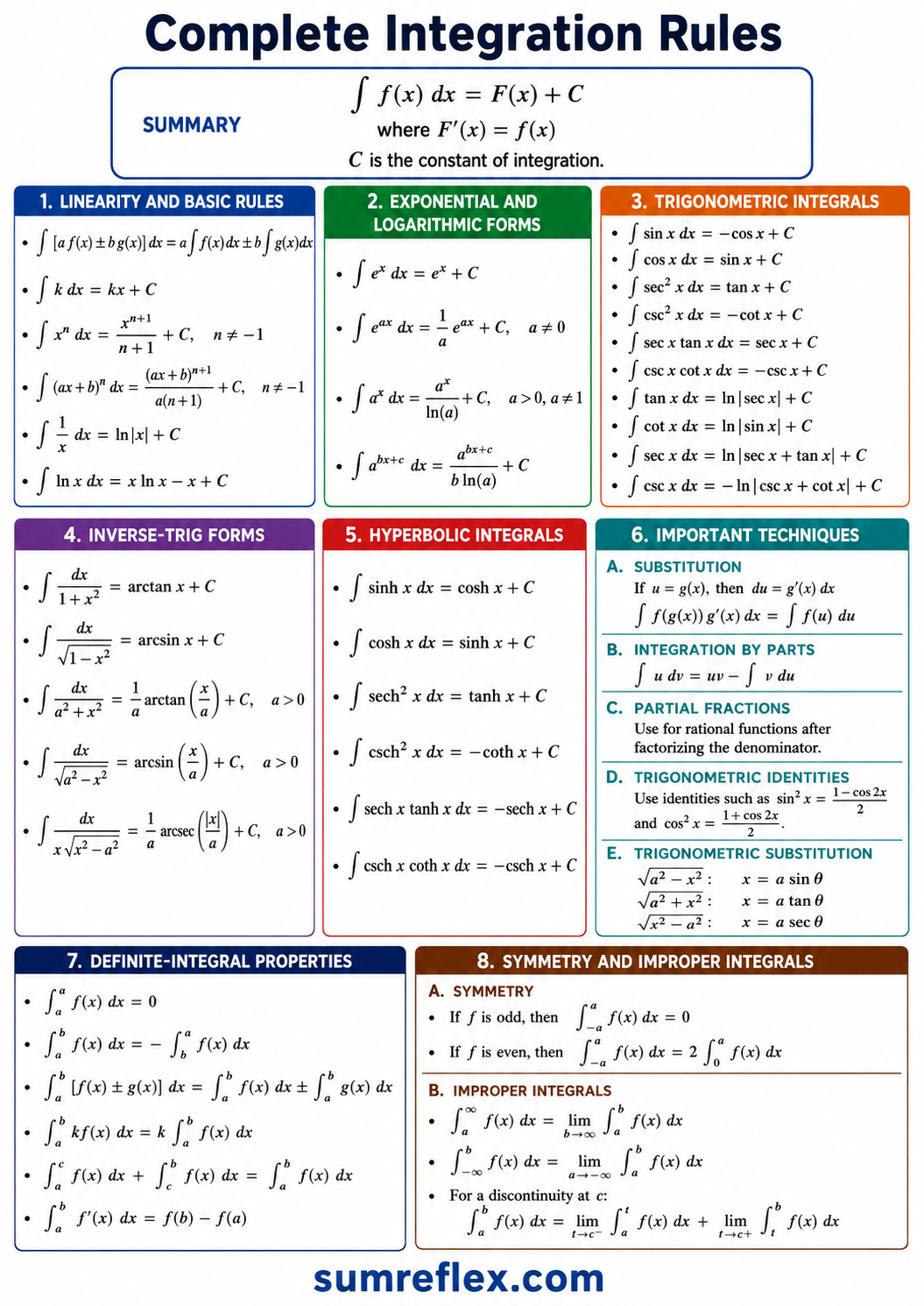
Use this chart as a reference after you understand which rule fits the expression. It groups basic linearity rules, exponential and logarithmic forms, trigonometric integrals, inverse-trig forms, hyperbolic integrals, important techniques, definite-integral properties, symmetry, and improper-integral setup.
The same chart is also available in the Printable Calculus Charts section with print and download options.
Indefinite integral formula
An indefinite integral gives a family of antiderivatives.
\[ \int f(x)\,dx = F(x)+C \]
The \(dx\) tells us the variable of integration. The \(+C\) appears because many functions can have the same derivative.
For example, \(x^2\), \(x^2+7\), and \(x^2-100\) all have derivative \(2x\). Therefore:
\[ \int 2x\,dx=x^2+C \]
Basic integration rules
The first rules come from reversing the most common derivative rules. If you recently studied differentiation, the derivative rules lesson is a useful companion because every antiderivative should check by differentiating.
Linearity lets constants and sums be handled cleanly:
\[ \int [af(x)\pm bg(x)]\,dx = a\int f(x)\,dx \pm b\int g(x)\,dx \]
The constant rule is:
\[ \int k\,dx=kx+C \]
The power rule for integration is:
\[ \int x^n\,dx=\frac{x^{n+1}}{n+1}+C,\quad n\ne -1 \]
The special \(n=-1\) case is logarithmic:
\[ \int \frac{1}{x}\,dx=\ln|x|+C \]
| Rule type | Formula | When to use it |
|---|---|---|
| Constant | \(\int k\,dx=kx+C\) | A number is being integrated with respect to \(x\). |
| Power | \(\int x^n\,dx=\frac{x^{n+1}}{n+1}+C,\ n\ne -1\) | A single power of \(x\) appears. |
| Log case | \(\int \frac{1}{x}\,dx=\ln|x|+C\) | The integrand is reciprocal \(x^{-1}\). |
| Linearity | \(\int [af(x)\pm bg(x)]\,dx=a\int f(x)\,dx\pm b\int g(x)\,dx\) | Terms are added or subtracted. |
| Exponential | \(\int e^x\,dx=e^x+C\) | The base is \(e\). |
| Sine and cosine | \(\int \sin x\,dx=-\cos x+C,\quad \int \cos x\,dx=\sin x+C\) | Basic trigonometric integrals. |
How to choose an integration rule
Do not start by memorizing a long list. Start by reading the structure of the integrand.
If the integrand is a sum or difference, split it using linearity.
If the integrand is a power of \(x\), use the power rule unless the exponent is \(-1\).
If the integrand contains a function and its derivative, consider substitution.
If the integrand is a product where one part becomes simpler when differentiated, consider integration by parts.
If the integrand is a rational function, factor the denominator and check whether partial fractions will separate it into simpler pieces.
If the integrand contains powers of sine or cosine, try a trigonometric identity before integrating.
If a square root has the shape \(\sqrt{a^2-x^2}\), \(\sqrt{a^2+x^2}\), or \(\sqrt{x^2-a^2}\), check whether trigonometric substitution fits.
If a definite integral has symmetry around zero, check whether the function is even or odd before doing extra algebra.
Example 1: power rule and linearity
Find:
\[ \int (6x^5-4x^3+9)\,dx \]
Step 1: Split the terms.
\[ \int 6x^5\,dx-\int 4x^3\,dx+\int 9\,dx \]
Step 2: Apply the power and constant rules.
\[ 6\cdot \frac{x^6}{6}-4\cdot \frac{x^4}{4}+9x+C \]
Step 3: Simplify.
\[ x^6-x^4+9x+C \]
Check: Differentiate the answer:
\[ \frac{d}{dx}(x^6-x^4+9x+C)=6x^5-4x^3+9 \]
The derivative matches the original integrand, so the answer is correct.
Example 2: the logarithmic exception
Find:
\[ \int \left(\frac{5}{x}+3x^2\right)\,dx \]
Step 1: Split the integral.
\[ \int \frac{5}{x}\,dx+\int 3x^2\,dx \]
Step 2: Use the special reciprocal rule for the first term.
\[ \int \frac{5}{x}\,dx=5\ln|x| \]
Step 3: Use the power rule for the second term.
\[ \int 3x^2\,dx=x^3 \]
Step 4: Add the constant.
\[ 5\ln|x|+x^3+C \]
Check: The derivative of \(5\ln|x|\) is \(\frac{5}{x}\), and the derivative of \(x^3\) is \(3x^2\).
Linear inside powers and the integral of ln x
The chart includes a useful power rule for a linear expression inside parentheses:
\[ \int (ax+b)^n\,dx=\frac{(ax+b)^{n+1}}{a(n+1)}+C,\quad n\ne -1 \]
This is really substitution in shortcut form. The denominator includes \(a\) because the derivative of \(ax+b\) is \(a\).
Example:
\[ \int (3x-2)^5\,dx=\frac{(3x-2)^6}{3\cdot 6}+C=\frac{(3x-2)^6}{18}+C \]
The chart also includes the integral of the natural logarithm:
\[ \int \ln x\,dx=x\ln x-x+C \]
That formula comes from integration by parts with \(u=\ln x\) and \(dv=dx\).
Example 2B: integrate ln x by parts
Find:
\[ \int \ln x\,dx \]
Step 1: Choose \(u=\ln x\) and \(dv=dx\).
\[ du=\frac{1}{x}\,dx,\quad v=x \]
Step 2: Use integration by parts.
\[ \int u\,dv=uv-\int v\,du \]
Step 3: Substitute.
\[ \int \ln x\,dx=x\ln x-\int x\cdot \frac{1}{x}\,dx \]
Step 4: Simplify and integrate.
\[ x\ln x-\int 1\,dx=x\ln x-x+C \]
Check: The derivative of \(x\ln x-x\) is \(\ln x+1-1=\ln x\).
Example 3: exponential rules
Find:
\[ \int (4e^x+6\cdot 2^x)\,dx \]
Step 1: Use \(\int e^x\,dx=e^x+C\).
\[ \int 4e^x\,dx=4e^x \]
Step 2: Use the rule for \(a^x\).
\[ \int a^x\,dx=\frac{a^x}{\ln a}+C,\quad a>0,\ a\ne 1 \]
So:
\[ \int 6\cdot 2^x\,dx=6\cdot \frac{2^x}{\ln 2} \]
Step 3: Combine.
\[ 4e^x+\frac{6\cdot 2^x}{\ln 2}+C \]
Check: Differentiating \(\frac{2^x}{\ln 2}\) gives \(2^x\), so the second term checks.
Complete exponential and logarithmic forms
The chart shows several exponential forms. The simplest is:
\[ \int e^x\,dx=e^x+C \]
If the exponent has a constant multiplier, divide by that multiplier:
\[ \int e^{ax}\,dx=\frac{1}{a}e^{ax}+C,\quad a\ne 0 \]
For a base \(a\) other than \(e\):
\[ \int a^x\,dx=\frac{a^x}{\ln a}+C,\quad a>0,\ a\ne 1 \]
For a linear exponent \(bx+c\):
\[ \int a^{bx+c}\,dx=\frac{a^{bx+c}}{b\ln a}+C,\quad a>0,\ a\ne 1,\ b\ne 0 \]
These formulas all come from reversing exponential derivative rules. The factor in the denominator corrects for the derivative of the exponent.
Example 3B: exponential forms with inner constants
Find:
\[ \int \left(7e^{-2x}+5^{3x+1}\right)\,dx \]
Step 1: Integrate \(7e^{-2x}\). Since \(a=-2\), divide by \(-2\):
\[ \int 7e^{-2x}\,dx=-\frac{7}{2}e^{-2x} \]
Step 2: Integrate \(5^{3x+1}\). Here the base is \(5\) and the exponent has derivative \(3\).
\[ \int 5^{3x+1}\,dx=\frac{5^{3x+1}}{3\ln 5} \]
Step 3: Combine.
\[ -\frac{7}{2}e^{-2x}+\frac{5^{3x+1}}{3\ln 5}+C \]
Check: Differentiating the first term brings down \(-2\), and differentiating the second term brings down \(3\ln 5\), so both correction factors cancel.
Example 4: trigonometric integrals
Find:
\[ \int (3\sin x-2\sec^2 x)\,dx \]
Step 1: Use the basic trig rules.
\[ \int \sin x\,dx=-\cos x+C \]
\[ \int \sec^2 x\,dx=\tan x+C \]
Step 2: Apply constants.
\[ \int 3\sin x\,dx=-3\cos x \]
\[ \int -2\sec^2 x\,dx=-2\tan x \]
Step 3: Combine.
\[ -3\cos x-2\tan x+C \]
Check: The derivative of \(-3\cos x\) is \(3\sin x\), and the derivative of \(-2\tan x\) is \(-2\sec^2 x\).
Full trigonometric integral list
The trigonometric part of the chart is more than sine and cosine. It includes the standard antiderivatives that appear often in calculus.
These formulas are worth learning as paired derivative reversals. For example, since \(\frac{d}{dx}(\tan x)=\sec^2 x\), we have \(\int \sec^2 x\,dx=\tan x+C\).
| Integral | Antiderivative | Quick check |
|---|---|---|
| \(\int \sin x\,dx\) | \(-\cos x+C\) | Derivative of \(-\cos x\) is \(\sin x\). |
| \(\int \cos x\,dx\) | \(\sin x+C\) | Derivative of \(\sin x\) is \(\cos x\). |
| \(\int \sec^2 x\,dx\) | \(\tan x+C\) | Derivative of \(\tan x\) is \(\sec^2 x\). |
| \(\int \csc^2 x\,dx\) | \(-\cot x+C\) | Derivative of \(-\cot x\) is \(\csc^2 x\). |
| \(\int \sec x\tan x\,dx\) | \(\sec x+C\) | Derivative of \(\sec x\) is \(\sec x\tan x\). |
| \(\int \csc x\cot x\,dx\) | \(-\csc x+C\) | Derivative of \(-\csc x\) is \(\csc x\cot x\). |
| \(\int \tan x\,dx\) | \(\ln|\sec x|+C\) | Rewrite \(\tan x=\frac{\sin x}{\cos x}\). |
| \(\int \cot x\,dx\) | \(\ln|\sin x|+C\) | Rewrite \(\cot x=\frac{\cos x}{\sin x}\). |
| \(\int \sec x\,dx\) | \(\ln|\sec x+\tan x|+C\) | A standard secant antiderivative. |
| \(\int \csc x\,dx\) | \(-\ln|\csc x+\cot x|+C\) | A standard cosecant antiderivative. |
Example 4B: tan, sec, and csc patterns
Find:
\[ \int (4\tan x+3\sec x\tan x-\csc^2 x)\,dx \]
Step 1: Match each term with a standard trig integral.
\[ \int \tan x\,dx=\ln|\sec x|+C \]
\[ \int \sec x\tan x\,dx=\sec x+C \]
\[ \int \csc^2 x\,dx=-\cot x+C \]
Step 2: Apply constants and signs.
\[ 4\ln|\sec x|+3\sec x+\cot x+C \]
Check: The derivative of \(\cot x\) is \(-\csc^2 x\), so the final positive \(\cot x\) correctly produces the negative \(\csc^2 x\) term.
Inverse-trigonometric forms
Some integrals produce inverse trigonometric functions. These usually appear when the denominator has a square root or a quadratic expression with a fixed pattern.
The chart lists these common forms:
| Pattern | Result | Main shape |
|---|---|---|
| \(\int \frac{dx}{1+x^2}\) | \(\arctan x+C\) | Quadratic \(1+x^2\). |
| \(\int \frac{dx}{\sqrt{1-x^2}}\) | \(\arcsin x+C\) | Square root \(1-x^2\). |
| \(\int \frac{dx}{a^2+x^2}\) | \(\frac{1}{a}\arctan\left(\frac{x}{a}\right)+C,\ a>0\) | Quadratic sum. |
| \(\int \frac{dx}{\sqrt{a^2-x^2}}\) | \(\arcsin\left(\frac{x}{a}\right)+C,\ a>0\) | Square root difference. |
| \(\int \frac{dx}{x\sqrt{x^2-a^2}}\) | \(\frac{1}{a}\operatorname{arcsec}\left|\frac{x}{a}\right|+C,\ a>0\) | Secant-type pattern. |
Example 4C: inverse-trig forms
Find:
\[ \int \frac{dx}{9+x^2} \]
Step 1: Match the pattern \(a^2+x^2\). Here \(a^2=9\), so \(a=3\).
Step 2: Use the arctangent form.
\[ \int \frac{dx}{9+x^2}=\frac{1}{3}\arctan\left(\frac{x}{3}\right)+C \]
Now find:
\[ \int \frac{dx}{\sqrt{16-x^2}} \]
Here \(a=4\), so:
\[ \int \frac{dx}{\sqrt{16-x^2}}=\arcsin\left(\frac{x}{4}\right)+C \]
Check: The first denominator is a sum of squares, so arctangent fits. The second is a square root of \(a^2-x^2\), so arcsine fits.
Hyperbolic integrals
The chart includes hyperbolic functions because they appear in advanced calculus, differential equations, and some substitution work.
The main hyperbolic antiderivatives mirror their derivative rules.
| Integral | Antiderivative |
|---|---|
| \(\int \sinh x\,dx\) | \(\cosh x+C\) |
| \(\int \cosh x\,dx\) | \(\sinh x+C\) |
| \(\int \operatorname{sech}^2 x\,dx\) | \(\tanh x+C\) |
| \(\int \operatorname{csch}^2 x\,dx\) | \(-\coth x+C\) |
| \(\int \operatorname{sech}x\tanh x\,dx\) | \(-\operatorname{sech}x+C\) |
| \(\int \operatorname{csch}x\coth x\,dx\) | \(-\operatorname{csch}x+C\) |
Example 4D: hyperbolic integral
Find:
\[ \int (2\cosh x-5\operatorname{sech}^2 x)\,dx \]
Step 1: Integrate \(\cosh x\).
\[ \int 2\cosh x\,dx=2\sinh x \]
Step 2: Integrate \(\operatorname{sech}^2 x\).
\[ \int -5\operatorname{sech}^2 x\,dx=-5\tanh x \]
Step 3: Combine.
\[ 2\sinh x-5\tanh x+C \]
Check: The derivative of \(\tanh x\) is \(\operatorname{sech}^2 x\), so the coefficient \(-5\) is preserved.
Substitution rule
Substitution is used when an expression contains an inside function and a matching derivative factor.
If \(u=g(x)\), then \(du=g^{\prime}(x)\,dx\).
The pattern is:
\[ \int f(g(x))g^{\prime}(x)\,dx=\int f(u)\,du \]
Substitution is the integration version of undoing the chain rule.
Example 5: u-substitution
Find:
\[ \int 2x(x^2+5)^4\,dx \]
Step 1: Choose the inside expression.
\[ u=x^2+5 \]
Step 2: Differentiate \(u\).
\[ du=2x\,dx \]
Step 3: Rewrite the integral.
\[ \int 2x(x^2+5)^4\,dx=\int u^4\,du \]
Step 4: Integrate with the power rule.
\[ \int u^4\,du=\frac{u^5}{5}+C \]
Step 5: Substitute \(x^2+5\) back for \(u\).
\[ \frac{(x^2+5)^5}{5}+C \]
Check: Differentiate the answer. The outside derivative gives \((x^2+5)^4\), and the inside derivative gives \(2x\), matching the integrand.
Integration by parts
Integration by parts is used for products when substitution does not directly fit.
The formula is:
\[ \int u\,dv=uv-\int v\,du \]
A practical choice is to let \(u\) be the part that becomes simpler when differentiated. Common choices for \(u\) include logarithmic, inverse trigonometric, algebraic, and sometimes trigonometric factors.
Example 6: integration by parts
Find:
\[ \int x e^x\,dx \]
Step 1: Choose \(u=x\) and \(dv=e^x\,dx\).
\[ du=dx,\quad v=e^x \]
Step 2: Use the formula.
\[ \int u\,dv=uv-\int v\,du \]
Step 3: Substitute.
\[ \int x e^x\,dx=xe^x-\int e^x\,dx \]
Step 4: Integrate the remaining term.
\[ xe^x-e^x+C \]
Check: Differentiate \(xe^x-e^x\):
\[ \frac{d}{dx}(xe^x-e^x)=e^x+xe^x-e^x=xe^x \]
Partial fractions
Partial fractions are used for rational functions after the denominator has been factored. The goal is to break one complicated fraction into smaller fractions that integrate into logarithms or simple powers.
This method is most useful when the numerator has lower degree than the denominator. If the numerator degree is greater than or equal to the denominator degree, divide first.
For distinct linear factors, the setup looks like this:
\[ \frac{P(x)}{(x-a)(x-b)}=\frac{A}{x-a}+\frac{B}{x-b} \]
After finding \(A\) and \(B\), integrate each smaller fraction separately.
Example 6B: partial fractions step by step
Find:
\[ \int \frac{5x+7}{x^2+x-2}\,dx \]
Step 1: Factor the denominator.
\[ x^2+x-2=(x-1)(x+2) \]
Step 2: Set up partial fractions.
\[ \frac{5x+7}{(x-1)(x+2)}=\frac{A}{x-1}+\frac{B}{x+2} \]
Step 3: Clear the denominator.
\[ 5x+7=A(x+2)+B(x-1) \]
Step 4: Use convenient \(x\)-values. If \(x=1\), then \(12=3A\), so \(A=4\). If \(x=-2\), then \(-3=-3B\), so \(B=1\).
Step 5: Rewrite and integrate.
\[ \int \frac{5x+7}{x^2+x-2}\,dx=\int \left(\frac{4}{x-1}+\frac{1}{x+2}\right)\,dx \]
\[ 4\ln|x-1|+\ln|x+2|+C \]
Check: Differentiate the answer to get \(\frac{4}{x-1}+\frac{1}{x+2}\), then combine the fractions. The numerator becomes \(4(x+2)+(x-1)=5x+7\).
Trigonometric identities before integrating
Some trigonometric integrals look difficult only because the expression has not been rewritten yet. The chart highlights power-reduction identities because they turn squared trig functions into integrals of constants and cosines.
Two high-value identities are:
\[ \sin^2 x=\frac{1-\cos 2x}{2} \]
\[ \cos^2 x=\frac{1+\cos 2x}{2} \]
Use these when a direct antiderivative for the original trig power is not obvious.
Example 6C: integrate with a trig identity
Find:
\[ \int \sin^2 x\,dx \]
Step 1: Rewrite \(\sin^2 x\) using the power-reduction identity.
\[ \sin^2 x=\frac{1-\cos 2x}{2} \]
Step 2: Integrate term by term.
\[ \int \sin^2 x\,dx=\int \frac{1-\cos 2x}{2}\,dx \]
\[ =\frac{x}{2}-\frac{1}{2}\int \cos 2x\,dx \]
Step 3: Account for the inside derivative \(2\).
\[ \int \cos 2x\,dx=\frac{1}{2}\sin 2x \]
Step 4: Write the final answer.
\[ \int \sin^2 x\,dx=\frac{x}{2}-\frac{\sin 2x}{4}+C \]
Check: Differentiating \(\frac{x}{2}-\frac{\sin 2x}{4}\) gives \(\frac{1}{2}-\frac{\cos 2x}{2}=\frac{1-\cos 2x}{2}=\sin^2 x\).
Trigonometric substitution
Trigonometric substitution is used when a square root has a shape that matches a Pythagorean identity. The substitution changes the radical into a cleaner trig expression.
It is not the first tool for every radical. Try simpler substitution first when the inside derivative is already present.
| Radical shape | Use this substitution | Identity behind it |
|---|---|---|
| \(\sqrt{a^2-x^2}\) | \(x=a\sin\theta\) | \(1-\sin^2\theta=\cos^2\theta\) |
| \(\sqrt{a^2+x^2}\) | \(x=a\tan\theta\) | \(1+\tan^2\theta=\sec^2\theta\) |
| \(\sqrt{x^2-a^2}\) | \(x=a\sec\theta\) | \(\sec^2\theta-1=\tan^2\theta\) |
Example 6D: trig substitution step by step
Find:
\[ \int \frac{dx}{\sqrt{9-x^2}} \]
Step 1: Match the shape \(\sqrt{a^2-x^2}\). Here \(a=3\), so use:
\[ x=3\sin\theta \]
Step 2: Differentiate.
\[ dx=3\cos\theta\,d\theta \]
Step 3: Rewrite the square root.
\[ \sqrt{9-x^2}=\sqrt{9-9\sin^2\theta}=3\cos\theta \]
Step 4: Substitute and simplify.
\[ \int \frac{dx}{\sqrt{9-x^2}}=\int \frac{3\cos\theta\,d\theta}{3\cos\theta}=\int 1\,d\theta \]
\[ =\theta+C \]
Step 5: Return to \(x\). Since \(x=3\sin\theta\), \(\theta=\arcsin\left(\frac{x}{3}\right)\).
\[ \int \frac{dx}{\sqrt{9-x^2}}=\arcsin\left(\frac{x}{3}\right)+C \]
Check: This agrees with the inverse-trig formula \(\int \frac{dx}{\sqrt{a^2-x^2}}=\arcsin\left(\frac{x}{a}\right)+C\).
Definite integrals and the Fundamental Theorem of Calculus
A definite integral gives a number, not a family of functions.
If \(F^{\prime}(x)=f(x)\), then:
\[ \int_a^b f(x)\,dx=F(b)-F(a) \]
This is the part of the Fundamental Theorem of Calculus that turns an antiderivative into accumulated change.
The Mean Value Theorem is another major theorem about rates and intervals, but it answers a different question: it guarantees a tangent slope equal to an average slope.
Definite-integral property table
The chart includes definite-integral properties because they often simplify a problem before any antiderivative is needed.
These rules are about endpoints, interval direction, splitting, constants, sums, and accumulated change.
| Property | Formula | What it means |
|---|---|---|
| Same bounds | \(\int_a^a f(x)\,dx=0\) | No interval width means no accumulated area. |
| Reversed bounds | \(\int_a^b f(x)\,dx=-\int_b^a f(x)\,dx\) | Changing direction changes the sign. |
| Sum or difference | \(\int_a^b [f(x)\pm g(x)]\,dx=\int_a^b f(x)\,dx\pm \int_a^b g(x)\,dx\) | Integrate each term separately. |
| Constant multiple | \(\int_a^b kf(x)\,dx=k\int_a^b f(x)\,dx\) | A constant factor can move outside the integral. |
| Interval split | \(\int_a^c f(x)\,dx+\int_c^b f(x)\,dx=\int_a^b f(x)\,dx\) | Adjacent pieces add to the full interval. |
| Net change | \(\int_a^b f^{\prime}(x)\,dx=f(b)-f(a)\) | The integral of a rate gives total change. |
Example 7: definite integral
Evaluate:
\[ \int_1^3 (2x+1)\,dx \]
Step 1: Find an antiderivative.
\[ \int (2x+1)\,dx=x^2+x+C \]
For a definite integral, the \(+C\) cancels, so use \(F(x)=x^2+x\).
Step 2: Evaluate at the endpoints.
\[ F(3)=3^2+3=12 \]
\[ F(1)=1^2+1=2 \]
Step 3: Subtract.
\[ \int_1^3 (2x+1)\,dx=12-2=10 \]
Check: The integrand is positive on \([1,3]\), so the area value should be positive.
Symmetry rules
Symmetry can make definite integrals much faster.
If \(f\) is odd, then:
\[ \int_{-a}^{a} f(x)\,dx=0 \]
If \(f\) is even, then:
\[ \int_{-a}^{a} f(x)\,dx=2\int_0^a f(x)\,dx \]
Example: \(x^3\) is odd, so \(\int_{-2}^{2}x^3\,dx=0\).
Example: \(x^2\) is even, so \(\int_{-3}^{3}x^2\,dx=2\int_0^3 x^2\,dx\).
Improper integral setup
An improper integral appears when an interval is infinite or the function has a discontinuity inside the interval.
For an infinite upper limit:
\[ \int_a^{\infty} f(x)\,dx=\lim_{b\to\infty}\int_a^b f(x)\,dx \]
For an infinite lower limit:
\[ \int_{-\infty}^{b} f(x)\,dx=\lim_{a\to-\infty}\int_a^b f(x)\,dx \]
For a discontinuity at \(c\) inside \([a,b]\), split the integral:
\[ \int_a^b f(x)\,dx=\lim_{t\to c^-}\int_a^t f(x)\,dx+\lim_{t\to c^+}\int_t^b f(x)\,dx \]
Improper integrals require limits. Do not plug in infinity as if it were an ordinary number.
Example 8: improper integrals with limits
Evaluate:
\[ \int_1^{\infty}\frac{1}{x^2}\,dx \]
Step 1: Replace infinity with a limit.
\[ \int_1^{\infty}\frac{1}{x^2}\,dx=\lim_{b\to\infty}\int_1^b x^{-2}\,dx \]
Step 2: Integrate.
\[ \int x^{-2}\,dx=-x^{-1}=-\frac{1}{x} \]
Step 3: Evaluate and take the limit.
\[ \lim_{b\to\infty}\left[-\frac{1}{x}\right]_1^b=\lim_{b\to\infty}\left(-\frac{1}{b}+1\right)=1 \]
Now evaluate an endpoint singularity:
\[ \int_0^1 \frac{1}{\sqrt{x}}\,dx \]
Step 1: The function is undefined at \(x=0\), so use a limit from the right.
\[ \int_0^1 x^{-1/2}\,dx=\lim_{t\to0^+}\int_t^1 x^{-1/2}\,dx \]
Step 2: Integrate and evaluate.
\[ \lim_{t\to0^+}\left[2\sqrt{x}\right]_t^1=\lim_{t\to0^+}(2-2\sqrt{t})=2 \]
Check: Both results are finite, so both improper integrals converge.
Ideas beyond the chart
The chart gives formulas and method choices, but integration is also used to interpret quantities.
A definite integral gives signed area. Area above the \(x\)-axis counts positive, and area below the \(x\)-axis counts negative. If a question asks for total geometric area, split at intercepts and use absolute values where needed.
The average value of a function on \([a,b]\) is:
\[ f_{\text{avg}}=\frac{1}{b-a}\int_a^b f(x)\,dx \]
The area between two curves is found by subtracting bottom from top:
\[ \text{Area}=\int_a^b [\text{top function}-\text{bottom function}]\,dx \]
Some integrals have no elementary antiderivative. In those cases, students may estimate with numerical methods such as the trapezoidal rule or Simpson rule, depending on what the course allows.
How to confirm an integration answer
The most reliable check for an indefinite integral is differentiation.
If your answer is \(F(x)+C\), then \(F^{\prime}(x)\) must equal the original integrand.
For a definite integral, also check whether the sign and size make sense. If the function is positive over the interval, the integral should be positive. If a function is odd on a symmetric interval, the result may be zero.
For a substitution answer, differentiate carefully enough to see whether the inside derivative was included.
Common mistakes
Do not forget \(+C\) on indefinite integrals.
Do not use the power rule when \(n=-1\). The integral of \(\frac{1}{x}\) is \(\ln|x|+C\), not \(\frac{x^0}{0}\).
Do not drop the inside derivative in substitution problems. If the required factor is missing, you may need to adjust by a constant or choose another method.
Do not forget the denominator \(a\) in \(\int (ax+b)^n\,dx\). The inside derivative is why the shortcut has \(a(n+1)\) in the denominator.
Do not confuse \(\int \sin x\,dx\) and \(\int \cos x\,dx\). The integral of sine is \(-\cos x+C\), while the integral of cosine is \(\sin x+C\).
Do not confuse the logarithmic trig forms: \(\int \tan x\,dx=\ln|\sec x|+C\), while \(\int \cot x\,dx=\ln|\sin x|+C\).
Do not use an inverse-trig formula until the denominator really matches the correct \(a^2+x^2\), \(a^2-x^2\), or \(x^2-a^2\) pattern.
Do not start partial fractions before factoring the denominator and checking whether polynomial division is needed.
Do not use trigonometric substitution too early. A basic \(u\)-substitution or trig identity may be shorter.
Do not assume an improper integral converges. Set up the limit and check whether the limit is finite.
Do not leave \(u\) in a final \(x\)-integral answer unless the problem specifically asks for the answer in terms of \(u\).
Do not attach \(+C\) to a final definite-integral value. Definite integrals evaluate to numbers.
Practice questions
1. Find \(\int (8x^3-6x+4)\,dx\).
2. Find \(\int \left(\frac{3}{x}+5e^x\right)\,dx\).
3. Find \(\int (2x-1)^4\,dx\).
4. Find \(\int 4x(2x^2-1)^5\,dx\).
5. Find \(\int x\cos x\,dx\).
6. Find \(\int \frac{dx}{25+x^2}\).
7. Find \(\int (3\sinh x+2\operatorname{sech}^2 x)\,dx\).
8. Find \(\int \frac{7x+4}{x^2-x-2}\,dx\).
9. Find \(\int \cos^2 x\,dx\).
10. Find \(\int \frac{dx}{\sqrt{4-x^2}}\).
11. Evaluate \(\int_0^2 (3x^2+1)\,dx\).
12. Use symmetry to evaluate \(\int_{-4}^{4} x^5\,dx\).
13. Evaluate \(\int_1^{\infty}\frac{1}{x^3}\,dx\).
14. Find the average value of \(f(x)=x^2\) on \([0,3]\).
Practice answers
1. \(\int (8x^3-6x+4)\,dx=2x^4-3x^2+4x+C\).
2. \(\int \left(\frac{3}{x}+5e^x\right)\,dx=3\ln|x|+5e^x+C\).
3. Use the linear-inside power rule: \(\int (2x-1)^4\,dx=\frac{(2x-1)^5}{10}+C\).
4. Let \(u=2x^2-1\), so \(du=4x\,dx\). The answer is \(\frac{(2x^2-1)^6}{6}+C\).
5. Use integration by parts with \(u=x\) and \(dv=\cos x\,dx\). Then \(du=dx\) and \(v=\sin x\), so the answer is \(x\sin x+\cos x+C\).
6. Since \(25+x^2=5^2+x^2\), \(\int \frac{dx}{25+x^2}=\frac{1}{5}\arctan\left(\frac{x}{5}\right)+C\).
7. \(\int (3\sinh x+2\operatorname{sech}^2 x)\,dx=3\cosh x+2\tanh x+C\).
8. Factor \(x^2-x-2=(x-2)(x+1)\). Then \(\frac{7x+4}{(x-2)(x+1)}=\frac{6}{x-2}+\frac{1}{x+1}\), so the answer is \(6\ln|x-2|+\ln|x+1|+C\).
9. Use \(\cos^2 x=\frac{1+\cos 2x}{2}\). The answer is \(\frac{x}{2}+\frac{\sin 2x}{4}+C\).
10. Since \(4-x^2=2^2-x^2\), \(\int \frac{dx}{\sqrt{4-x^2}}=\arcsin\left(\frac{x}{2}\right)+C\).
11. An antiderivative is \(x^3+x\). Evaluate: \(F(2)-F(0)=(8+2)-0=10\).
12. The function \(x^5\) is odd, and the interval is symmetric, so \(\int_{-4}^{4}x^5\,dx=0\).
13. \(\int_1^{\infty}x^{-3}\,dx=\lim_{b\to\infty}\left[-\frac{1}{2x^2}\right]_1^b=\frac{1}{2}\).
14. \(f_{\text{avg}}=\frac{1}{3-0}\int_0^3x^2\,dx=\frac{1}{3}\cdot 9=3\).
Final idea
Integration rules are not a single trick. They are a toolkit for reversing derivatives and measuring accumulated change.
A good integration solution names the structure, chooses the rule, writes each step, and checks the answer by differentiating or by using interval reasoning.
The chart is useful for recall, but the real skill is knowing why a rule fits the expression in front of you.