



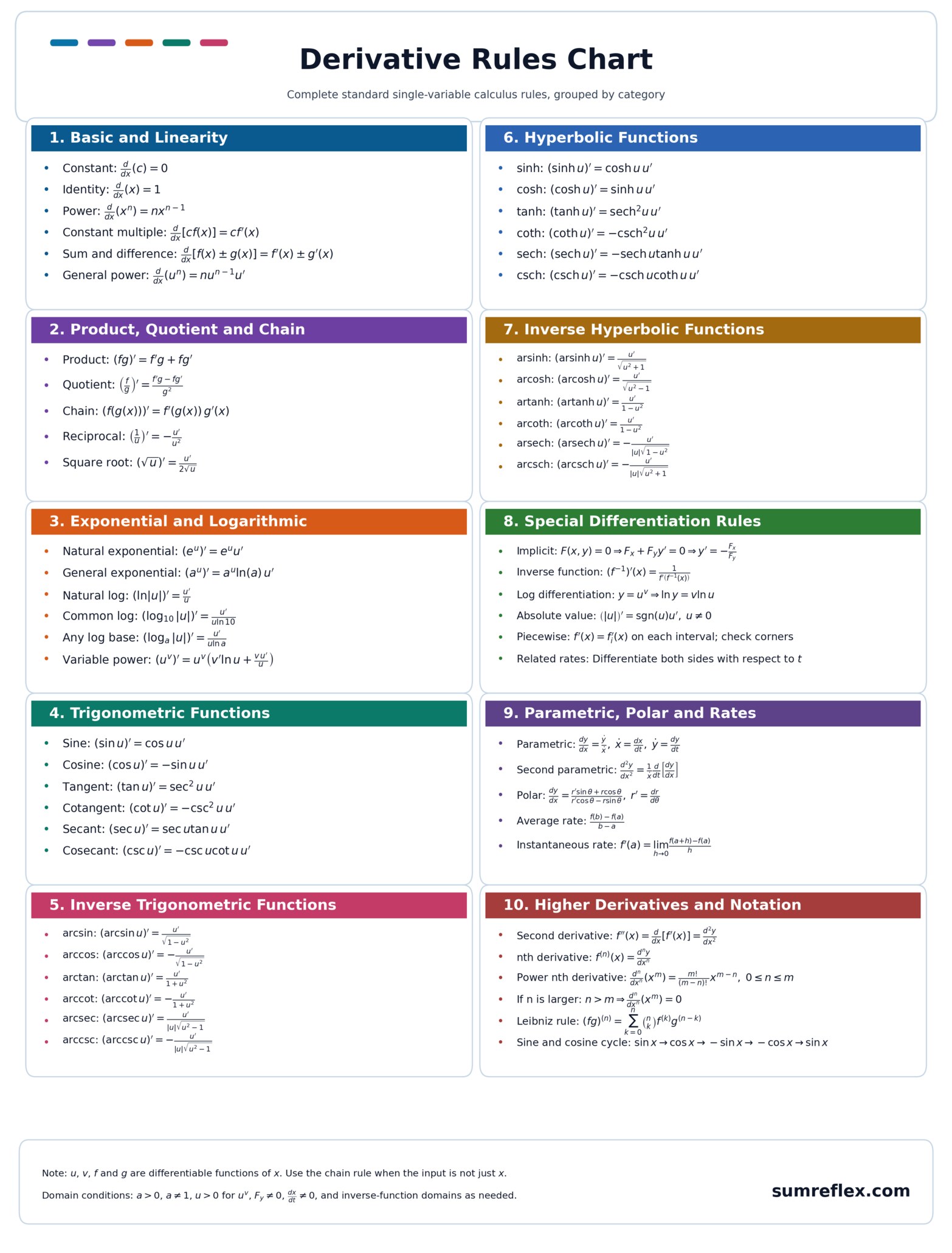
Calculus reference guide
Using a derivative rules chart without guessing the rule
Choose the rule from the structure
A derivative chart is most useful when students read the structure of the function first. A plain power such as \(x^7\) points to the power rule. A product such as \(f(x)g(x)\) points to the product rule. A quotient points to the quotient rule. A function inside another function points to the chain rule.
That structure-first habit matters because many derivative mistakes come from applying a familiar rule to the wrong shape. The chart keeps the formulas visible, but the student still needs to decide what kind of expression is being differentiated.
Keep the chain rule visible
The chart writes many rules with an inside function \(u\). That is intentional. When the input is not just \(x\), the derivative must include \(u'\). For example, \( \frac{d}{dx}[\sin(5x)] = 5\cos(5x) \), not just \( \cos(5x) \).
Students should mark the inside expression before differentiating. That one step makes exponential, logarithmic, trigonometric, inverse trigonometric, and power-chain problems much safer.
Use the chart beside worked examples
The printable gives formulas, but students learn the rules by using them in complete lines of work. A good setup names the rule, differentiates each piece, substitutes into the formula, and simplifies only after the derivative structure is correct.
Use the derivative rules lesson for step-by-step examples, common mistakes, and ways to check an answer. The chart is best as a reference sheet during that practice, not as a replacement for the written solution.
Connect derivative rules to earlier algebra
Derivative work depends on algebra fluency. Before using logarithmic derivatives, students should understand how logarithms behave; the logarithm rules lesson is a useful support. Before using trig derivatives, students should know the basic trig functions and exact values.
After the correct rule has been chosen, a calculator can check the final expression. The Step-by-Step Calculator is useful after the student has already written the rule-based setup.