


Grade 11 algebra lesson
Logarithm Rules: Product, Quotient, Power, and Change of Base
Logarithm rules help you rewrite logs, combine logs, expand expressions, and solve equations where an exponent is hidden.
What a logarithm means
A logarithm is another way to write an exponent question.
The expression \( \log_b a \) means: what power should go on \( b \) to get \( a \)?
\[ \log_b a = x \Longleftrightarrow b^x = a \]
For example, \( \log_2 8 = 3 \) because \( 2^3 = 8 \). The logarithm gives the exponent, not the base and not the final value.
Rules before you start
Logarithms have restrictions. In \( \log_b a \), the base must be positive, the base cannot be 1, and the input must be positive.
\[ b > 0,\quad b \ne 1,\quad a > 0 \]
These restrictions are not decoration. If a problem has \( \log_b(x-4) \), then the inside must satisfy \( x - 4 > 0 \), so \( x > 4 \).
Logarithm rules chart
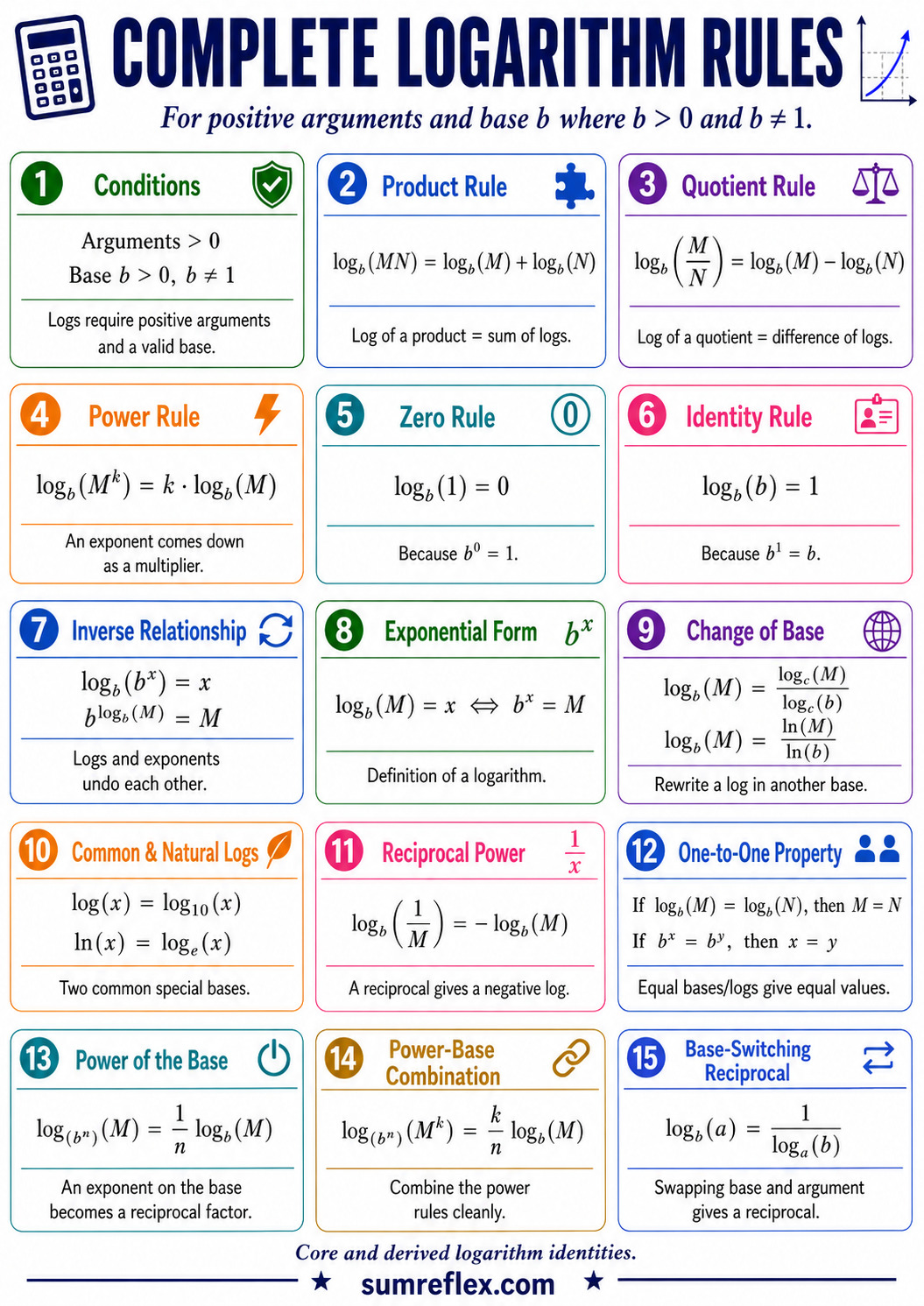
Use this chart as a quick reference, then read the same rules in math notation. The letters \( M \) and \( N \) stand for positive expressions.
Product rule:
\[ \log_b(MN) = \log_b M + \log_b N \]
Quotient rule:
\[ \log_b\left(\frac{M}{N}\right) = \log_b M - \log_b N \]
Power rule:
\[ \log_b(M^r) = r\log_b M \]
Root rule:
\[ \log_b\sqrt[n]{M} = \frac{1}{n}\log_b M \]
Change-of-base rule:
\[ \log_b M = \frac{\log_c M}{\log_c b} \]
Why the product rule works
The product rule comes from adding exponents with the same base.
Suppose \( \log_b M = p \) and \( \log_b N = q \). That means \( b^p = M \) and \( b^q = N \).
Multiply the two equations:
\[ MN = b^p \cdot b^q = b^{p+q} \]
So the exponent that produces \( MN \) is \( p + q \), which gives:
\[ \log_b(MN) = \log_b M + \log_b N \]
Example 1: combine logarithms
Combine this expression into one logarithm:
\[ \log_2 8 + \log_2 4 \]
The logs have the same base, so use the product rule:
\[ \log_2 8 + \log_2 4 = \log_2(8\cdot4) \]
\[ \log_2(32) = 5 \]
The final answer is \( 5 \) because \( 2^5 = 32 \).
Example 2: expand a logarithm
Expand the expression:
\[ \log_3\left(\frac{27x^2}{y}\right) \]
Use the quotient rule first:
\[ \log_3(27x^2) - \log_3 y \]
Then use the product rule on \( 27x^2 \):
\[ \log_3 27 + \log_3(x^2) - \log_3 y \]
Now simplify and use the power rule:
\[ 3 + 2\log_3 x - \log_3 y \]
This expanded form is valid when \( x > 0 \) and \( y > 0 \).
Example 3: condense an expression
Condense this expression into one logarithm:
\[ 2\log_5 x - \log_5 3 \]
Move the coefficient into the exponent:
\[ 2\log_5 x = \log_5(x^2) \]
Now use the quotient rule:
\[ \log_5(x^2) - \log_5 3 = \log_5\left(\frac{x^2}{3}\right) \]
So the condensed expression is \( \log_5\left(\frac{x^2}{3}\right) \), with \( x > 0 \).
Inverse rules for logs and exponents
Logarithms and exponents undo each other when the base matches.
\[ \log_b(b^x) = x \]
\[ b^{\log_b x} = x \]
These rules are useful when solving equations. They let you move between logarithmic form and exponential form without changing the meaning.
Example 4: solve a logarithmic equation
Solve this equation:
\[ \log_5(x - 1) = 2 \]
Rewrite the equation in exponential form:
\[ x - 1 = 5^2 \]
\[ x - 1 = 25 \]
\[ x = 26 \]
Check the restriction: \( x - 1 > 0 \). Since \( 26 - 1 = 25 \), the solution is allowed.
Change of base
The change-of-base rule lets you evaluate a logarithm even when your calculator only has \( \log \) or \( \ln \).
\[ \log_b M = \frac{\log M}{\log b} = \frac{\ln M}{\ln b} \]
For example:
\[ \log_2 10 = \frac{\log 10}{\log 2} \]
This is especially helpful when the base is not 10 and not \( e \).
Common mistakes
Do not split a sum inside a log. In general, \( \log_b(M + N) \ne \log_b M + \log_b N \). The product rule works for multiplication, not addition.
Do not ignore the base. The expression \( \log_2 8 \) is not the same as \( \log_4 8 \).
Do not apply log rules when the bases are different. You cannot combine \( \log_2 x + \log_3 y \) with the product rule.
Do not forget restrictions. A final answer must make every logarithm input positive.
Quick practice
1. Evaluate \( \log_3 81 \). Answer: \( 4 \).
2. Expand \( \log_2(8x) \). Answer: \( 3 + \log_2 x \), with \( x > 0 \).
3. Condense \( \log_7 a + \log_7 b \). Answer: \( \log_7(ab) \).
4. Condense \( 3\log_4 x \). Answer: \( \log_4(x^3) \), with \( x > 0 \).
5. Solve \( \log_2(x + 5) = 4 \). Answer: \( x = 11 \).
6. Rewrite \( \log_6 14 \) using common logs. Answer: \( \frac{\log 14}{\log 6} \).