


Grade 8 geometry lesson
Volume of a Cone and Cone Volume Formula
The volume of a cone is one third of the matching cylinder, so the main formula is V = 1/3 pi r squared h.
What does volume of a cone mean?
The volume of a cone tells how much space is inside the cone. If a cone could be filled with sand, water, or air, the volume would describe how much it holds.
A cone has one circular base and one pointed top called an apex. The base gives the cone its round footprint. The height tells how far the apex is above the base. For volume, that height must be the straight vertical height, not the slanted side.
This lesson focuses on right circular cones, the usual school cone where the apex is centered above the circular base. If you need a quick shape reminder first, review common solid figures before using the formula.
Cone volume formula
Main formula: \[V=\frac{1}{3}\pi r^2h\]
In this formula, \(V\) means volume, \(r\) means radius of the circular base, and \(h\) means perpendicular height. The radius is half the diameter, so if the diameter is given, divide it by 2 before using the main formula.
The squared part belongs only to the radius. A common mistake is to square the height as well. Do not do that. The formula uses base area, \(\pi r^2\), and then multiplies by height.
Printable cone volume formula chart
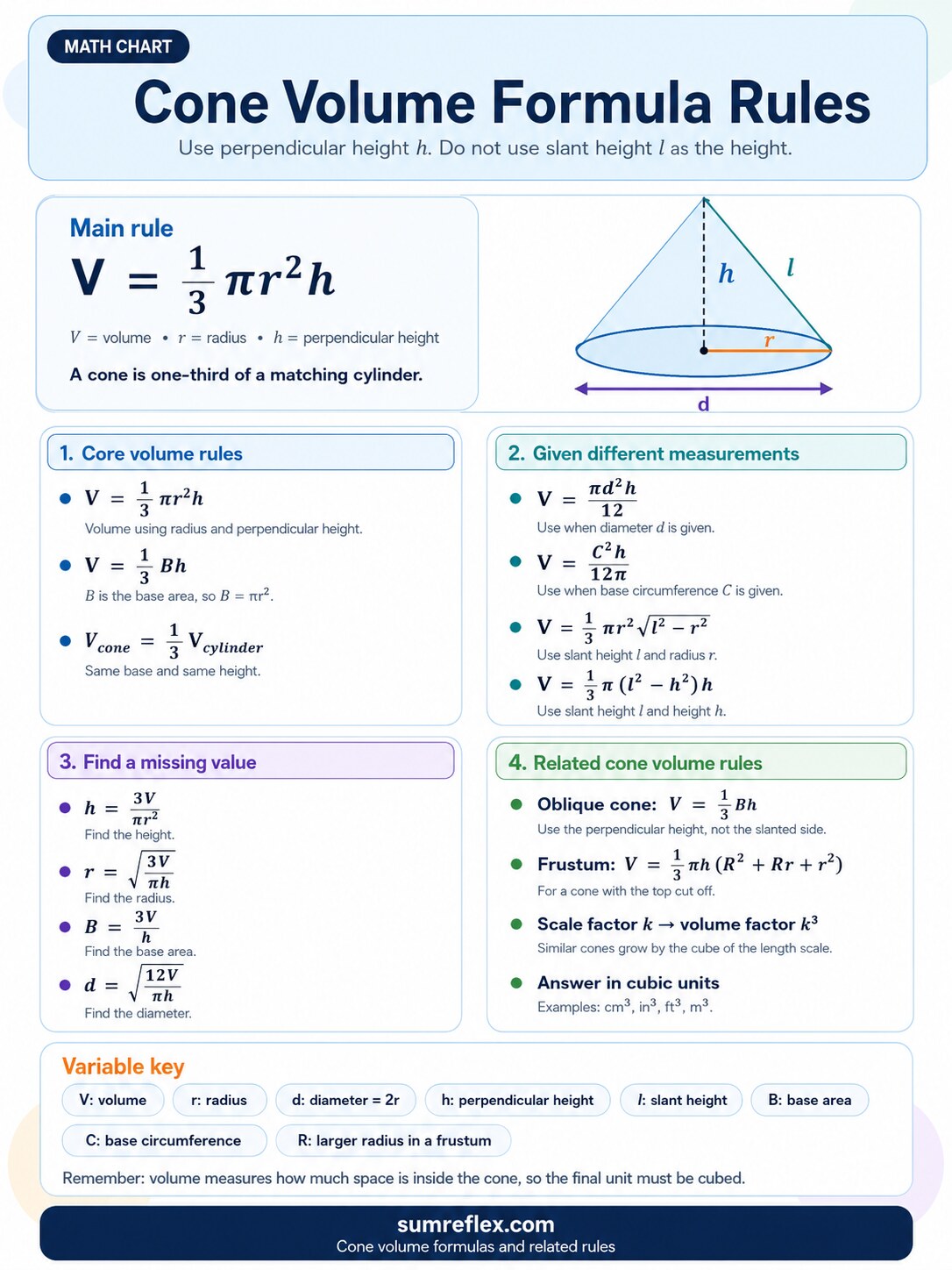
Use this chart as a quick reference after you understand the main idea. It shows the radius formula, diameter version, missing-value forms, slant-height warning, and related cone rules in one place.
The same chart is also available in the printable geometry chart section with print and download buttons.
Why is there a one third in the formula?
A cone with radius \(r\) and height \(h\) fits inside a cylinder with the same radius and height. The cylinder volume is \(\pi r^2h\). The cone does not fill the whole cylinder; it fills exactly one third of that matching cylinder.
That is why the cone formula starts with the cylinder formula and then multiplies by \(\frac{1}{3}\). Written another way, \[V_{\text{cone}}=\frac{1}{3}V_{\text{cylinder}}\] when the cone and cylinder have the same base and height.
This comparison is useful because it gives the formula a reason. Students often remember it better when they picture three equal cones filling the matching cylinder.
Example 1: radius and height are given
Problem: A cone has radius 4 cm and height 9 cm. Find its volume.
Step 1: Write the formula: \[V=\frac{1}{3}\pi r^2h\]
Step 2: Substitute \(r=4\) and \(h=9\): \[V=\frac{1}{3}\pi(4)^2(9)\]
Step 3: Simplify: \[V=\frac{1}{3}\pi(16)(9)=48\pi\]
Answer: The volume is \(48\pi\) cubic centimeters, or about 150.8 cubic centimeters.
Example 2: diameter is given instead of radius
Problem: A cone has diameter 10 in. and height 12 in. Find its volume.
Step 1: Convert diameter to radius. Since \(r=\frac{d}{2}\), the radius is 5 in.
Step 2: Use the cone volume formula: \[V=\frac{1}{3}\pi(5)^2(12)\]
Step 3: Simplify: \[V=\frac{1}{3}\pi(25)(12)=100\pi\]
Answer: The volume is \(100\pi\) cubic inches, or about 314.2 cubic inches.
Finding a missing height or radius
Sometimes the volume is given and one measurement is missing. Start from the same formula, then rearrange it carefully.
To find height, use \[h=\frac{3V}{\pi r^2}\] when volume and radius are known.
To find radius, use \[r=\sqrt{\frac{3V}{\pi h}}\] when volume and height are known.
These forms are not new rules to memorize separately. They are the same cone formula solved for a different letter.
Do not use slant height as the height
The slant height is the diagonal distance down the side of the cone. It is useful for surface area, but it is not the height used in the volume formula.
Cone volume uses perpendicular height because volume measures stacked space from the base upward. If a problem gives slant height \(l\) and radius \(r\), find the perpendicular height with the Pythagorean relationship \[h=\sqrt{l^2-r^2}\] before calculating volume.
This is the same kind of height check students use in other geometry formulas: the height must meet the base at a right angle.
Units and rounding
Volume answers use cubic units: cubic centimeters, cubic meters, cubic inches, cubic feet, and so on. If the measurements are in centimeters, the volume is in cubic centimeters.
When the answer includes \(\pi\), your teacher may ask for an exact answer such as \(48\pi\), or a decimal approximation such as 150.8. Keep the exact answer until the last step, then round only if the problem asks for a decimal.
If you want to check arithmetic after setting up the formula yourself, use the Volume Calculator. The important learning step is still choosing the cone mode and entering radius and perpendicular height correctly.
Quick practice
1. A cone has radius 3 cm and height 7 cm. The volume is \(21\pi\) cubic centimeters.
2. A cone has radius 6 m and height 5 m. The volume is \(60\pi\) cubic meters.
3. A cone has diameter 8 in. and height 9 in. The volume is \(48\pi\) cubic inches.
4. A cone has volume \(72\pi\) cubic ft and radius 6 ft. The height is 6 ft.
5. A cone has slant height 13 cm and radius 5 cm. First find \(h=12\) cm, then use the volume formula.