


Grade 4 geometry lesson
Common Solid Figures: Cube, Cuboid, Sphere, Cone, Cylinder, Pyramid, and Prism
Solid figures are 3-dimensional shapes. This lesson explains cube, cuboid, sphere, cone, cylinder, square pyramid, and triangular prism with parts, examples, and labeled diagrams.
What are solid figures?
A solid figure is a 3-dimensional shape. That means it has length, width, and height. It takes up space, so you can usually hold it, stack it, roll it, or place it on a table.
Flat shapes such as squares, circles, and triangles are 2-dimensional. Solid figures such as cubes, cuboids, spheres, cones, cylinders, pyramids, and prisms are 3-dimensional.
When you study solid figures, you do not only name the shape. You also learn its important parts: faces, edges, vertices, bases, and curved surfaces.
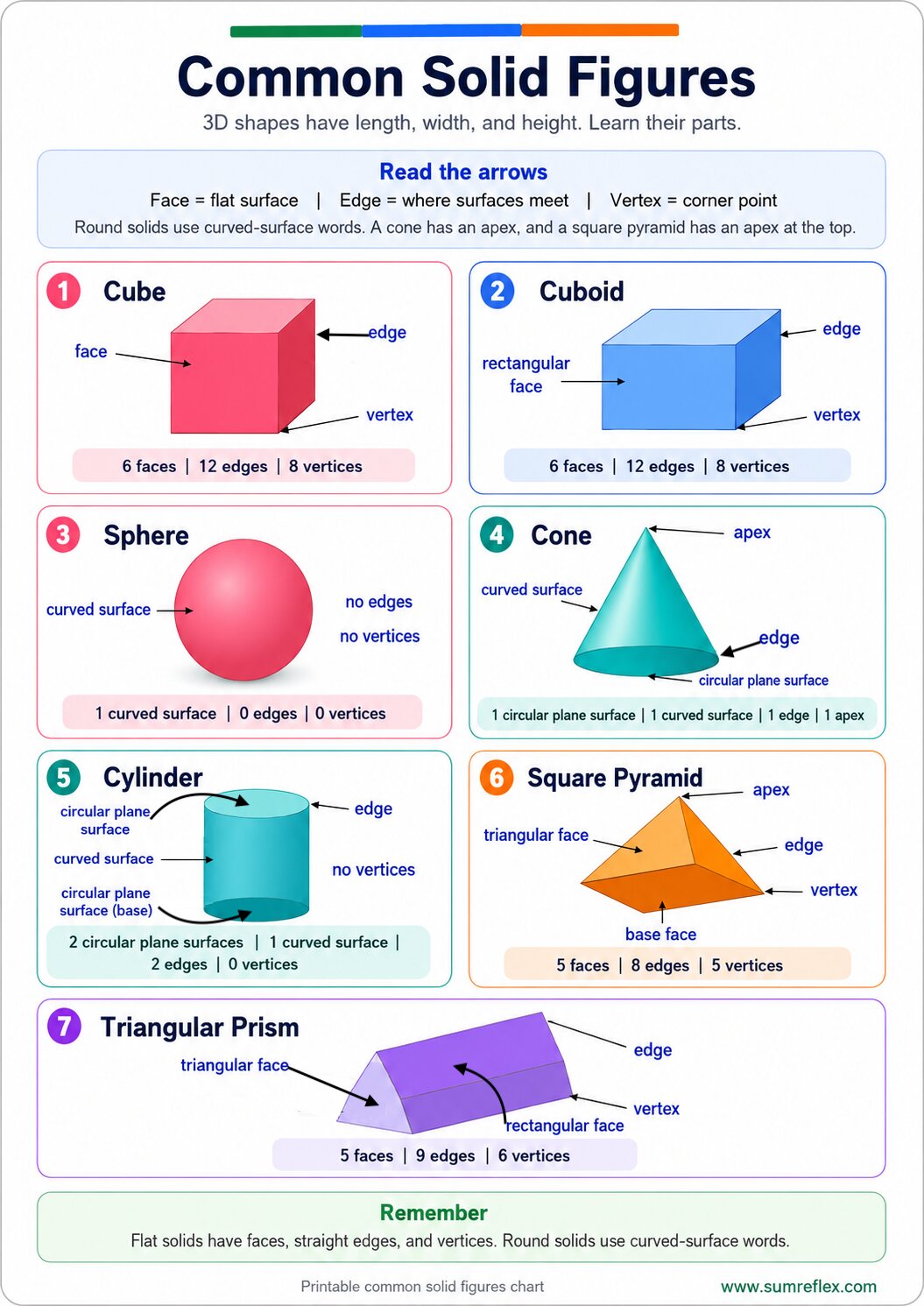
Printable common solid figures chart
Use this SumReflex chart as a quick classroom reference for the most common solid figures. It shows each shape, its labeled parts, and the number of faces, edges, and vertices students should remember.
The same chart is also available in the Printable Geometry Charts section with print and download options.
Important words for solid figures
Face: a flat surface on a solid figure. A cube has 6 flat square faces.
Edge: a line where two faces meet. On a box, the sharp straight lines are edges.
Vertex: a corner point where edges meet. More than one vertex are called vertices.
Apex: the special top point of a cone or pyramid. An apex is a vertex when it is a corner point, but not every vertex is an apex.
Base: the flat face a solid figure can rest on. A cylinder has two circular bases.
Curved surface: a rounded surface. Spheres, cones, and cylinders have curved surfaces.
One small note: some books count only flat surfaces as faces. In that style, the round part of a sphere, cone, or cylinder is called a curved surface instead of a face. This lesson uses that clear school wording.
Cube
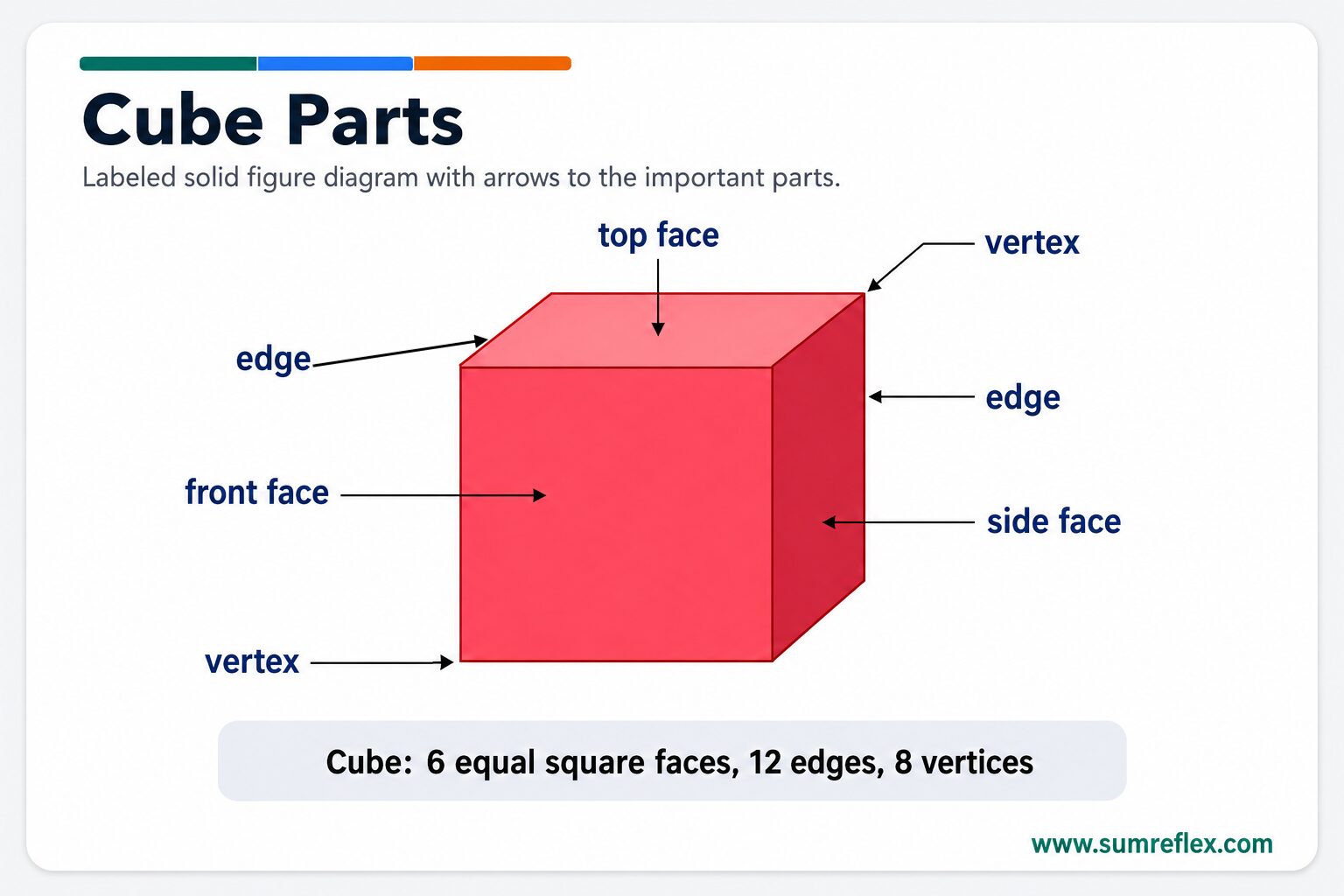
A cube is a solid figure with 6 equal square faces. Every edge has the same length.
A cube has 6 faces, 12 edges, and 8 vertices.
Real-life examples include dice, ice cubes, building blocks, cube boxes, and some puzzle blocks.
A cube is easy to recognize because all its flat faces are the same size and shape.
Cuboid or rectangular prism
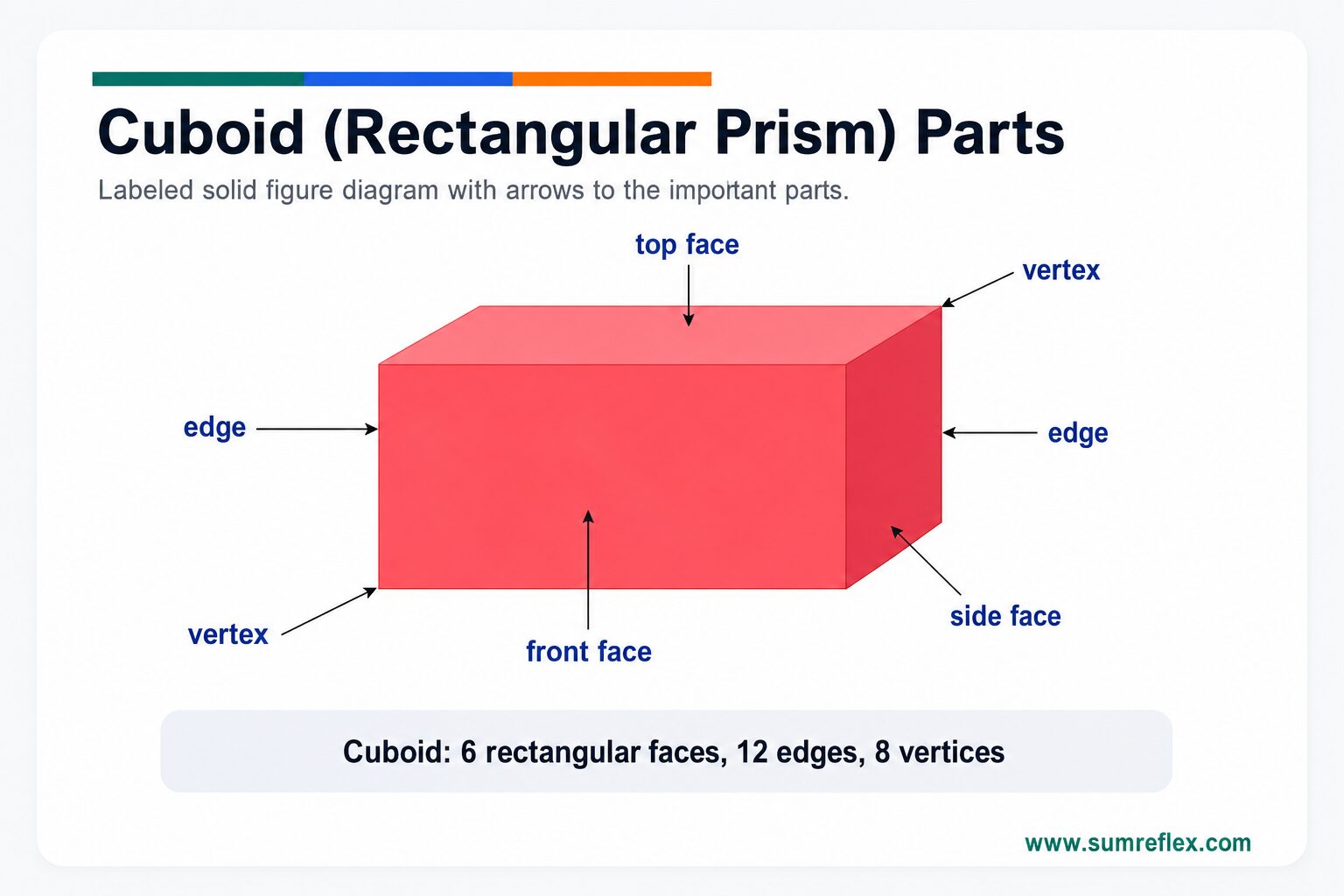
A cuboid is also called a rectangular prism. It looks like a box.
A cuboid has 6 rectangular faces, 12 edges, and 8 vertices.
A cube is a special cuboid where every face is a square, but most cuboids have longer and shorter sides.
Real-life examples include cereal boxes, books, shoe boxes, bricks, lunch boxes, and many rooms.
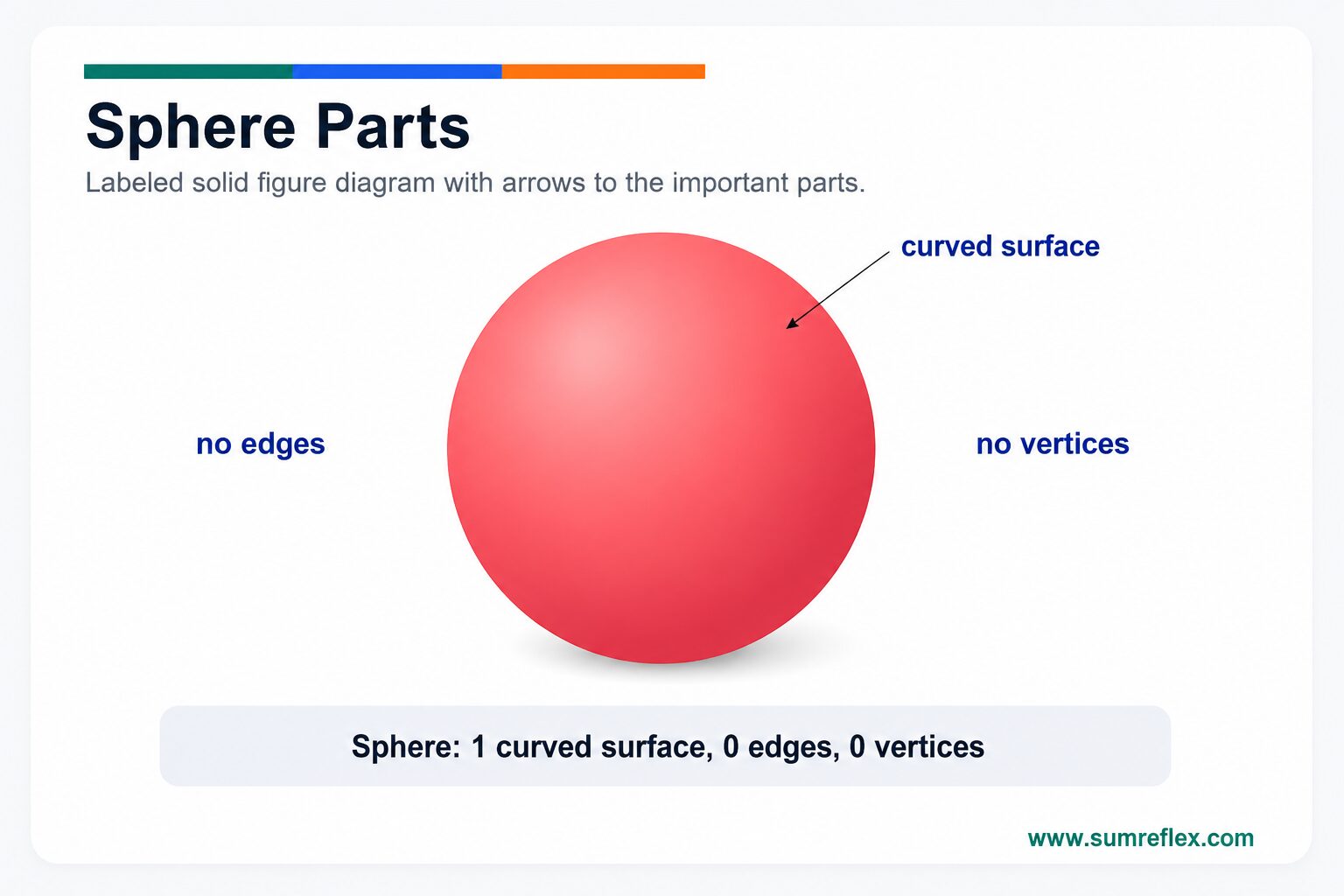
Sphere
A sphere is a perfectly round solid figure. Every point on the surface is the same distance from the center.
A sphere has 1 curved surface, 0 flat faces, 0 edges, and 0 vertices.
Real-life examples include balls, marbles, bubbles, oranges, globes, and planets.
A sphere can roll in any direction because it has no flat face to stop it.
Cone
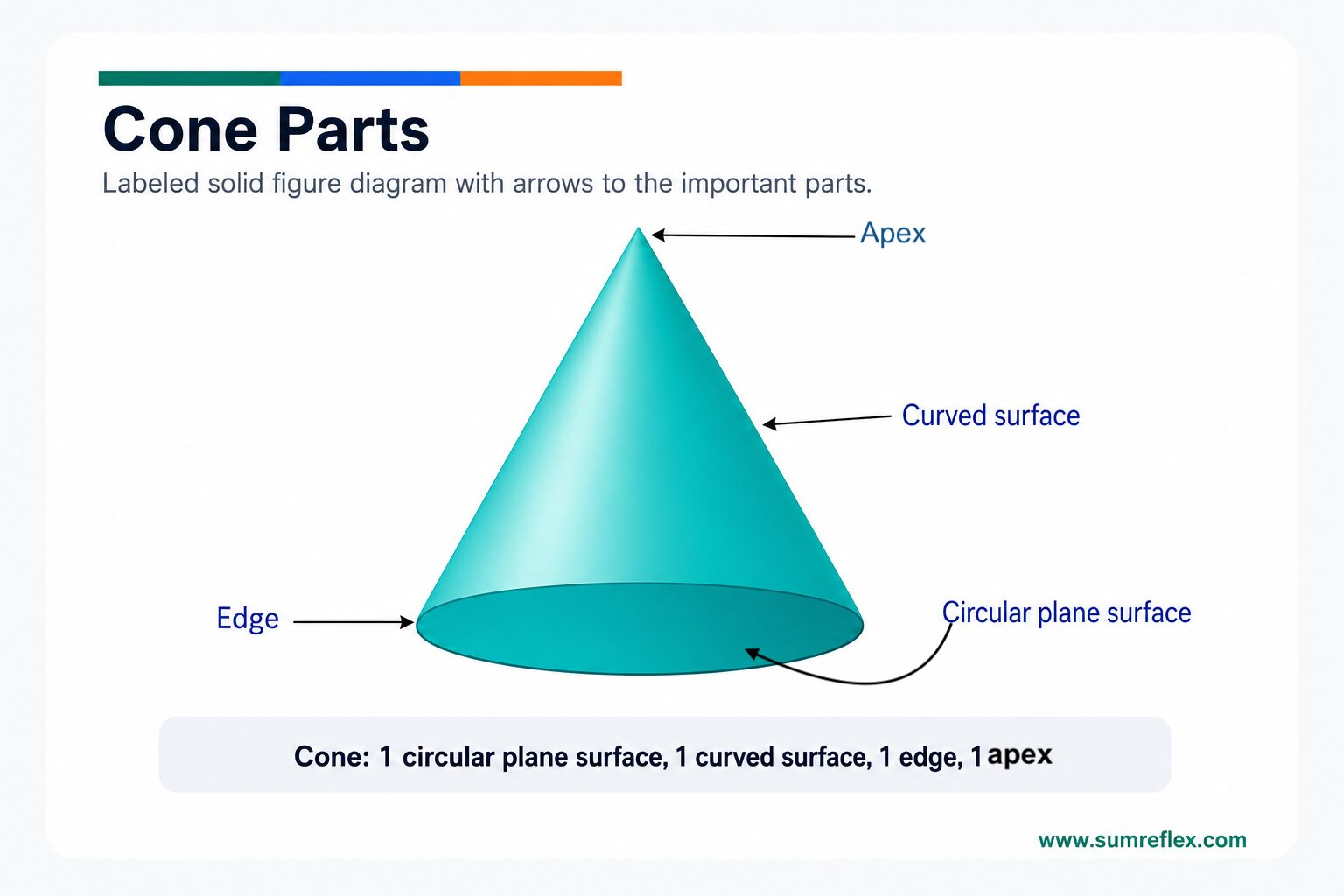
A cone has one flat circular base and one curved surface that comes to a point.
The top point of a cone is called the apex. Many math books also call it the cone's vertex, because it is the single pointed corner of the cone.
A cone has 1 flat circular base, 1 curved surface, 1 curved edge, and 1 apex.
Real-life examples include ice cream cones, party hats, traffic cones, funnels, and some tree shapes.
Cylinder
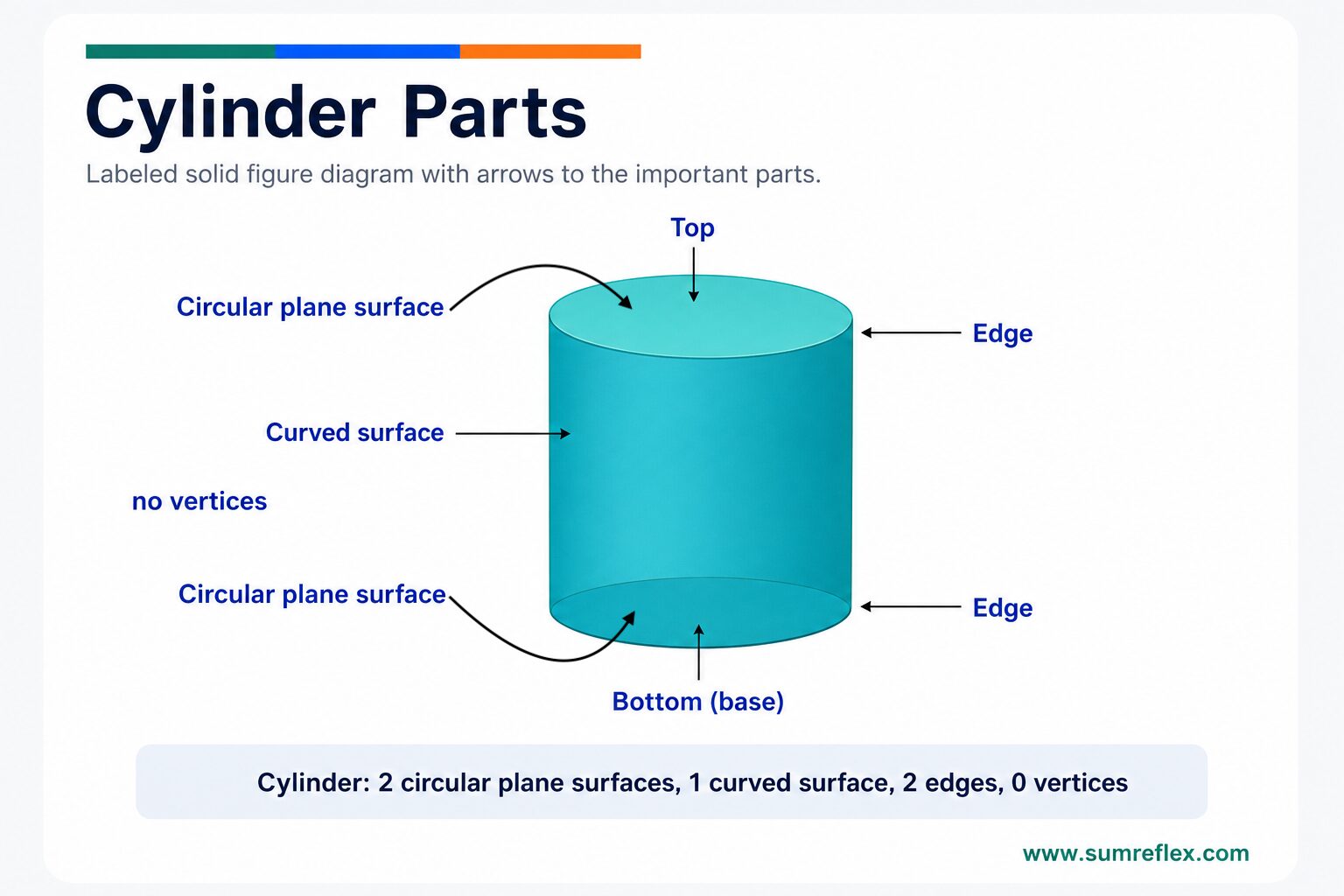
A cylinder has two equal circular bases and one curved surface between them.
A cylinder has 2 flat circular bases, 1 curved surface, 2 curved edges, and 0 vertices.
Real-life examples include cans, drums, jars, batteries, pipes, candles, and paper towel rolls.
A cylinder can stand on a flat circular base, but it can also roll on its curved surface.
Square pyramid
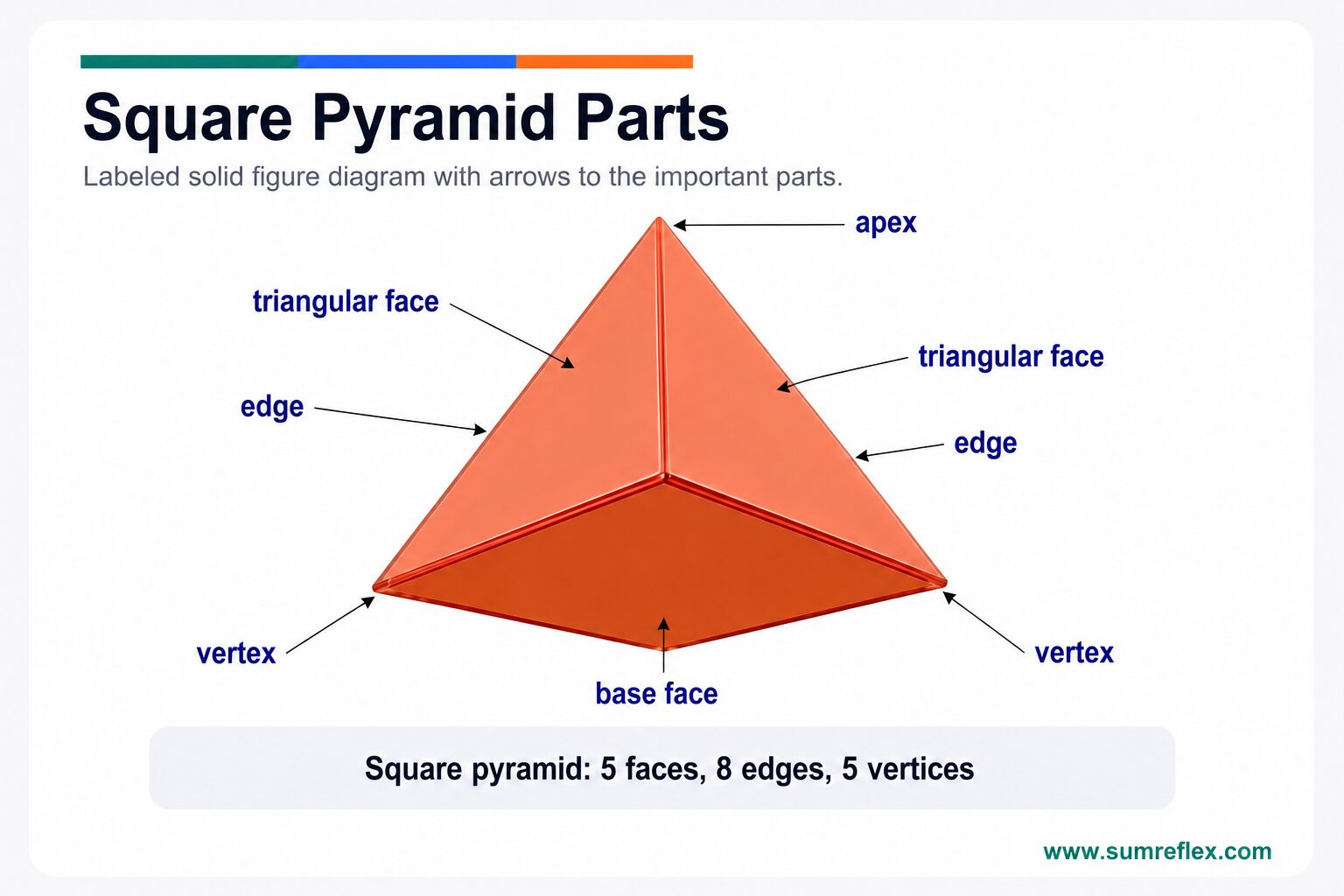
A square pyramid has a square base and triangular side faces that meet at one top point.
A square pyramid has 5 faces, 8 edges, and 5 vertices.
Real-life examples include some roof shapes, pyramid models, tent tops, and decorative paper crafts.
The square base is the bottom face. The triangular faces lean upward and meet at the apex.
The apex is one of the pyramid's vertices. The other four vertices are the corners of the square base, so they are vertices but not the apex.
Triangular prism
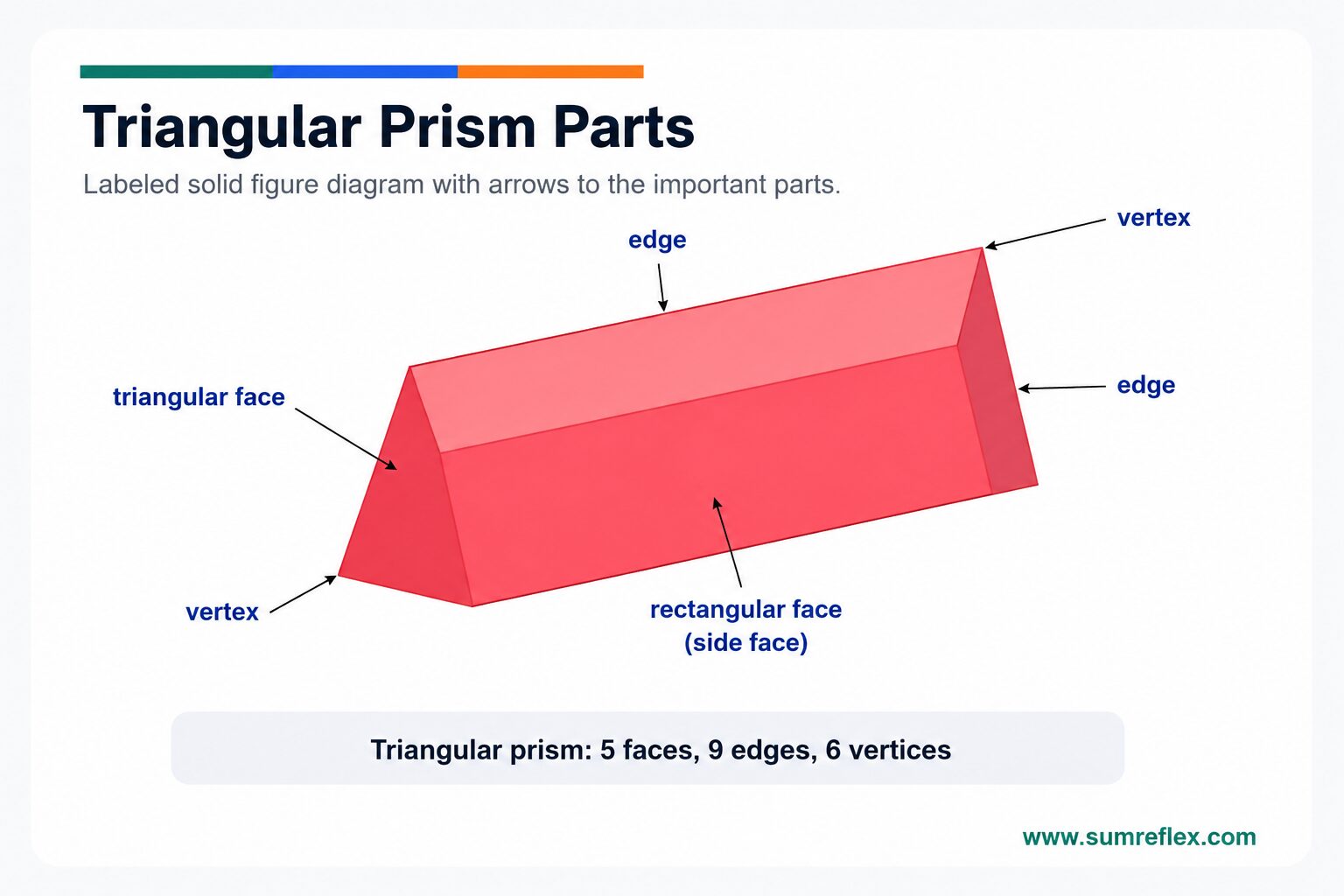
A triangular prism has two matching triangular bases and three rectangular side faces.
A triangular prism has 5 faces, 9 edges, and 6 vertices.
Real-life examples include some tents, chocolate bars, roof pieces, ramps, and wedge-shaped blocks.
A prism has the same cross-section from one end to the other. For a triangular prism, that cross-section is a triangle.
Quick comparison
Cube: 6 faces, 12 edges, 8 vertices. All faces are squares.
Cuboid: 6 faces, 12 edges, 8 vertices. Faces are rectangles.
Sphere: 1 curved surface, 0 flat faces, 0 edges, 0 vertices.
Cone: 1 flat circular base, 1 curved surface, 1 curved edge, 1 apex.
Cylinder: 2 flat circular bases, 1 curved surface, 2 curved edges, 0 vertices.
Square pyramid: 5 faces, 8 edges, 5 vertices including 1 apex.
Triangular prism: 5 faces, 9 edges, 6 vertices.
Apex vs vertex
A vertex is any corner point on a solid figure.
An apex is a special vertex at the top of a cone or pyramid, opposite the base.
For a square pyramid, the top point is the apex and also a vertex. The four bottom corners are vertices, but they are not apexes.
For a cone, the pointed top is usually called the apex. Many school books also call that same point the vertex of the cone.
How to identify a solid figure
Step 1: Ask if the shape is flat or solid. If it has length, width, and height, it is a solid figure.
Step 2: Look for flat faces. Are they squares, rectangles, triangles, or circles?
Step 3: Look for curved surfaces. If it is fully round, it may be a sphere. If it has circles and a curved side, it may be a cone or cylinder.
Step 4: Count vertices. A sphere and cylinder have no vertices. A cone has one. A cube and cuboid have eight.
Step 5: Use real-life clues. A can is usually a cylinder, a ball is usually a sphere, a dice is usually a cube, and a cereal box is usually a cuboid.
Worked examples
Example 1: A dice has 6 equal square faces. What solid figure is it? It is a cube because all faces are equal squares.
Example 2: A soup can has two circular bases and a curved side. What solid figure is it? It is a cylinder.
Example 3: A party hat has one circular base and one point at the top. What solid figure is it? It is a cone.
Example 4: A shoebox has rectangular faces and 8 corners. What solid figure is it? It is a cuboid, also called a rectangular prism.
Example 5: A ball has no flat faces and no corners. What solid figure is it? It is a sphere.
Example 6: A tent has two triangular ends and three rectangular faces. What solid figure is it? It is a triangular prism.
Common mistakes
Do not call every box a cube. A cube must have all square faces. A long box is usually a cuboid.
Do not count the round side of a cone or cylinder as a flat face. It is a curved surface.
Do not say a sphere has a face like a circle. A circle is flat, but a sphere is curved all around.
Do not forget that a cone has one apex at the pointed top, while a cylinder has no vertices.
Do not mix up apex and vertex. Every apex is a special top point, but a shape can have other vertices that are not apexes.
Do not mix up a pyramid and a prism. A pyramid comes to one apex. A prism has matching bases at two ends.
Practice questions
1. Which solid figure has 6 equal square faces?
2. Which solid figure has one curved surface and no flat faces?
3. Which solid figure has two circular bases?
4. Which solid figure has one circular base and one apex?
5. How many vertices does a cuboid have?
6. A shape has a square base and four triangular side faces. What is it?
7. A shape has two triangular bases and three rectangular faces. What is it?
Answers
1. Cube.
2. Sphere.
3. Cylinder.
4. Cone.
5. 8 vertices.
6. Square pyramid.
7. Triangular prism.
The big idea
Solid figures are 3-dimensional shapes. To understand them well, name the shape, then describe its faces, edges, vertices, bases, and curved surfaces.
A cube, cuboid, sphere, cone, cylinder, pyramid, and prism each has a different structure. Once you know the parts, the names become much easier to remember.