



Grade 5 geometry lesson
Positive Quadrant Coordinate Plane: Ordered Pairs, Examples, Chart, and Practice
The positive quadrant, also called Quadrant I, is the part of the coordinate plane where x and y values are positive.
What is the positive quadrant?
The positive quadrant is the upper-right part of a coordinate plane.
It is also called Quadrant I or the first quadrant.
In this quadrant, both coordinates are positive. That means x is positive and y is positive.
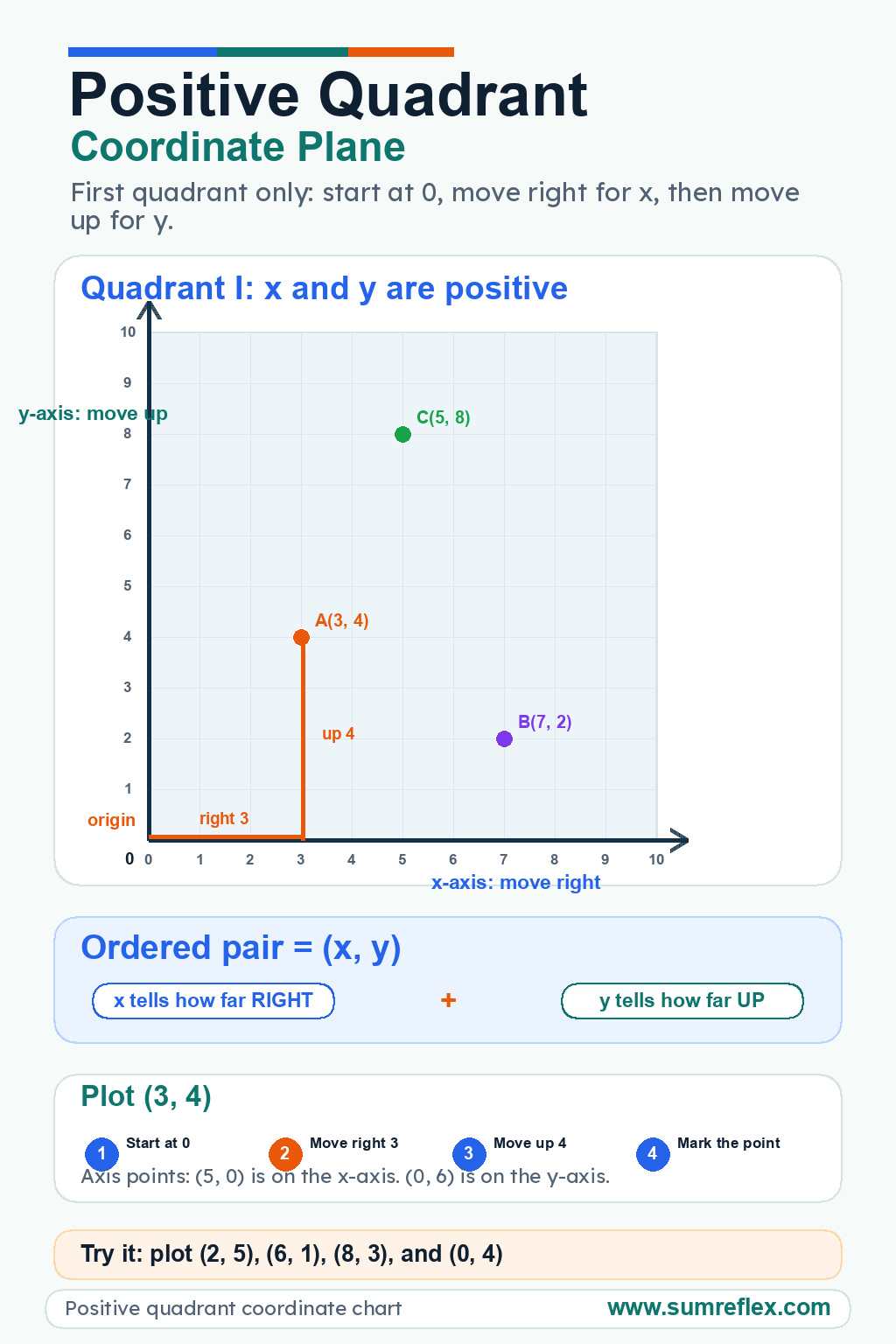
Examples of points in the positive quadrant are (3, 4), (7, 2), and (5, 8).
Printable positive quadrant chart
Use this chart as a quick reference for plotting ordered pairs in the first quadrant. It shows the x-axis, y-axis, origin, positive number labels, and example plotted points.
The same chart is also available in the Printable Geometry Charts section with print and download buttons.
Why this comes before all four quadrants
The positive quadrant is easier to learn first because students only move in two directions: right and up.
There are no negative coordinates yet.
After students understand ordered pairs in Quadrant I, they are ready to study left, down, and the all four quadrants coordinate plane.
Parts of the coordinate plane
The x-axis is the horizontal number line. In the positive quadrant, x-values move to the right.
The y-axis is the vertical number line. In the positive quadrant, y-values move up.
The origin is the starting point where the axes meet. It is written as (0, 0).
What an ordered pair means
A point on the coordinate plane is written as an ordered pair: (x, y).
The first number, x, tells how far to move right.
The second number, y, tells how far to move up.
The order matters. The point (3, 4) is not the same as (4, 3).
How to plot (3, 4)
Step 1: Start at the origin, (0, 0).
Step 2: Read the x-coordinate first. In (3, 4), x is 3, so move 3 spaces right.
Step 3: Read the y-coordinate second. In (3, 4), y is 4, so move 4 spaces up.
Step 4: Mark the point and label it (3, 4).
Examples with solutions
Example 1: Plot (2, 5). Start at 0, move 2 spaces right, then 5 spaces up.
Example 2: Plot (6, 1). Start at 0, move 6 spaces right, then 1 space up.
Example 3: Plot (8, 3). Start at 0, move 8 spaces right, then 3 spaces up.
Example 4: Plot (5, 0). Move 5 spaces right and 0 spaces up. The point is on the x-axis.
Example 5: Plot (0, 4). Move 0 spaces right and 4 spaces up. The point is on the y-axis.
Common mistakes
Do not read the y-coordinate first. Ordered pairs are read as x first, then y.
Do not count the origin as step 1. Start at 0, then count the spaces you move.
Do not switch (3, 4) and (4, 3). They land in different places.
Do not use negative numbers on this beginner chart. Negative coordinates come later when students learn all four quadrants.
Quick practice
1. In (7, 2), what is the x-coordinate? Answer: 7.
2. In (7, 2), what is the y-coordinate? Answer: 2.
3. To plot (4, 6), how far right do you move? Answer: 4 spaces.
4. To plot (4, 6), how far up do you move? Answer: 6 spaces.
5. Where is (0, 5)? Answer: On the y-axis.
6. Where is (5, 0)? Answer: On the x-axis.
The big idea
The positive quadrant is the first quadrant.
Ordered pairs are written as (x, y).
In the positive quadrant, x means move right and y means move up.
Once this feels easy, students are ready for all four quadrants with negative coordinates.