



Grade 6 geometry lesson
All Four Quadrants: Coordinate Plane, Signs, Examples, and Practice
The four quadrants are the four sections of a coordinate plane. Each quadrant has its own x and y sign pattern.
What are the four quadrants?
The four quadrants are the four sections of a coordinate plane.
A coordinate plane is made by two number lines crossing at 0. The horizontal number line is the x-axis. The vertical number line is the y-axis.
These two axes split the plane into four parts. Each part is called a quadrant.
Printable four quadrants chart
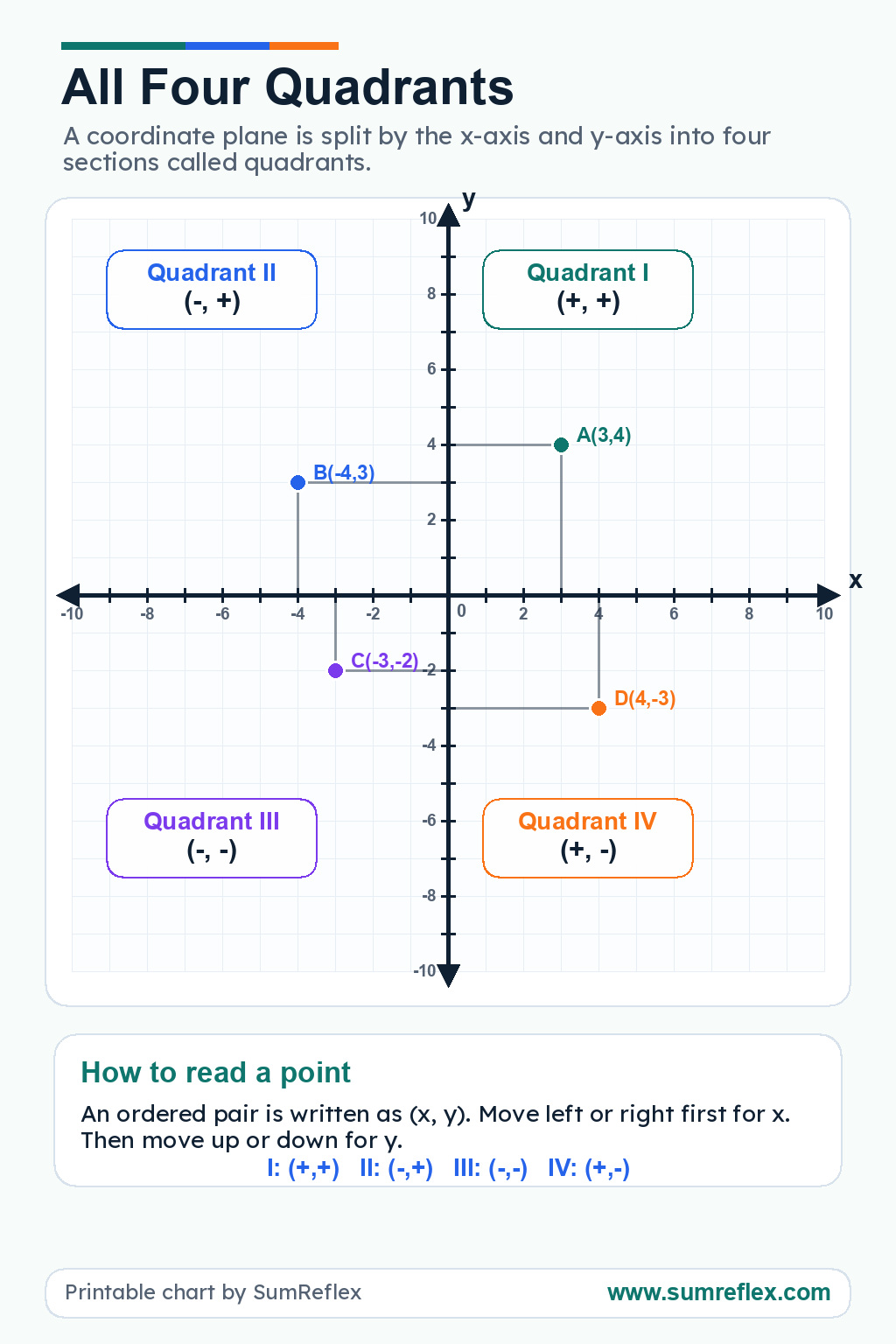
Use this chart as a quick reference for the quadrant names, sign patterns, and sample points. The chart shows a real coordinate grid with the x-axis, y-axis, origin, four quadrants, and plotted ordered pairs.
The x-axis and y-axis
The x-axis runs left and right. Positive x-values are to the right of 0. Negative x-values are to the left of 0.
The y-axis runs up and down. Positive y-values are above 0. Negative y-values are below 0.
The place where the two axes cross is called the origin. The origin is written as (0, 0).
Quadrant names and signs
Quadrant I is the upper-right section. Points in Quadrant I have positive x and positive y values, so the signs are (+, +).
Quadrant II is the upper-left section. Points in Quadrant II have negative x and positive y values, so the signs are (-, +).
Quadrant III is the lower-left section. Points in Quadrant III have negative x and negative y values, so the signs are (-, -).
Quadrant IV is the lower-right section. Points in Quadrant IV have positive x and negative y values, so the signs are (+, -).
How to read an ordered pair
A point on a coordinate plane is usually written as an ordered pair: (x, y).
The first number tells you where to move on the x-axis. The second number tells you where to move on the y-axis.
For example, (3, 4) means move 3 spaces right from the origin, then 4 spaces up. That point is in Quadrant I.
Examples in each quadrant
(5, 2) is in Quadrant I because x is positive and y is positive.
(-6, 3) is in Quadrant II because x is negative and y is positive.
(-4, -7) is in Quadrant III because x is negative and y is negative.
(8, -1) is in Quadrant IV because x is positive and y is negative.
Points on the axes are not in a quadrant
A point is inside a quadrant only when both coordinates are not zero.
If y is 0, the point is on the x-axis. For example, (4, 0) is on the x-axis, not in Quadrant I or Quadrant IV.
If x is 0, the point is on the y-axis. For example, (0, -3) is on the y-axis, not in Quadrant III or Quadrant IV.
The point (0, 0) is the origin. It is not in any quadrant.
How to plot a point
Step 1: Start at the origin, (0, 0).
Step 2: Use the x-coordinate first. Move right for a positive x-value and left for a negative x-value.
Step 3: Use the y-coordinate second. Move up for a positive y-value and down for a negative y-value.
Step 4: Mark the point and check the quadrant by looking at the signs.
Worked example: plot (-3, 5)
Start at the origin.
The x-coordinate is -3, so move 3 spaces left.
The y-coordinate is 5, so move 5 spaces up.
The point (-3, 5) is in Quadrant II because the signs are (-, +).
Worked example: name the quadrant
Problem: Which quadrant contains the point (7, -4)?
The x-value is 7, so x is positive. The y-value is -4, so y is negative.
The sign pattern is (+, -), so the point is in Quadrant IV.
Common mistakes
Do not read the y-coordinate first. Ordered pairs are always read as (x, y).
Do not call a point on an axis a quadrant point. A point like (0, 6) is on the y-axis.
Do not mix up Quadrant II and Quadrant IV. Quadrant II is left and up. Quadrant IV is right and down.
Remember that quadrant numbers go counterclockwise: I, II, III, IV.
Quick practice
1. Which quadrant contains (2, 9)? Answer: Quadrant I.
2. Which quadrant contains (-5, 1)? Answer: Quadrant II.
3. Which quadrant contains (-8, -6)? Answer: Quadrant III.
4. Which quadrant contains (3, -7)? Answer: Quadrant IV.
5. Is (0, 4) in a quadrant? Answer: No. It is on the y-axis.