


Grade 4 geometry lesson
Intersecting Lines: Definition, Examples, Chart, and Practice
Intersecting lines are lines that cross or meet at one point. The meeting point is called the point of intersection.
What are intersecting lines?
Intersecting lines are lines that meet or cross at one point.
The point where they meet is called the point of intersection.
If two lines cross like an X, a plus sign, or two roads meeting at a corner, they are intersecting lines.
A line keeps going in both directions, so when we decide whether two lines intersect, we often imagine the lines continuing beyond the part drawn on the page.
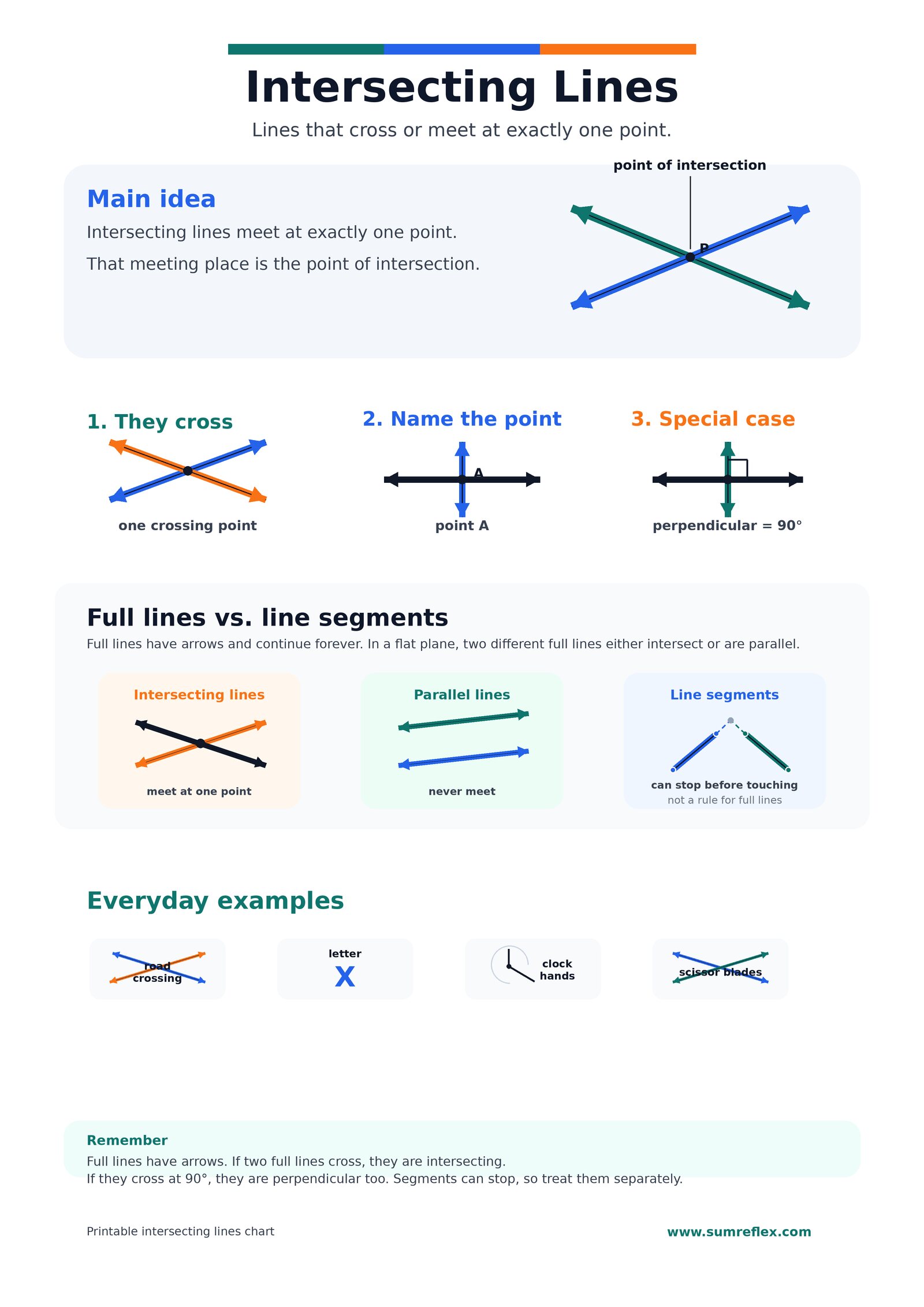
Printable intersecting lines chart
Use this SumReflex chart to remember the main rule: intersecting lines meet at exactly one point.
The same chart is also available in the Printable Geometry Charts section with print and download options.
Important words
Line: a straight path that goes on forever in both directions.
Line segment: part of a line with two endpoints.
Point of intersection: the exact point where two lines meet.
Angle: the opening made when two lines or rays meet.
Perpendicular lines: intersecting lines that meet at a right angle, or 90°.
How to identify intersecting lines
Step 1: Look for two straight lines or line segments.
Step 2: Check whether they cross or meet.
Step 3: Mark the exact meeting point. That point is the point of intersection.
Step 4: If the lines make a square corner, they are perpendicular too.
If the lines never meet and stay the same distance apart, they are parallel lines, not intersecting lines.
Intersecting lines vs. parallel lines
Intersecting lines meet at one point.
Parallel lines never meet. They go in the same direction and stay the same distance apart.
Example: the two sides of the letter X are intersecting lines. The ruled lines on notebook paper are usually parallel lines.
A quick test is to ask: Would these two lines touch if they kept going? If yes, they intersect. If no, they may be parallel.
Intersecting lines vs. perpendicular lines
All perpendicular lines are intersecting lines because they meet at one point.
But not all intersecting lines are perpendicular.
If two lines meet at 90°, they are perpendicular. If they meet at a different angle, they are intersecting but not perpendicular.
Example: a plus sign usually shows perpendicular lines. A tilted X shows intersecting lines, but the angles may not be 90°.
Line segments can be tricky
A line segment is only the part drawn between two endpoints.
Two line segments intersect only if the drawn pieces actually touch or cross.
However, the full lines that contain those segments might intersect if you extend them. That is why geometry problems sometimes say lines and sometimes say line segments.
Example: two short slanted sticks may not touch on the page, but if you imagine the full lines continuing, they might meet later.
Real-life examples of intersecting lines
Road crossing: two roads meet at one point.
Scissor blades: the two blades cross at the screw.
Clock hands: the hour hand and minute hand meet at the center of the clock.
The letter X: two slanted strokes cross.
Window grids: vertical and horizontal bars meet at points.
Map streets: streets that cross create intersections.
Graph paper: horizontal and vertical grid lines intersect at many points.
Shape corners: two sides of a triangle, square, or rectangle meet at a vertex.
Worked example 1
Problem: Two lines cross like the letter X. Are they intersecting lines?
Step 1: The two lines cross.
Step 2: They meet at one point in the middle.
Answer: Yes. They are intersecting lines.
Worked example 2
Problem: Two lines meet at a square corner. What special name can we use?
Step 1: The lines meet, so they are intersecting.
Step 2: The corner is a right angle, or 90°.
Answer: They are perpendicular lines, which are a special type of intersecting lines.
Worked example 3
Problem: Two railway tracks run side by side and do not meet. Are they intersecting?
Step 1: The tracks stay beside each other.
Step 2: They do not cross or meet.
Answer: No. They are parallel, not intersecting.
Worked example 4
Problem: The minute hand and hour hand on a clock both start at the center. Do they intersect?
Step 1: Both hands touch at the center point.
Step 2: That center is the meeting point.
Answer: Yes. The clock hands intersect at the center of the clock.
Worked example 5
Problem: Two short line segments point toward each other but do not touch. Are the segments intersecting?
Step 1: Look only at the drawn segments.
Step 2: The drawn pieces do not touch.
Answer: The segments do not intersect. The full lines might intersect if extended, but the segments shown do not.
Common mistakes
Do not call two lines intersecting just because they are close. They must meet or cross.
Do not forget to name the meeting place. It is the point of intersection.
Do not confuse parallel lines with intersecting lines. Parallel lines never meet.
Do not say every pair of intersecting lines is perpendicular. Perpendicular lines must meet at exactly 90°.
Do not ignore the word segment. Two full lines may intersect even when two short drawn segments do not touch.
Practice questions
1. What do we call the point where two lines meet?
2. Are perpendicular lines intersecting lines?
3. Are parallel lines intersecting lines?
4. Two lines cross like an X. How many points of intersection do they have?
5. A plus sign makes four square corners. What special type of intersecting lines does it show?
6. Two line segments do not touch on the page. Do the segments intersect?
7. Give one real-life example of intersecting lines.
Answers
1. The point of intersection.
2. Yes. Perpendicular lines meet at 90°.
3. No. Parallel lines never meet.
4. One point of intersection.
5. Perpendicular lines.
6. No, not if the drawn segments do not touch.
7. Possible answers include road crossings, clock hands, scissor blades, the letter X, window grids, or graph paper lines.
The big idea
Intersecting lines meet at one point.
That meeting point is the point of intersection.
If the lines meet at 90°, they are perpendicular. If they never meet, they are parallel.