


Line relationship notes
Teaching line vocabulary through the place where lines meet
Meeting at one point changes the conversation
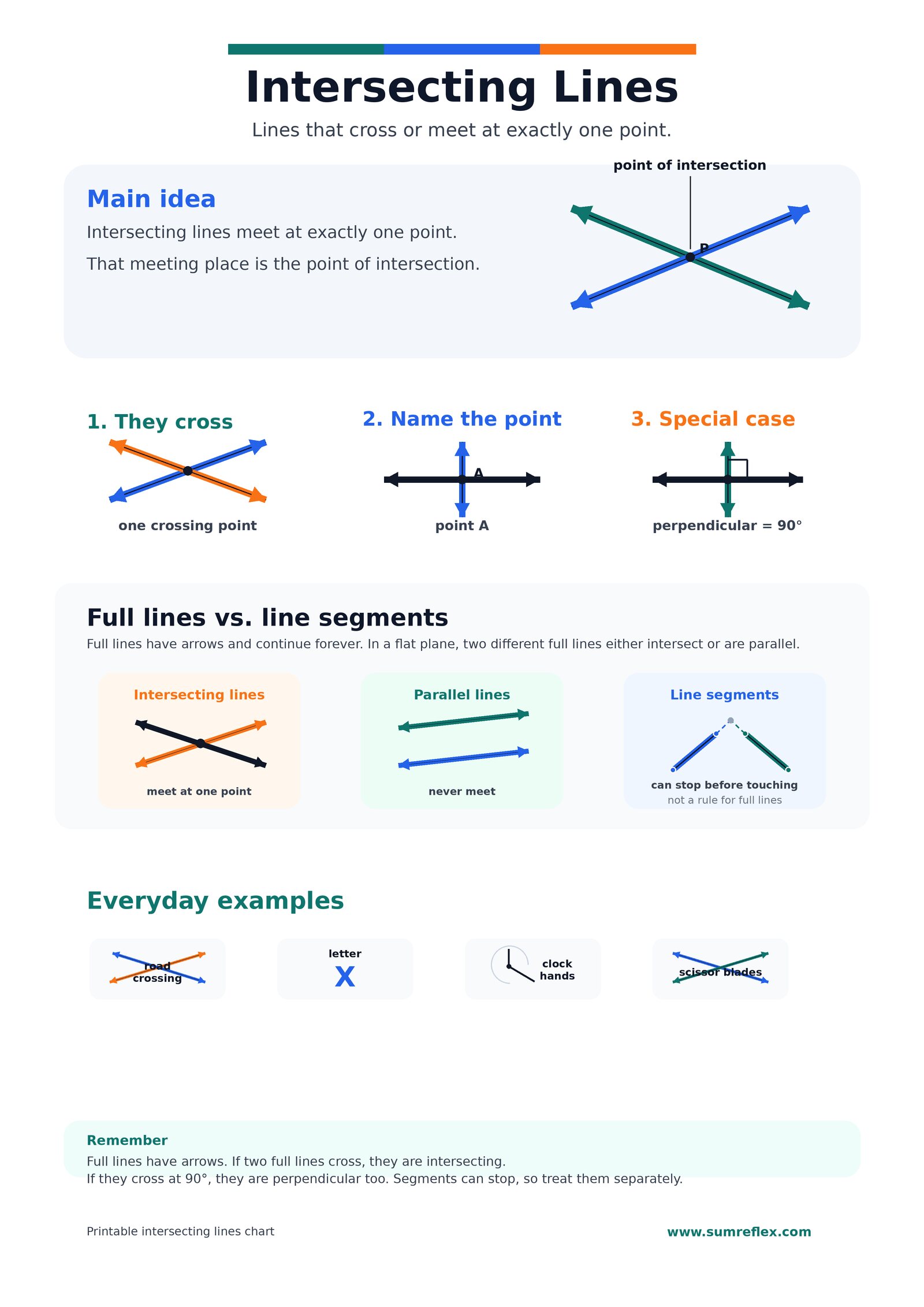
Intersecting lines are defined by a simple idea: two lines meet at a point. That point deserves attention. Students may look at a pair of crossing lines and say only that the lines "touch" or "make an X." The chart gives them the stronger phrase, point of intersection, and shows where that point belongs. Naming the point helps students move from informal noticing to geometry language.
A good first activity is to show several pairs of lines and ask students to place a dot where the lines meet. If no meeting point exists, they explain why. This small action makes the concept visible. It also helps students distinguish intersecting lines from lines that are only near each other on the page.
Perpendicular is a special case
All perpendicular lines intersect, but not all intersecting lines are perpendicular. That sentence is worth spending time on. Intersecting lines can meet at many angle sizes. Perpendicular lines meet at a right angle. The chart shows the right-angle marker so students can see the extra condition. Without that condition, they may label every pair of crossing lines as perpendicular.
Use the chart with a corner-finding activity. Students can look around the room for table edges, window panes, floor tiles, notebook corners, or graph-paper lines. They should decide whether each example shows lines crossing, lines crossing at right angles, or lines that stay parallel. Real objects make the categories easier to remember because students can see that geometry vocabulary describes familiar arrangements.
Why line segments can mislead
Students sometimes judge only the drawn part of a line segment. Two short segments may not touch on the page, but the full lines could intersect if extended. In early grades, the chart can stay with visible crossings and simple parallel examples. Later, it becomes useful to ask whether the lines themselves would meet beyond the shown segment. That question prepares students for coordinate geometry, slope, and equations of lines.
The distinction also supports graphing. When students study the all four quadrants chart, they see axes crossing at the origin. Those axes are perpendicular because they intersect at a right angle. When they later compare line slopes, the Slope Calculator can help check numerical relationships, but the visual language begins here.
Classroom questions that make the vocabulary stick
Instead of asking only "Do these lines intersect?", vary the questions. Where is the point of intersection? Are the lines perpendicular or just crossing? Would these segments meet if they were extended? Which picture is the non-example? Which word best describes the sides of this rectangle? Each question forces students to use a different part of the chart.
For independent work, have students draw three examples on one page: intersecting but not perpendicular, perpendicular, and parallel. They should label the point of intersection only where it exists. This drawing task checks understanding better than matching definitions because students must create the relationship, not merely recognize it.
That final label is important: a crossing without the named point is only half of the geometric description.