



Grade 4 fractions lesson with signed-number extensions
How to Multiply Fractions: Every Method Explained
Multiply proper fractions, improper fractions, mixed numbers, whole numbers, and signed fractions with clear methods and solved examples.
What multiplying fractions means
In a fraction multiplication question, the word of often means multiply. For example, \(\frac{1}{2}\) of \(\frac{3}{4}\) means \(\frac{1}{2}\times\frac{3}{4}\).
Unlike addition and subtraction, the denominators do not need to match. Multiply the numerators to count the chosen small parts, and multiply the denominators to find the total number of equal small parts.
Positive fractions form the main Grade 4 lesson. Negative examples are marked as signed-number extensions because they are usually taught later.
See multiplication with an area model
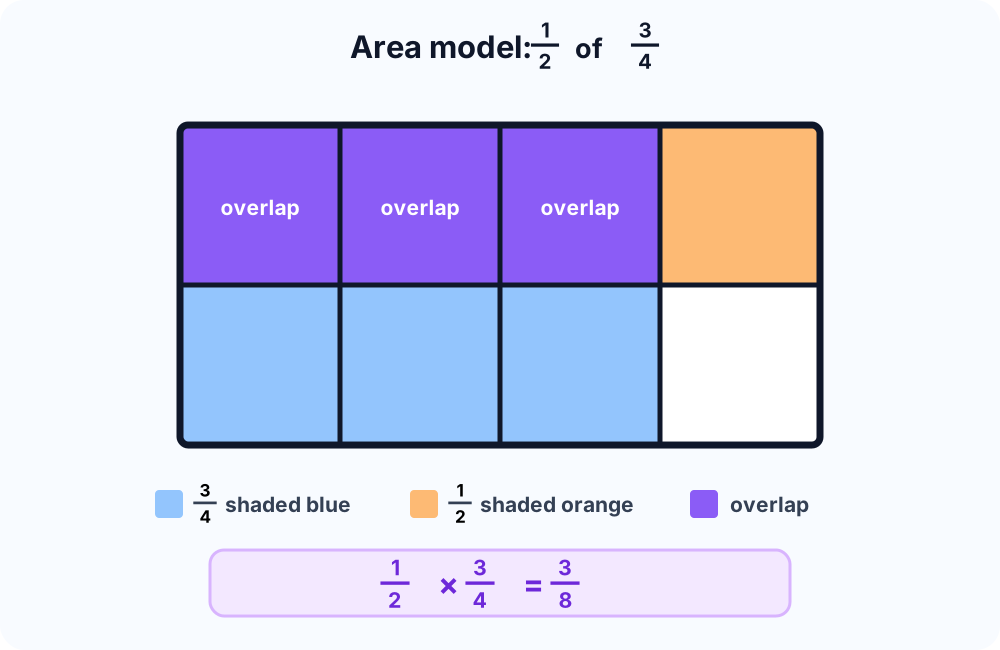
Draw a rectangle and split it into \(4\) equal columns. Shade \(3\) columns to show \(\frac{3}{4}\). Next, split the same rectangle into \(2\) equal rows and mark \(\frac{1}{2}\) of the shaded part.
The rectangle now has \(2\times4=8\) equal small parts. The two shadings overlap in \(3\) parts, so \(\frac{1}{2}\times\frac{3}{4}=\frac{3}{8}\).
This model explains the straight-across rule: \(1\times3=3\) selected parts and \(2\times4=8\) total parts.
Method 1: multiply straight across
Multiply numerator by numerator. Then multiply denominator by denominator. Simplify the result if possible.
Solved example: \(\frac{2}{3}\times\frac{4}{5}\)
- 1. Multiply numerators: \(2\times4=8\).
- 2. Multiply denominators: \(3\times5=15\).
- 3. Write the product: \(\frac{2}{3}\times\frac{4}{5}=\frac{8}{15}\).
- 4. Check simplest form: the GCF of \(8\) and \(15\) is \(1\), so \(\frac{8}{15}\) is final.
Method 2: simplify after multiplying
The straight-across result may not be in simplest form. Divide its numerator and denominator by their greatest common factor.
Solved example: \(\frac{3}{4}\times\frac{2}{9}\)
- 1. Multiply: \(\frac{3\times2}{4\times9}=\frac{6}{36}\).
- 2. Find the GCF: the GCF of \(6\) and \(36\) is \(6\).
- 3. Simplify: \(\frac{6\div6}{36\div6}=\frac{1}{6}\).
- 4. Answer: \(\frac{3}{4}\times\frac{2}{9}=\frac{1}{6}\).
Method 3: cross-cancel before multiplying
Cross-cancelling simplifies a numerator and a denominator from different fractions before multiplication. It keeps the numbers small.
Only cancel common factors between a numerator and a denominator. Never cancel two numerators, and never use cross-cancelling for addition or subtraction.
Solved example: \(\frac{8}{15}\times\frac{9}{14}\)
- 1. Cancel \(8\) with \(14\) by \(2\): they become \(4\) and \(7\).
- 2. Cancel \(9\) with \(15\) by \(3\): they become \(3\) and \(5\).
- 3. Multiply the smaller numbers: \(\frac{4}{5}\times\frac{3}{7}=\frac{12}{35}\).
- 4. Check: the GCF of \(12\) and \(35\) is \(1\).
Multiplying improper fractions
Improper fractions use exactly the same multiplication rule. Multiply or cross-cancel, simplify, and convert the final answer to a mixed number only if requested.
Solved example: \(\frac{7}{3}\times\frac{6}{5}\)
- 1. Cross-cancel \(6\) with \(3\) by \(3\): \(6\) becomes \(2\), and \(3\) becomes \(1\).
- 2. Multiply: \(\frac{7\times2}{1\times5}=\frac{14}{5}\).
- 3. Convert if needed: \(14\div5=2\) remainder \(4\), so \(\frac{14}{5}=2\frac{4}{5}\).
Multiplying mixed numbers
Convert every mixed number to an improper fraction before multiplying. Do not multiply the whole-number parts and fraction parts separately.
Review Converting Improper Fractions and Mixed Numbers if that first step is unfamiliar.
Solved example: \(2\frac{1}{3}\times1\frac{1}{2}\)
- 1. Convert: \(2\frac{1}{3}=\frac{7}{3}\) and \(1\frac{1}{2}=\frac{3}{2}\).
- 2. Cross-cancel the two \(3\)s: each becomes \(1\).
- 3. Multiply: \(\frac{7}{1}\times\frac{1}{2}=\frac{7}{2}\).
- 4. Convert: \(\frac{7}{2}=3\frac{1}{2}\).
Multiplying a fraction by a whole number
Write the whole number over \(1\), then multiply normally.
Solved example: \(6\times\frac{5}{8}\)
- 1. Write \(6\) as a fraction: \(6=\frac{6}{1}\).
- 2. Cross-cancel \(6\) with \(8\) by \(2\): they become \(3\) and \(4\).
- 3. Multiply: \(\frac{3}{1}\times\frac{5}{4}=\frac{15}{4}\).
- 4. Convert if needed: \(\frac{15}{4}=3\frac{3}{4}\).
Zero, one, and unit fractions
Multiply by zero: any fraction times \(0\) is \(0\). For example, \(\frac{7}{9}\times0=0\).
Multiply by one: a number stays the same. For example, \(\frac{5}{8}\times1=\frac{5}{8}\).
Multiply by a unit fraction: \(\frac{1}{n}\) means one of \(n\) equal groups. For example, \(\frac{1}{3}\times\frac{3}{5}=\frac{3}{15}=\frac{1}{5}\).
When both positive factors are less than \(1\), the product is smaller than either factor. This is a useful reasonableness check.
Multiplying three or more fractions
Place all factors in one multiplication chain. Cross-cancel any numerator with any denominator, then multiply what remains.
Solved example: \(\frac{2}{3}\times\frac{9}{10}\times\frac{5}{4}\)
- 1. Cancel \(2\) with \(10\) by \(2\): they become \(1\) and \(5\).
- 2. Cancel \(9\) with \(3\) by \(3\): they become \(3\) and \(1\).
- 3. Cancel the remaining \(5\)s: both become \(1\).
- 4. Multiply: \(\frac{1\times3\times1}{1\times1\times4}=\frac{3}{4}\).
Signed-number extension: multiplying negative fractions
First decide the sign, then multiply the absolute values. Factors with the same sign give a positive product. Factors with different signs give a negative product.
One negative factor: \(-\frac{3}{5}\times\frac{10}{9}=-\frac{30}{45}=-\frac{2}{3}\).
Two negative factors: \(-\frac{4}{7}\times-\frac{21}{8}=\frac{84}{56}=\frac{3}{2}=1\frac{1}{2}\).
Negative mixed number: \(-1\frac{1}{2}\times\frac{2}{5}=-\frac{3}{2}\times\frac{2}{5}=-\frac{3}{5}\).
Which multiplication method should you choose?
| Situation | Usually clearest method |
|---|---|
| Small fractions already simplified | multiply straight across |
| Many common factors | cross-cancel first |
| A mixed number appears | convert it to an improper fraction |
| A whole number appears | write it over \(1\) |
| Three or more factors | cross-cancel across the whole chain |
| Need to understand why | draw an area model |
Common multiplication mistakes
- Finding an LCD: multiplication does not require matching denominators.
- Multiplying mixed numbers as separate parts: convert them to improper fractions first.
- Cross-cancelling across addition: cancellation works only among multiplied factors.
- Cancelling two numerators: cancel only a numerator with a denominator.
- Forgetting simplest form: simplify before or after multiplying.
- Forgetting sign rules: one negative factor gives a negative product; two give a positive product.
Multiplication checklist and related lessons
Review Simplifying Fractions, compare multiplication with Adding Fractions and Subtracting Fractions, or use the Fraction Operations overview. A completed calculation can be checked with the Fraction Calculator.
- 1. Convert mixed numbers to improper fractions and whole numbers to fractions over \(1\).
- 2. Decide the sign if negative numbers appear.
- 3. Cross-cancel common factors when helpful.
- 4. Multiply numerators and multiply denominators.
- 5. Simplify and convert the final answer form if requested.