


Grade 4 fractions lesson with signed-number extensions
How to Subtract Fractions: Every Method Explained
Subtract proper fractions, improper fractions, mixed numbers, and signed fractions with common denominators, regrouping, and solved examples.
What subtraction of fractions means
Subtracting fractions can mean taking part of an amount away or finding the difference between two amounts.
The pieces must have the same size before their numerators can be subtracted. That means the denominators must match.
Positive-fraction methods form the main Grade 4 lesson. Negative-fraction examples are marked as signed-number extensions.
Review Adding Fractions for common-denominator methods or Simplifying Fractions for reducing final answers.
Method 1: subtract fractions with the same denominator
When denominators already match, subtract the numerators and keep the denominator.
Solved example: \(\frac{6}{9}-\frac{2}{9}\)
- 1. Check: both fractions count ninths.
- 2. Subtract numerators: \(6-2=4\).
- 3. Keep denominator \(9\): \(\frac{6}{9}-\frac{2}{9}=\frac{4}{9}\).
- 4. Simplify: the GCF of \(4\) and \(9\) is \(1\), so \(\frac{4}{9}\) is final.
Method 2: use a take-away model
Draw or imagine a fraction bar divided into equal pieces. Shade the starting fraction, then remove the number of pieces named by the second fraction.
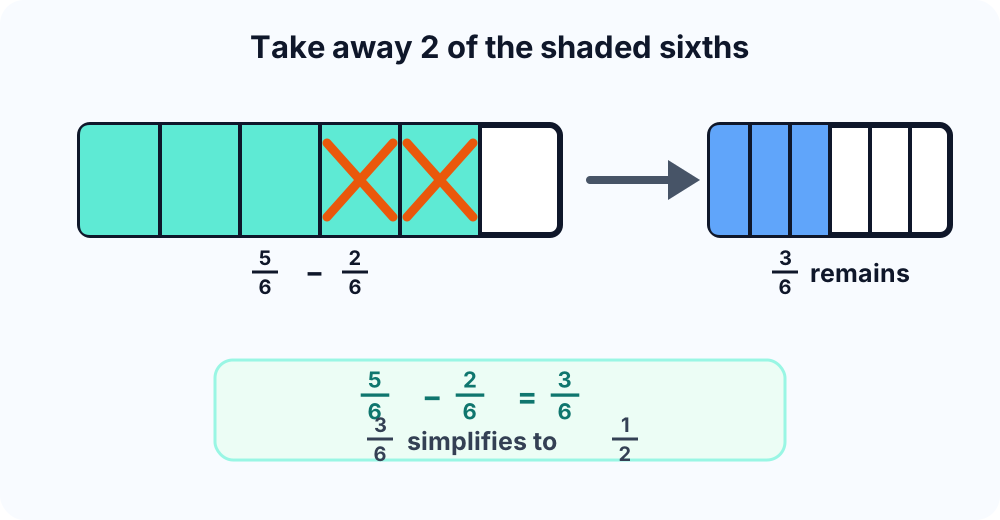
Solved example: \(\frac{5}{6}-\frac{2}{6}\)
- 1. Shade five sixths.
- 2. Remove two shaded sixths.
- 3. Count what remains: \(\frac{3}{6}\).
- 4. Simplify: \(\frac{3}{6}=\frac{1}{2}\).
Method 3: use a comparison model
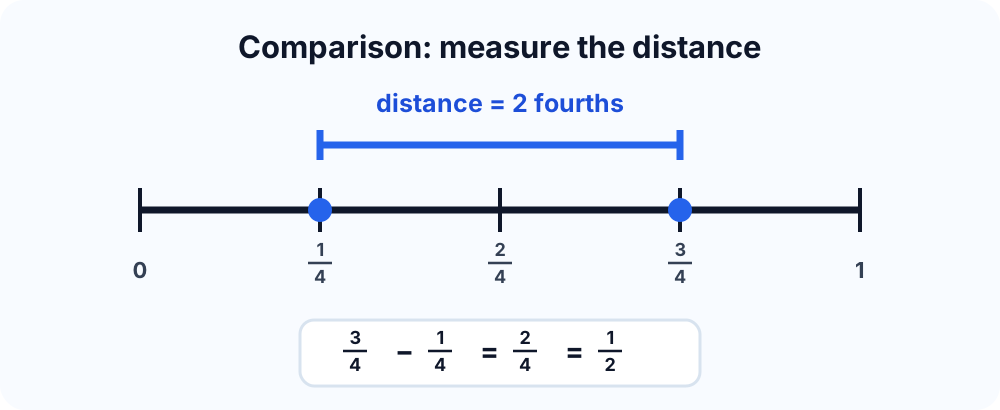
Subtraction can find the distance between two fractions. The distance from \(\frac{1}{4}\) to \(\frac{3}{4}\) is two fourth-size steps, so \(\frac{3}{4}-\frac{1}{4}=\frac{2}{4}=\frac{1}{2}\).
The comparison model shows the difference as a distance between two values.
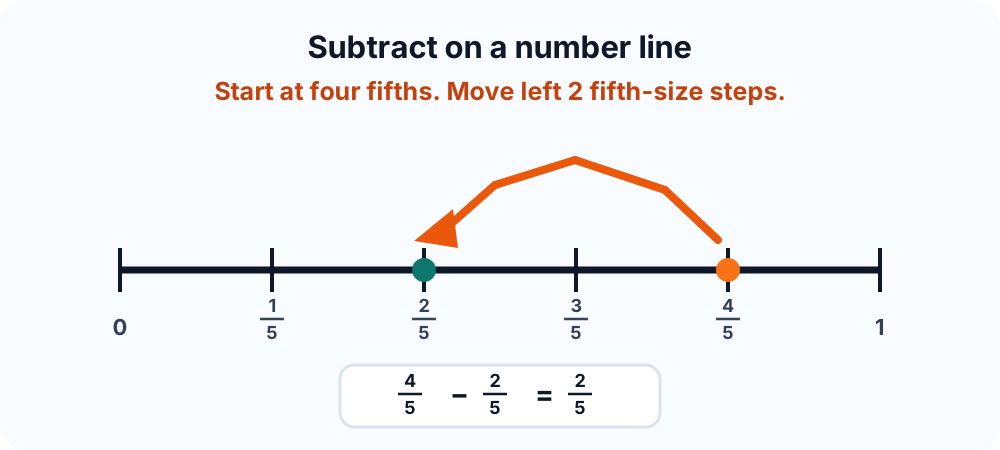
Method 4: subtract on a number line
Start at \(\frac{4}{5}\). Move left \(2\) fifth-size steps and land at \(\frac{2}{5}\), so \(\frac{4}{5}-\frac{2}{5}=\frac{2}{5}\).
Before subtracting: make the pieces the same size
You cannot directly subtract sixths and fourths because the pieces have different sizes. First give both fractions a common denominator.
Ask what multiplier changes the old denominator into the common denominator. Multiply the numerator by that same multiplier.
For example, if sixths must become twelfths, \(6\times2=12\). The numerator must also be multiplied by \(2\): \(\frac{5}{6}=\frac{5\times2}{6\times2}=\frac{10}{12}\). The amount stays the same; only its fraction name changes.
Never change only the denominator. That would change the size and value of the fraction.
Unlike denominators, method 1: list multiples to find the LCD
List multiples of both denominators. The first shared multiple is the least common denominator.
Solved example: \(\frac{5}{6}-\frac{1}{4}\)
- 1. List multiples of \(6\): \(6,\mathbf{12},18,\ldots\).
- 2. List multiples of \(4\): \(4,8,\mathbf{12},\ldots\). The first shared multiple is \(12\), so the LCD is \(12\).
- 3. Change \(\frac{5}{6}\) into twelfths: \(6\times2=12\), so \(5\times2=10\). Therefore, \(\frac{5}{6}=\frac{5\times2}{6\times2}=\frac{10}{12}\).
- 4. Change \(\frac{1}{4}\) into twelfths: \(4\times3=12\), so \(1\times3=3\). Therefore, \(\frac{1}{4}=\frac{1\times3}{4\times3}=\frac{3}{12}\).
- 5. Subtract equal-sized pieces: \(\frac{10}{12}-\frac{3}{12}=\frac{7}{12}\).
- 6. Check: \(7\) and \(12\) have no common factor greater than \(1\), so \(\frac{7}{12}\) is already simplified.
Unlike denominators, method 2: use an LCM ladder
The LCM ladder, also called the repeated-division method, finds the least common multiple using prime dividers.
Divide by a prime that divides at least one number. When a number cannot divide exactly, bring it down unchanged. Continue until both numbers are \(1\), then multiply the prime dividers on the left.
Fraction question: Subtract \(\frac{11}{18}-\frac{5}{24}\). The denominators are \(18\) and \(24\), so the first task is to use the ladder below to find their LCM.
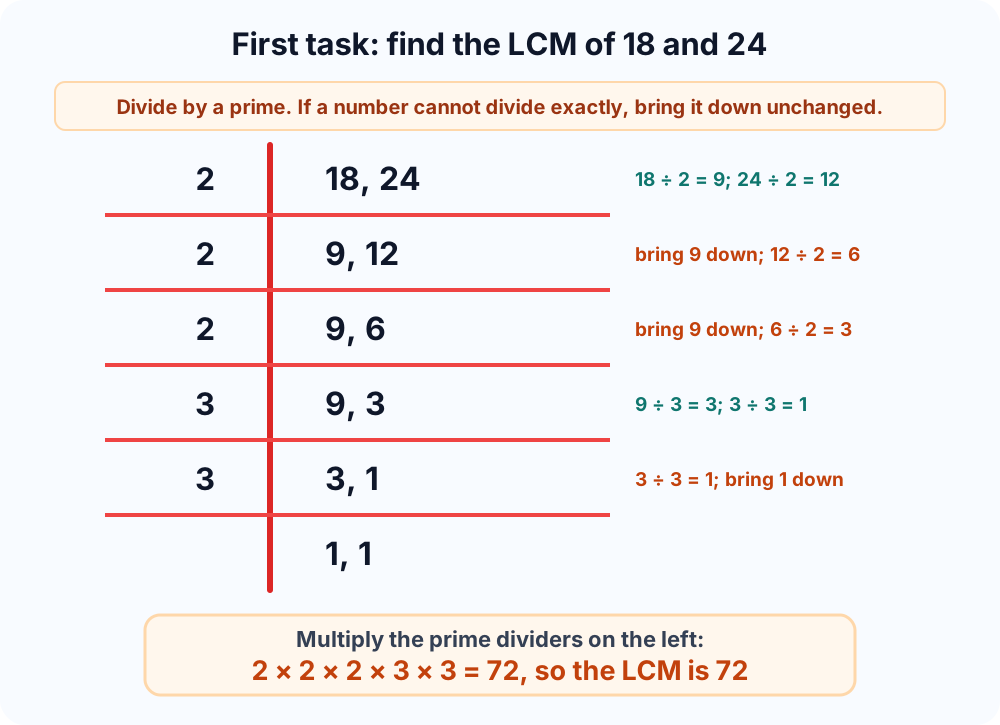
After the ladder gives \(72\), finish \(\frac{11}{18}-\frac{5}{24}\)
- 1. Find the multiplier for \(\frac{11}{18}\): divide the new denominator by the old denominator. \(72\div18=4\).
- 2. Use that multiplier on the numerator: \(11\times4=44\). Therefore, \(\frac{11}{18}=\frac{11\times4}{18\times4}=\frac{44}{72}\).
- 3. Find the multiplier for \(\frac{5}{24}\): \(72\div24=3\).
- 4. Use that multiplier on the numerator: \(5\times3=15\). Therefore, \(\frac{5}{24}=\frac{5\times3}{24\times3}=\frac{15}{72}\).
- 5. Subtract the numerators over the shared denominator: \(\frac{44}{72}-\frac{15}{72}=\frac{44-15}{72}=\frac{29}{72}\).
- 6. Check: \(29\) and \(72\) have no common factor greater than \(1\), so \(\frac{29}{72}\) is in simplest form.
Unlike denominators, method 3: product denominator
Multiplying the denominators always produces a common denominator. Each fraction is then converted to that denominator by multiplying its top and bottom by the other fraction’s denominator.
For \(\frac{a}{b}-\frac{c}{d}\), calculate \(\frac{ad-bc}{bd}\). The cross-products \(ad\) and \(bc\) are the numerators of the equivalent fractions.
This cross-multiplication or butterfly method is fast but can create a denominator larger than the LCD.
Solved example: \(\frac{3}{4}-\frac{1}{6}\)
- 1. Make the product denominator: \(4\times6=24\).
- 2. Convert \(\frac{3}{4}\) into twenty-fourths: multiply its top and bottom by \(6\). \(\frac{3}{4}=\frac{3\times6}{4\times6}=\frac{18}{24}\).
- 3. Convert \(\frac{1}{6}\) into twenty-fourths: multiply its top and bottom by \(4\). \(\frac{1}{6}=\frac{1\times4}{6\times4}=\frac{4}{24}\).
- 4. Subtract: \(\frac{18}{24}-\frac{4}{24}=\frac{14}{24}\).
- 5. Simplify: divide the numerator and denominator by \(2\): \(\frac{14}{24}=\frac{7}{12}\).
When one denominator is a multiple of the other
Use the larger denominator when it is already a multiple of the smaller denominator.
Solved example: \(\frac{7}{8}-\frac{1}{4}\)
- 1. Use denominator \(8\).
- 2. Change only \(\frac{1}{4}\) into eighths: \(4\times2=8\), so \(1\times2=2\). Therefore, \(\frac{1}{4}=\frac{2}{8}\).
- 3. Subtract: \(\frac{7}{8}-\frac{2}{8}=\frac{5}{8}\).
Subtracting mixed numbers without regrouping
If the first fraction part is at least as large as the fraction part being subtracted, subtract whole parts and fraction parts separately.
Solved example: \(6\frac{5}{8}-2\frac{1}{8}\)
- 1. Subtract wholes: \(6-2=4\).
- 2. Subtract fractions: \(\frac{5}{8}-\frac{1}{8}=\frac{4}{8}\).
- 3. Combine: \(4\frac{4}{8}\).
- 4. Simplify: \(4\frac{4}{8}=4\frac{1}{2}\).
Subtracting mixed numbers by regrouping one whole
Regroup when the first fraction part is smaller. Take \(1\) from the whole number and rewrite it using the fraction denominator.
Solved example: \(5\frac{1}{4}-2\frac{3}{4}\)
- 1. Notice: \(\frac{1}{4}\) is smaller than \(\frac{3}{4}\).
- 2. Regroup: take \(1\) from \(5\), leaving \(4\). Rewrite the borrowed whole as \(\frac{4}{4}\).
- 3. Join fraction parts: \(\frac{4}{4}+\frac{1}{4}=\frac{5}{4}\), so \(5\frac{1}{4}=4\frac{5}{4}\).
- 4. Subtract: \(4\frac{5}{4}-2\frac{3}{4}=2\frac{2}{4}\).
- 5. Simplify: \(2\frac{2}{4}=2\frac{1}{2}\).
Subtracting mixed numbers by converting to improper fractions
Conversion is the dependable general method, especially when the denominators differ.
Solved example: \(4\frac{1}{2}-2\frac{3}{4}\)
- 1. Convert: \(4\frac{1}{2}=\frac{9}{2}\) and \(2\frac{3}{4}=\frac{11}{4}\).
- 2. Change halves into fourths: \(2\times2=4\), so \(9\times2=18\). Therefore, \(\frac{9}{2}=\frac{18}{4}\).
- 3. Subtract: \(\frac{18}{4}-\frac{11}{4}=\frac{7}{4}\).
- 4. Convert back: \(\frac{7}{4}=1\frac{3}{4}\).
Subtracting an improper fraction
Improper fractions use the same common-denominator rules. You may keep the result improper or convert it to a mixed number when requested.
Solved example: \(\frac{13}{6}-\frac{3}{4}\)
- 1. Find LCD \(12\): it is the first shared multiple of \(6\) and \(4\).
- 2. Change sixths into twelfths: \(6\times2=12\), so \(13\times2=26\). Thus, \(\frac{13}{6}=\frac{26}{12}\).
- 3. Change fourths into twelfths: \(4\times3=12\), so \(3\times3=9\). Thus, \(\frac{3}{4}=\frac{9}{12}\).
- 4. Subtract: \(\frac{26}{12}-\frac{9}{12}=\frac{17}{12}\).
- 5. Convert if needed: \(\frac{17}{12}=1\frac{5}{12}\).
Signed-number extension: subtracting negative fractions
Subtracting a number means adding its opposite. Change subtraction to addition, change the sign of the second fraction, and use the addition rules.
Positive minus negative: \(\frac{3}{4}-\left(-\frac{1}{2}\right)=\frac{3}{4}+\frac{1}{2}=\frac{5}{4}=1\frac{1}{4}\).
Negative minus positive: \(-\frac{2}{3}-\frac{1}{6}=-\frac{4}{6}-\frac{1}{6}=-\frac{5}{6}\).
Negative minus negative: \(-\frac{1}{4}-\left(-\frac{3}{8}\right)=-\frac{1}{4}+\frac{3}{8}=-\frac{2}{8}+\frac{3}{8}=\frac{1}{8}\).
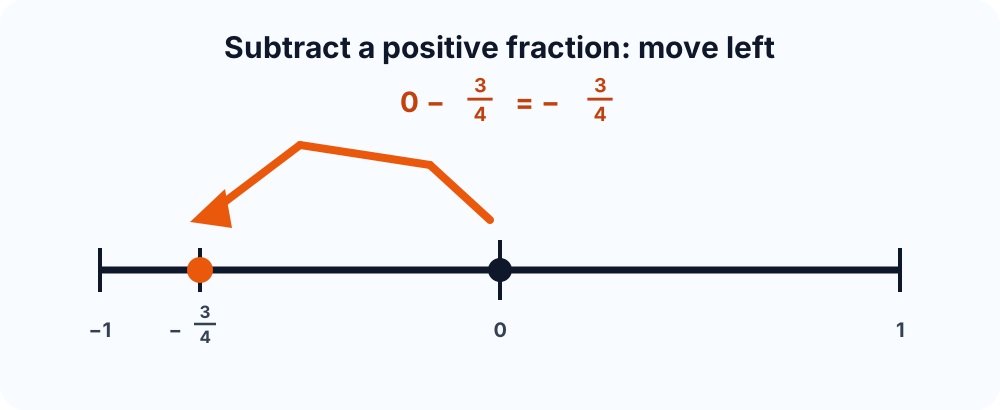
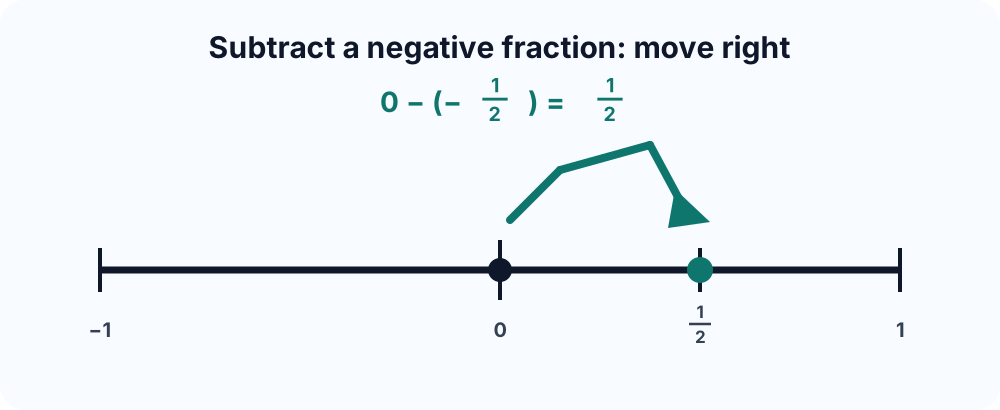
On a number line, subtracting a positive fraction moves left, while subtracting a negative fraction moves right.
Number-line example: subtract a positive fraction
Start at \(0\). Subtracting \(+\frac{3}{4}\) means moving left to \(-\frac{3}{4}\).
Number-line example: subtract a negative fraction
Start at \(0\). Subtracting \(-\frac{1}{2}\) means moving right to \(\frac{1}{2}\).
Which subtraction method should you choose?
| Situation | Usually clearest method |
|---|---|
| Like denominators | subtract numerators and keep denominator |
| Small unlike denominators | list multiples for the LCD |
| Larger unlike denominators | LCM using prime factors |
| Need a universal shortcut | product-denominator or butterfly method |
| One denominator divides the other | use the larger denominator |
| Mixed number with large enough top fraction | subtract parts separately |
| Mixed number with smaller top fraction | regroup one whole |
| Complicated mixed numbers | convert to improper fractions |
| Need visual understanding | take-away model, comparison model, or number line |
Common subtraction mistakes
- Subtracting denominators: with like denominators, keep the denominator.
- Using unlike pieces: first make equivalent fractions with a common denominator, using the same multiplier on each numerator and denominator.
- Subtracting in the wrong order: subtraction is not commutative; \(\frac{3}{4}-\frac{1}{4}\ne\frac{1}{4}-\frac{3}{4}\).
- Forgetting to regroup: borrow one whole when the first mixed-number fraction part is smaller.
- Cross-cancelling: cross-cancellation is not a subtraction method.
- Misreading two negative signs: subtracting a negative becomes addition.
- Stopping early: simplify and convert the final form if required.
Subtraction checklist and next lesson
Continue with Multiplying Fractions, compare all operations in the Fraction Operations overview, or check a completed result with the Fraction Calculator.
- 1. Check whether denominators match.
- 2. If needed, find the LCD and make equivalent fractions using the same multiplier on the top and bottom.
- 3. Regroup mixed numbers when the first fraction part is too small.
- 4. Subtract numerators and keep the common denominator.
- 5. Apply signed-number rules, simplify, and finish the required form.