

Grade 4 fractions lesson
Converting Improper Fractions and Mixed Numbers
Convert in both directions: divide an improper fraction to make a mixed number, or multiply and add to make an improper fraction.
Use the correct mathematical names
The academic term for a fraction such as \(\frac{7}{4}\) is an improper fraction. Its numerator is greater than or equal to its denominator.
The academic term for a number such as \(1\frac{3}{4}\) is a mixed number. It contains a whole number and a proper fraction.
People sometimes say “mixed fraction” or “normal fraction,” but mixed number and improper fraction are the clearer mathematical terms.
This lesson focuses only on converting between these two forms. Review Types of Fractions if you want to compare the other fraction classifications first.
The same amount written in two forms
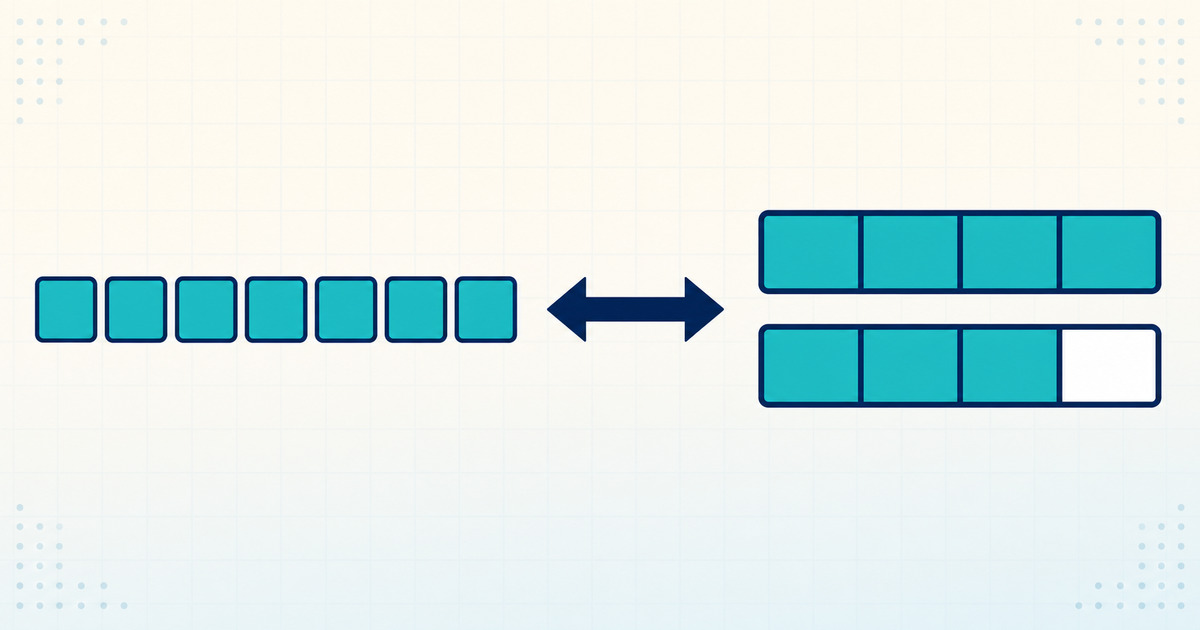
The picture shows seven one-fourth pieces on the left. On the right, four fourths have been grouped into one complete whole, with three fourths remaining.
Nothing has been added or removed. Only the way the same amount is written has changed.
Worked visual example: seven fourths
Start with the improper fraction \(\frac{7}{4}\). The denominator \(4\) tells us that four equal parts make one whole.
Make one complete group of \(4\) parts. That uses \(4\) of the \(7\) fourths and leaves \(3\) fourths.
\[\frac{7}{4}=1\frac{3}{4}\]
Reading in the opposite direction, one whole contains \(4\) fourths. Add the \(3\) extra fourths to get \(7\) fourths, so \(1\frac{3}{4}=\frac{7}{4}\).
The two conversion rules
| Starting form | Main calculation | How to write the answer |
|---|---|---|
| Improper fraction | Divide numerator by denominator | Quotient = whole number, remainder = new numerator, original denominator stays |
| Mixed number | Whole number × denominator + numerator | Result = new numerator, original denominator stays |
Improper fraction to mixed number: divide
Divide the numerator by the denominator. The quotient tells how many complete wholes there are. The remainder tells how many fractional parts are left.
Write the quotient as the whole number. Write the remainder as the new numerator. Keep the original denominator.
Solved example: Convert \(\frac{11}{4}\) to a mixed number.
\[11\div4=2\text{ remainder }3\]
The quotient is \(2\), the remainder is \(3\), and the denominator stays \(4\). Therefore:
\[\frac{11}{4}=2\frac{3}{4}\]
More improper-fraction conversions
Example 1: Convert \(\frac{17}{5}\). Since \(17\div5=3\) remainder \(2\), \(\frac{17}{5}=3\frac{2}{5}\).
Example 2: Convert \(\frac{23}{6}\). Since \(23\div6=3\) remainder \(5\), \(\frac{23}{6}=3\frac{5}{6}\).
Example 3: Convert \(\frac{29}{8}\). Since \(29\div8=3\) remainder \(5\), \(\frac{29}{8}=3\frac{5}{8}\).
In each example, the remainder is smaller than the denominator. That makes the fraction part proper.
When an improper fraction becomes a whole number
If the division has remainder \(0\), the improper fraction equals a whole number. Do not write a fraction part with numerator \(0\).
Solved example: Convert \(\frac{18}{6}\).
\[18\div6=3\text{ remainder }0\]
Therefore, \(\frac{18}{6}=3\), not \(3\frac{0}{6}\).
Another example: \(\frac{24}{8}=3\) because \(24\div8=3\) exactly.
Example: convert fourteen fourths and simplify
This example has two separate jobs. First convert the improper fraction into a mixed number. Then simplify only its fraction part.
The Simplifying Fractions lesson explains common factors and the GCF in detail.
Follow these five steps
- 1. Make complete groups: Four fourths make one whole. The number \(14\) contains three complete groups of \(4\), because \(4\times3=12\).
- 2. Find what is left: \(14-12=2\), so there are \(2\) fourths left after making the three wholes.
- 3. Write the mixed number: The quotient \(3\) is the whole number, the remainder \(2\) is the new numerator, and the denominator stays \(4\). Therefore, \(\frac{14}{4}=3\frac{2}{4}\).
- 4. Simplify only the fraction part: Both \(2\) and \(4\) divide by \(2\), so \(\frac{2}{4}=\frac{1}{2}\). The whole number \(3\) does not change.
- 5. Write the final answer: \(\frac{14}{4}=3\frac{1}{2}\).
Mixed number to improper fraction: multiply and add
Multiply the whole number by the denominator. This counts all the equal parts inside the complete wholes.
Add the original numerator to include the extra fractional parts. Put this total over the original denominator.
Solved example: Convert \(2\frac{3}{5}\) to an improper fraction.
\[(2\times5)+3=10+3=13\]
Keep denominator \(5\), so:
\[2\frac{3}{5}=\frac{13}{5}\]
This calculation multiplies a whole number by a denominator; it is not multiplication of two fractions.
More mixed-number conversions
Example 1: Convert \(4\frac{1}{3}\). Calculate \((4\times3)+1=13\), so \(4\frac{1}{3}=\frac{13}{3}\).
Example 2: Convert \(6\frac{5}{8}\). Calculate \((6\times8)+5=53\), so \(6\frac{5}{8}=\frac{53}{8}\).
Example 3: Convert \(3\frac{7}{10}\). Calculate \((3\times10)+7=37\), so \(3\frac{7}{10}=\frac{37}{10}\).
The denominator never changes because the equal parts keep the same size.
Why multiply the whole number by the denominator?
The denominator tells how many equal parts make one whole. If the denominator is \(5\), each whole contains \(5\) fifths.
In \(2\frac{3}{5}\), the two wholes contain \(2\times5=10\) fifths. The fraction part contributes \(3\) more fifths. Altogether there are \(13\) fifths.
That is why \(2\frac{3}{5}=\frac{13}{5}\). The rule is a quick way to count all the same-sized parts.
Check an answer by converting back
Conversion works in both directions, so reversing the process is a reliable check.
Check \(\frac{17}{5}=3\frac{2}{5}\): Convert the mixed number back. \((3\times5)+2=17\), and the denominator remains \(5\). The result is \(\frac{17}{5}\), matching the starting fraction.
Check \(4\frac{1}{3}=\frac{13}{3}\): Divide \(13\div3\). The quotient is \(4\) and the remainder is \(1\), giving \(4\frac{1}{3}\), matching the starting mixed number.
Solved conversion reference
| Starting number | Calculation | Converted form |
|---|---|---|
| \(\frac{7}{4}\) | \(7\div4=1\text{ R }3\) | \(1\frac{3}{4}\) |
| \(\frac{11}{4}\) | \(11\div4=2\text{ R }3\) | \(2\frac{3}{4}\) |
| \(\frac{18}{6}\) | \(18\div6=3\text{ R }0\) | \(3\) |
| \(\frac{14}{4}\) | \(14\div4=3\text{ R }2\) | \(3\frac{1}{2}\) after simplifying |
| \(2\frac{3}{5}\) | \((2\times5)+3=13\) | \(\frac{13}{5}\) |
| \(4\frac{1}{3}\) | \((4\times3)+1=13\) | \(\frac{13}{3}\) |
| \(6\frac{5}{8}\) | \((6\times8)+5=53\) | \(\frac{53}{8}\) |
Common conversion mistakes
- Dividing in the wrong order: for \(\frac{11}{4}\), calculate \(11\div4\), not \(4\div11\).
- Changing the denominator: the denominator stays the same in both conversion directions.
- Using the quotient as the new numerator: the quotient is the whole number; the remainder is the new numerator.
- Forgetting the original numerator: when converting \(2\frac{3}{5}\), calculate \((2\times5)+3\), not only \(2\times5\).
- Writing a zero fraction part: write \(\frac{18}{6}=3\), not \(3\frac{0}{6}\).
- Leaving a reducible fraction part: write \(\frac{14}{4}=3\frac{1}{2}\), not \(3\frac{2}{4}\), when simplest form is expected.
The conversion map to remember
Improper fraction to mixed number: divide the numerator by the denominator. Quotient becomes the whole number, remainder becomes the numerator, and the denominator stays.
Mixed number to improper fraction: multiply the whole number by the denominator, add the numerator, and keep the denominator.
For broader visual models and number-line explanations, continue with Improper Fractions. Mixed-number conversion is then used in the detailed lessons for addition, subtraction, and multiplication.
Use the Fraction Calculator only after completing the conversion by hand if you want to confirm the result.