
Rectangle perimeter notes
Building rectangle perimeter from the outside edge inward
Perimeter begins with a walk around the edge
The simplest way to introduce rectangle perimeter is to imagine walking around the border of the shape. Students start at one corner, travel along the length, turn along the width, continue across the opposite length, and finish along the opposite width. The total distance traveled is the perimeter. This physical picture is important because it keeps perimeter tied to the outside edge instead of letting it blur into area.
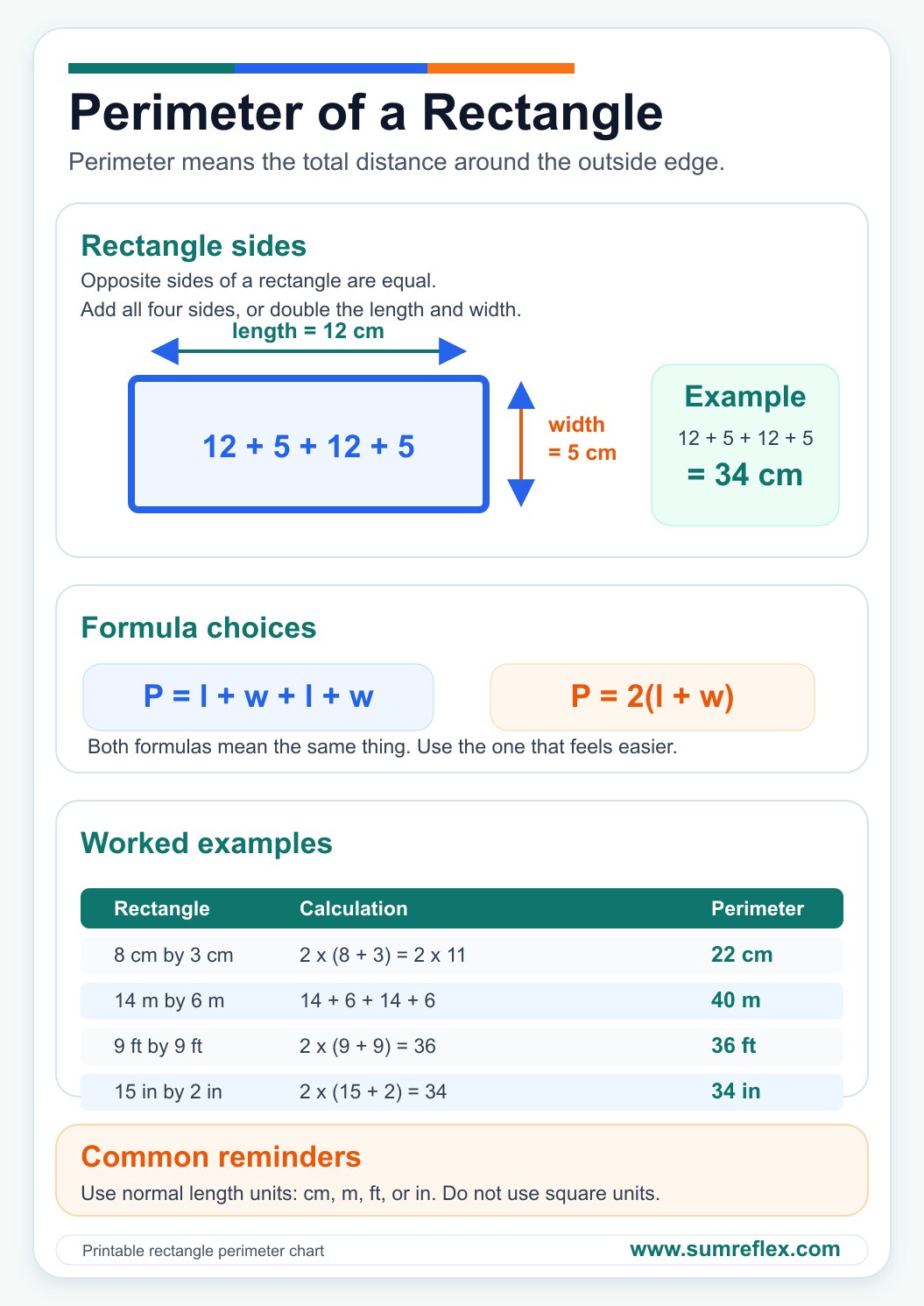
The chart labels length and width so students can see why opposite sides match. A rectangle has two lengths and two widths. That structure is the reason both perimeter formulas work. When students understand the side pattern, they are less likely to add only length plus width and stop too soon.
Two formulas, one distance
The add-all-sides formula, P = l + w + l + w, is often the best starting point because it mirrors the walk around the rectangle. Every side is named. The shorter formula, P = 2(l + w), is more compact because it groups one length and one width, then doubles the result. Both formulas describe the same perimeter, and students should be able to explain why they match.
A useful practice routine is to solve the same rectangle both ways. If the length is 12 cm and the width is 5 cm, the add-all-sides method gives 12 + 5 + 12 + 5. The doubled-sum method gives 2(12 + 5). Both lead to 34 cm. When both methods agree, students see that the formulas are equivalent rather than competing rules.
Keeping perimeter away from area
Rectangle perimeter and rectangle area use the same measurements, which is why students often mix them. Length and width appear in both topics, but they are used differently. Perimeter adds distances around the edge. Area multiplies length by width to measure the space inside. The unit labels help make the difference visible. Perimeter uses centimeters, meters, feet, inches, or another length unit. Area uses square units.
When this confusion appears, place the page beside the area and perimeter chart. Ask students to trace the border for perimeter and shade the inside for area. That movement gives each idea its own action. The formulas then become easier to remember because they are attached to different measurements.
Word problems where the chart earns its place
Rectangle perimeter appears in ordinary contexts: fencing a garden, framing a picture, trimming a bulletin board, outlining a field, or measuring the border of a rug. The chart helps students translate those stories. If the material goes around the outside, the problem is asking for perimeter. If the material covers the inside, it is asking for something else.
Encourage students to write the formula before substituting values. A word problem with a 9-foot length and a 4-foot width should become P = 2(9 + 4) or P = 9 + 4 + 9 + 4 before the arithmetic begins. This written setup makes the reasoning visible and gives teachers a place to find the mistake if the final answer is wrong.
What to practice after the printed page
After students can find perimeter from length and width, reverse the question. Give the perimeter and one side length, then ask for the missing width. This pushes them beyond direct substitution and helps them understand the relationship among the sides. For checking a completed numerical result, the Area Calculator is useful when area also enters the lesson, but rectangle perimeter itself should remain a written side-sum habit first.