


Grade 11 statistics lesson
Poisson Distribution: Formula, Chart, Examples, and Practice
A Poisson distribution models the number of times an event happens in a fixed interval when the average rate is known.
Is Poisson distribution already covered?
No dedicated Grade 11 Poisson distribution lesson existed.
The Poisson distribution belongs beside the binomial distribution because both are count models, but they answer different kinds of questions.
A binomial distribution counts successes in a fixed number of trials. A Poisson distribution counts events in a fixed interval when the average rate is known.
Poisson distribution definition
A Poisson distribution models the number of times an event happens in a fixed interval of time, distance, area, volume, or another measured space.
The average number of events in that interval is written as \(\lambda\), pronounced lambda.
If \(X\) follows a Poisson distribution with average rate \(\lambda\), we write:
\[X\sim\operatorname{Poisson}(\lambda)\]
The possible values are \(0,1,2,3,\ldots\) because a count cannot be negative.
Poisson distribution formula
The exact probability of getting \(k\) events is:
\[P(X=k)=\frac{e^{-\lambda}\lambda^k}{k!}\]
In this formula, \(k\) is the event count, \(\lambda\) is the average count for the interval, \(e\) is the natural exponential constant, and \(k!\) means factorial.
The formula is used for exact-count questions such as exactly 0 calls, exactly 2 arrivals, or exactly 5 errors.
Poisson distribution chart
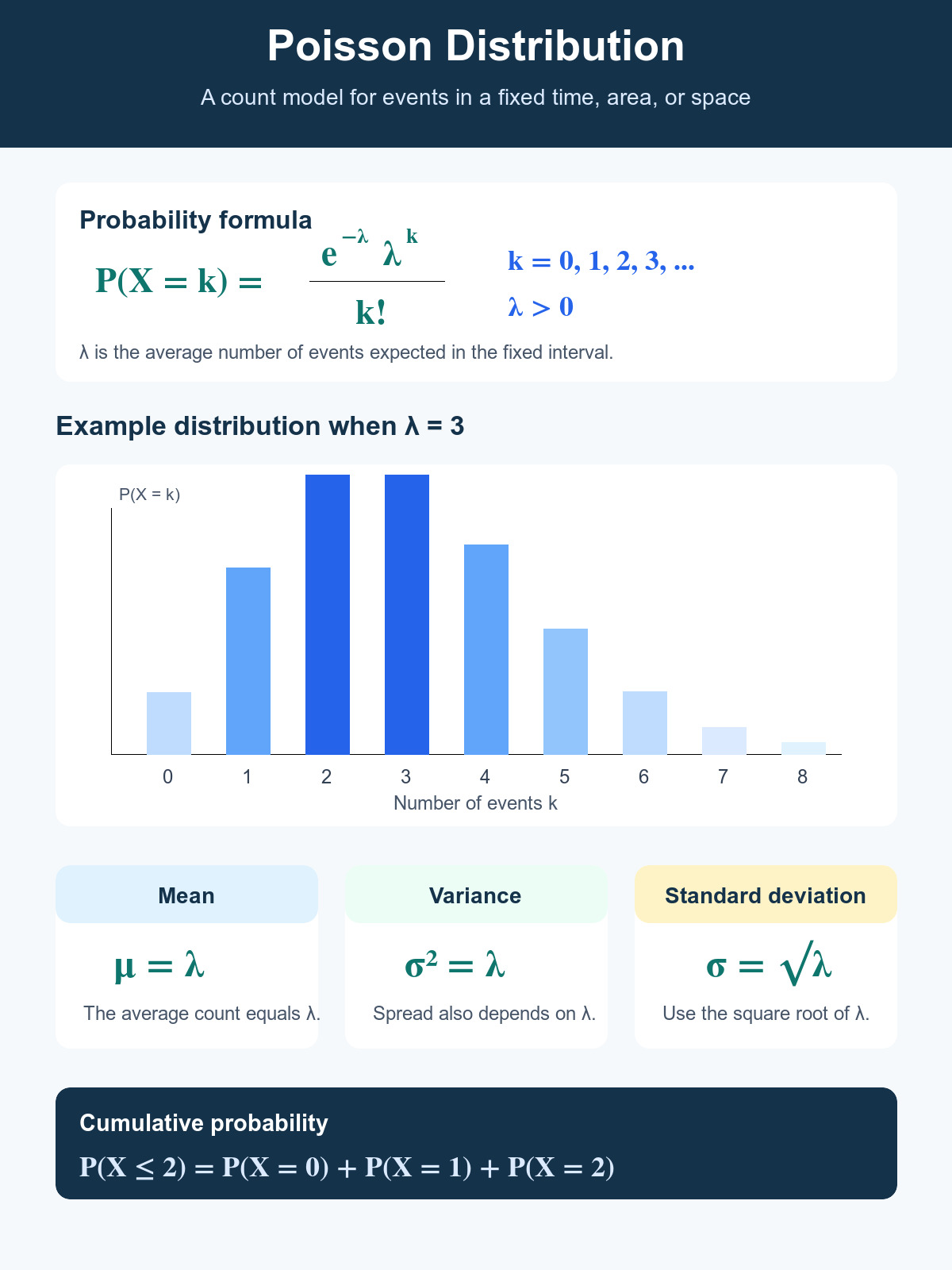
Use this chart to connect the Poisson formula, the meaning of \(\lambda\), the shape of the distribution, and cumulative probability.
The chart example uses \(\lambda=3\), so the tallest bars sit around 2 and 3 events.
When a Poisson model fits
Use a Poisson model when events are counted in a fixed interval and the average rate is known.
The events should happen one at a time, and one event should not strongly change the chance of the next event.
Common examples include calls per hour, typos per page, defects per meter, customers per minute, or accidents per month.
The interval must match the value of \(\lambda\). If the rate is per hour but the question asks about 10 minutes, convert the rate first.
Mean, variance, and standard deviation
For a Poisson distribution, the mean is:
\[\mu=\lambda\]
The variance is also:
\[\sigma^2=\lambda\]
The standard deviation is:
\[\sigma=\sqrt{\lambda}\]
This is a special feature of the Poisson distribution: the center and spread both come from the same value, \(\lambda\).
Example 1: exactly 2 events
A help desk receives an average of 3 tickets per hour. Assume the count follows a Poisson distribution. Find the probability of exactly 2 tickets in one hour.
Step 1: Identify the values: \[\lambda=3,\qquad k=2\]
Step 2: Write the formula: \[P(X=2)=\frac{e^{-3}3^2}{2!}\]
Step 3: Simplify the factorial and power: \[2!=2,\qquad 3^2=9\]
Step 4: Calculate: \[P(X=2)=\frac{e^{-3}\cdot9}{2}\approx0.2240\]
Answer: The probability of exactly 2 tickets in one hour is about \(0.2240\), or \(22.40\%\).
Example 2: no events
A website averages 0.8 checkout errors per hour. Find the probability of no checkout errors in the next hour.
Step 1: Use \(\lambda=0.8\) and \(k=0\).
Step 2: Substitute into the formula: \[P(X=0)=\frac{e^{-0.8}0.8^0}{0!}\]
Step 3: Use \(0.8^0=1\) and \(0!=1\): \[P(X=0)=e^{-0.8}\]
Step 4: Approximate: \[e^{-0.8}\approx0.4493\]
Answer: The probability of no checkout errors is about \(0.4493\), or \(44.93\%\).
Example 3: convert the rate first
A store receives an average of 6 customer calls per hour. Find the probability of exactly 2 calls in a 15-minute period.
Step 1: Convert the rate. Fifteen minutes is one quarter of an hour, so: \[\lambda=6\cdot\frac{1}{4}=1.5\]
Step 2: Use \(k=2\): \[P(X=2)=\frac{e^{-1.5}1.5^2}{2!}\]
Step 3: Simplify: \[P(X=2)=\frac{e^{-1.5}\cdot2.25}{2}\]
Step 4: Approximate: \[P(X=2)\approx0.2510\]
Answer: The probability of exactly 2 calls in 15 minutes is about \(25.10\%\).
Cumulative Poisson probability
A cumulative probability adds several exact Poisson probabilities.
For example, at most 2 events means:
\[P(X\le2)=P(X=0)+P(X=1)+P(X=2)\]
In summation form:
\[P(X\le m)=\sum_{k=0}^{m}\frac{e^{-\lambda}\lambda^k}{k!}\]
For a slower review of cumulative probability, use the cumulative distribution function lesson.
Poisson and binomial connection
A Poisson distribution can sometimes approximate a binomial distribution.
This is most useful when \(n\) is large, \(p\) is small, and \(np\) is a moderate-sized average.
The Poisson approximation uses:
\[\lambda=np\]
The exact binomial model is still better when the number of trials is small or the success probability is not small.
Poisson and normal connection
When \(\lambda\) is large, a Poisson distribution can look roughly bell-shaped.
In those cases, a normal probability distribution may be used as an approximation.
The matching normal model uses mean \(\lambda\) and standard deviation \(\sqrt{\lambda}\).
A continuity correction is usually needed because Poisson counts are discrete while the normal curve is continuous.
When not to use Poisson
Do not use a Poisson model when the event rate changes sharply during the interval.
Do not use it when events strongly trigger each other or block each other.
Do not use it for a fixed number of trials with success or failure on each trial; that is usually binomial.
Do not use a rate from one interval without converting it to the interval in the question.
Common mistakes
Do not treat \(\lambda\) as the number you want. \(\lambda\) is the average count, while \(k\) is the exact count being asked about.
Do not forget the factorial \(k!\) in the denominator.
Do not use the hourly \(\lambda\) for a 10-minute or 15-minute question without converting the interval.
Do not use \(P(X=2)\) when the question says at most 2. At most 2 means \(P(X\le2)\).
Do not assume the Poisson model fits every count. The event process has to match the assumptions reasonably well.
Quick practice
1. If a process averages 4 events per hour, what is \(\lambda\) for one hour? Answer: \(\lambda=4\).
2. If the same process is measured for 30 minutes, what is \(\lambda\)? Answer: \(\lambda=2\).
3. If \(X\sim\operatorname{Poisson}(5)\), what are the mean and variance? Answer: both are 5.
4. What expression gives the probability of exactly 3 events when \(\lambda=2\)? Answer: \(\frac{e^{-2}2^3}{3!}\).