


Grade 11 statistics lesson
Cumulative Distribution Function: Formula, Graph, Examples, and Practice
A cumulative distribution function, or CDF, gives the probability that a random variable is less than or equal to a chosen value.
Is a cumulative distribution function different?
Yes. A cumulative distribution function, often shortened to CDF, is different from a probability distribution itself.
A probability distribution tells how probability is assigned across possible values. A CDF tells how much probability has accumulated up to a chosen value.
For example, a binomial distribution can tell the chance of exactly 3 successes. Its CDF can tell the chance of 3 or fewer successes.
CDF definition
The cumulative distribution function of a random variable \(X\) is written as \(F(x)\).
It is defined by this formula:
\[F(x)=P(X\le x)\]
Read the formula as: \(F(x)\) is the probability that \(X\) is less than or equal to \(x\).
The word cumulative matters. The CDF adds all probability at or below the cutoff value.
Cumulative distribution function chart
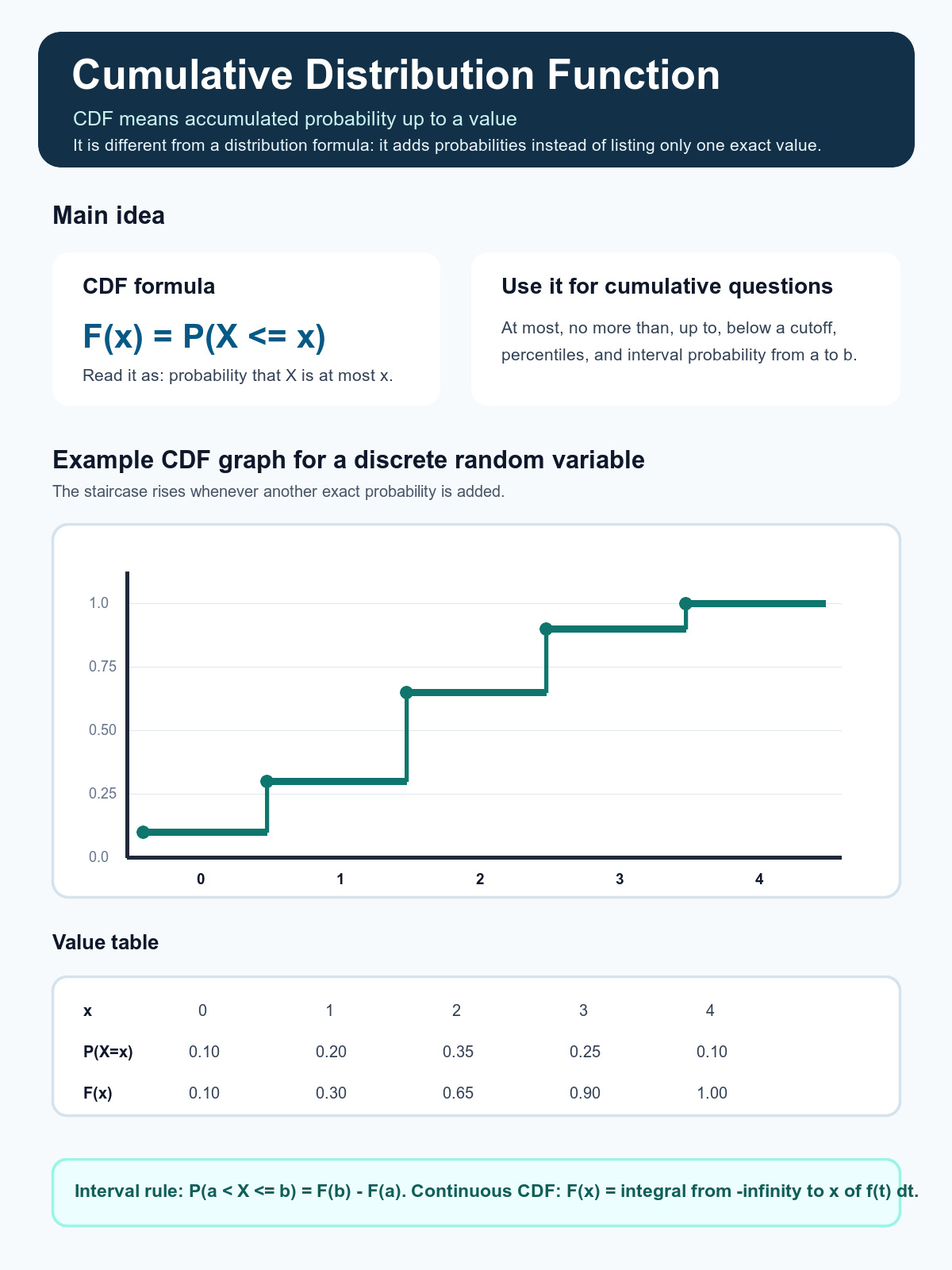
Use this chart to connect the CDF formula with a staircase graph and a small value table.
For a discrete random variable, the CDF usually looks like steps because probability is added at separate values.
CDF notation
The notation \(F(x)\) does not mean multiply \(F\) by \(x\). It names a function.
The input \(x\) is the cutoff. The output \(F(x)\) is a probability from 0 to 1.
If \(F(5)=0.72\), then 72% of the probability is at 5 or below.
Discrete CDF example
Suppose a random variable \(X\) has this probability table:
\[P(X=0)=0.10,\quad P(X=1)=0.20,\quad P(X=2)=0.35,\quad P(X=3)=0.25,\quad P(X=4)=0.10\]
Find \(F(2)\).
Step 1: Use the definition: \[F(2)=P(X\le2)\]
Step 2: Add every exact probability at or below 2: \[F(2)=P(X=0)+P(X=1)+P(X=2)\]
Step 3: Substitute and add: \[F(2)=0.10+0.20+0.35=0.65\]
Answer: \(F(2)=0.65\). There is a 65% chance that \(X\) is 2 or less.
Discrete CDF graph
A discrete CDF often looks like a staircase. The graph stays flat between possible values because no new probability is added between those values.
At each possible value of \(X\), the graph jumps upward by the amount of probability at that value.
In the chart example, the jump at \(x=2\) is 0.35 because \(P(X=2)=0.35\).
Interval probability from a CDF
A CDF is especially useful because interval probability can be found by subtracting two CDF values.
For many discrete setups, this rule is used:
\[P(a<X\le b)=F(b)-F(a)\]
Using the chart table, find \(P(1<X\le3)\).
Step 1: Write the rule: \[P(1<X\le3)=F(3)-F(1)\]
Step 2: Use the table values: \[F(3)=0.90,\quad F(1)=0.30\]
Step 3: Subtract: \[P(1<X\le3)=0.90-0.30=0.60\]
Answer: The interval probability is 0.60, or 60%.
CDF for a binomial distribution
A binomial distribution gives exact probabilities such as \(P(X=0)\), \(P(X=1)\), and \(P(X=2)\).
The binomial CDF adds exact binomial probabilities up to the cutoff.
If \(X\sim\operatorname{Binomial}(4,0.5)\), find \(F(2)\).
Step 1: Use the CDF definition: \[F(2)=P(X\le2)\]
Step 2: Add exact outcomes: \[F(2)=P(X=0)+P(X=1)+P(X=2)\]
Step 3: Use the binomial probabilities: \[F(2)=\frac{1}{16}+\frac{4}{16}+\frac{6}{16}=\frac{11}{16}\]
Step 4: Convert to a decimal: \[\frac{11}{16}=0.6875\]
Answer: The probability of 2 or fewer successes is 0.6875, or 68.75%.
Continuous CDF formula
For a continuous random variable, the CDF is connected to the probability density function \(f(x)\).
The formula is:
\[F(x)=\int_{-\infty}^{x} f(t)\,dt\]
This means the CDF collects the area under the density curve from the far left up to \(x\).
For continuous variables, \(P(X=x)=0\), so \(P(X\le x)\) and \(P(X
The normal probability distribution lesson shows this idea with bell-curve area and z-scores.
Continuous CDF example
Suppose \(X\) is uniformly distributed from 0 to 10. That means every value in the interval from 0 to 10 is equally likely.
For \(0\le x\le10\), the CDF is:
\[F(x)=\frac{x}{10}\]
Find \(F(7)\).
Step 1: Substitute \(x=7\): \[F(7)=\frac{7}{10}\]
Step 2: Simplify: \[F(7)=0.70\]
Answer: There is a 70% chance that \(X\) is 7 or less.
Conditional CDF note
A CDF can also be conditional. In that case, the distribution is first filtered by a condition and then accumulated up to a cutoff.
The notation is: \[F_{X\mid Y}(x\mid y)=P(X\le x\mid Y=y)\]
For the full idea of filtering a distribution after information is known, use the conditional probability distribution lesson.
Percentiles and medians
CDFs are also used for percentiles. A percentile is a value where a certain amount of probability has accumulated.
For example, if \(F(x)=0.90\), then \(x\) is a 90th-percentile value for that distribution.
A median is a value where the CDF reaches at least 0.50. In simple words, about half the probability is at or below the median.
CDF vs PDF vs PMF
A PMF, or probability mass function, gives exact probabilities for a discrete random variable, such as \(P(X=2)\).
A PDF, or probability density function, describes density for a continuous random variable. Its area over an interval gives probability.
A CDF gives cumulative probability: \(P(X\le x)\). It works for discrete, continuous, and mixed distributions.
Important CDF properties
A CDF never decreases. As \(x\) moves to the right, accumulated probability can stay the same or increase.
A CDF value is always between 0 and 1.
Far to the left, the CDF approaches 0. Far to the right, the CDF approaches 1.
For a discrete distribution, jumps show where exact probability is located.
Common mistakes
Do not confuse \(P(X=x)\) with \(P(X\le x)\). The first is exact probability. The second is cumulative probability.
Do not subtract CDF values in the wrong order. \(P(a<X\le b)\) uses \(F(b)-F(a)\), not \(F(a)-F(b)\).
Do not expect every CDF graph to look smooth. Discrete CDF graphs usually have steps.
Do not forget that a CDF includes the cutoff value because it uses \(X\le x\).
Quick practice
1. If \(F(4)=0.82\), what does that mean? Answer: \(P(X\le4)=0.82\).
2. If \(F(10)=0.95\) and \(F(6)=0.40\), what is \(P(6<X\le10)\)? Answer: \(0.95-0.40=0.55\).
3. If \(X\sim\operatorname{Binomial}(4,0.5)\), what does \(F(2)\) mean? Answer: the probability of 0, 1, or 2 successes.
4. Is a CDF value allowed to be 1.2? Answer: no, a CDF value must stay between 0 and 1.