



Grade 1 number sense lesson
Greater Than and Less Than: Basic Number Comparison for Grade 1
Greater than and less than symbols help students compare two numbers and decide which number is bigger, smaller, or the same.
What do greater than and less than mean?
When we compare two numbers, we look at their size.
A number is greater than another number when it is bigger. A number is less than another number when it is smaller.
If both numbers have the same value, they are equal.
For example, \(8\) is bigger than \(5\), so we write \(8 \gt 5\). The sentence says "8 is greater than 5."
Printable basic comparison chart
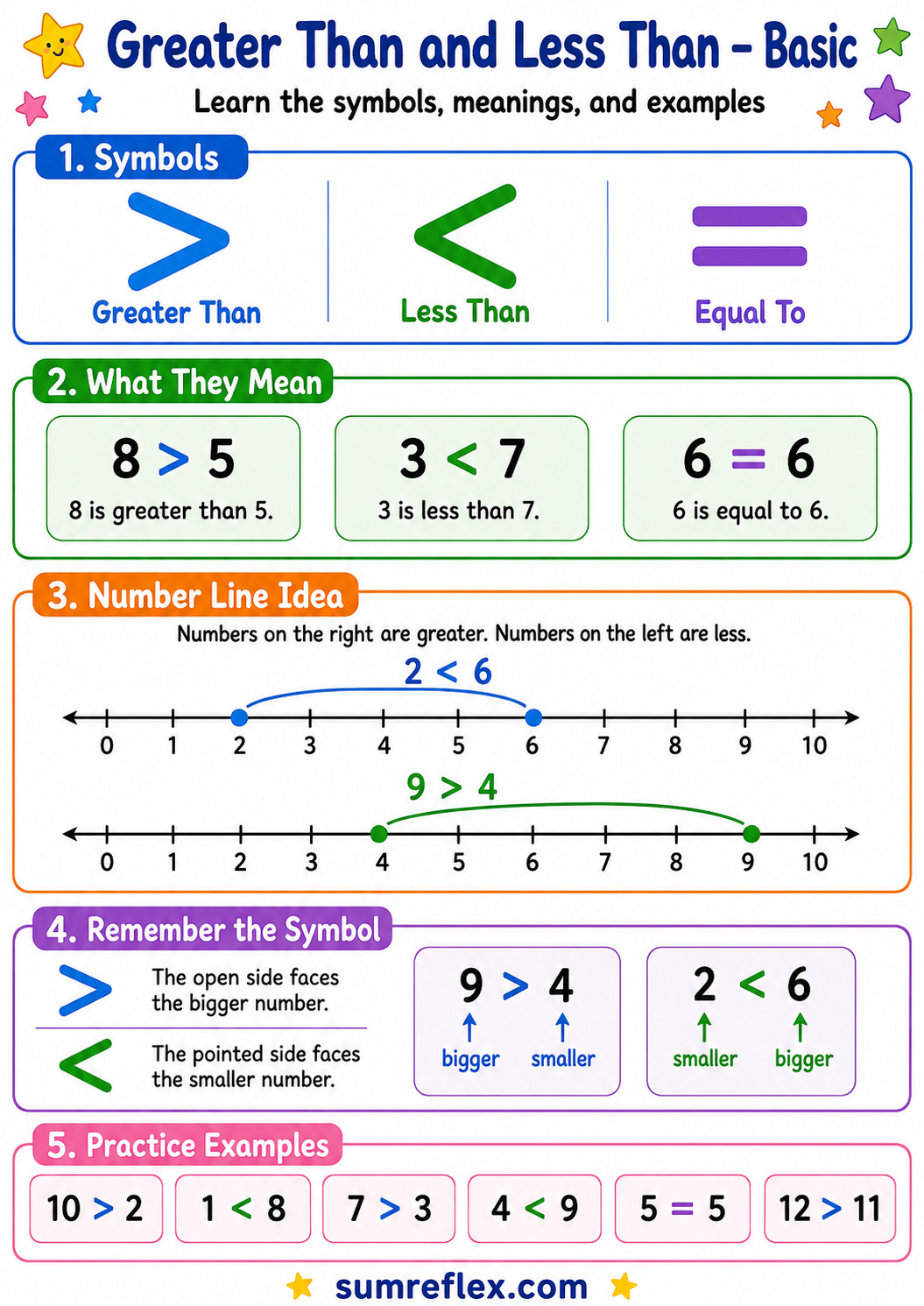
Use this chart to remember the comparison symbols, the number-line idea, and beginner examples from small whole numbers.
The same chart is also available in the Printable Number Reference Charts section with print and download options.
If a student is still learning how to read numbers, the numbers and their names lesson is a helpful review before comparing pairs.
The three comparison symbols
There are three symbols students use again and again when comparing numbers.
The greater-than symbol is \( \gt \). It points from the bigger number toward the smaller number.
The less-than symbol is \( \lt \). It shows that the first number is smaller than the second number.
The equal sign is \(=\). It means both sides have the same value.
| Symbol | How to read it | Simple example |
|---|---|---|
| \(\gt\) | is greater than | \(9 \gt 4\) |
| \(\lt\) | is less than | \(2 \lt 6\) |
| \(=\) | is equal to | \(5 = 5\) |
The open side faces the bigger number
A simple way to remember the symbol is to look at the wide open side.
The open side of \( \gt \) or \( \lt \) faces the bigger number.
The pointed side faces the smaller number.
In \(10 \gt 2\), the open side faces \(10\) because \(10\) is bigger. In \(1 \lt 8\), the open side faces \(8\) because \(8\) is bigger.
Number line idea
A number line helps students see size instead of guessing.
On a normal number line, numbers get larger as you move to the right.
Numbers on the left are smaller. Numbers on the right are bigger.
Because \(6\) is to the right of \(2\), we can write \(6 \gt 2\). Because \(4\) is to the left of \(9\), we can write \(4 \lt 9\).
For another visual reference, use the number line chart after this lesson.
Formula for comparing two numbers
For two numbers \(a\) and \(b\), use one of these comparison statements.
If \(a\) is bigger than \(b\), write \(a \gt b\).
If \(a\) is smaller than \(b\), write \(a \lt b\).
If \(a\) and \(b\) have the same value, write \(a = b\).
Step-by-step method for simple numbers
Step 1: Read both numbers carefully.
Step 2: Ask, "Which number is bigger?"
Step 3: Put the open side of the symbol toward the bigger number.
Step 4: Read the whole comparison sentence out loud to check that it makes sense.
Example 1: Compare 8 and 5
Problem: Fill in the symbol: \(8 \; \square \; 5\).
The number \(8\) is bigger than \(5\).
The open side should face \(8\), so the symbol is \( \gt \).
Answer: \(8 \gt 5\). Read it as "8 is greater than 5."
Example 2: Compare 3 and 7
Problem: Fill in the symbol: \(3 \; \square \; 7\).
The number \(3\) is smaller than \(7\).
Since the first number is smaller, use the less-than symbol.
Answer: \(3 \lt 7\). Read it as "3 is less than 7."
Example 3: Compare 6 and 6
Problem: Fill in the symbol: \(6 \; \square \; 6\).
Both sides show the same number.
When the values match, use the equal sign.
Answer: \(6 = 6\).
Example 4: Compare 12 and 11
Problem: Fill in the symbol: \(12 \; \square \; 11\).
Twelve comes after eleven when counting.
That means \(12\) is bigger than \(11\).
Answer: \(12 \gt 11\).
Example 5: Compare 0 and 4
Problem: Fill in the symbol: \(0 \; \square \; 4\).
Zero means none, and \(4\) means four objects.
Zero is smaller than \(4\).
Answer: \(0 \lt 4\).
Example 6: Compare 9 and 4 on a number line
Find \(9\) and \(4\) on the number line.
The number \(9\) is farther to the right.
The number farther to the right is greater.
Answer: \(9 \gt 4\).
More quick examples
Practice reading each one as a full sentence.
\(10 \gt 2\): 10 is greater than 2.
\(1 \lt 8\): 1 is less than 8.
\(7 \gt 3\): 7 is greater than 3.
\(4 \lt 9\): 4 is less than 9.
\(5 = 5\): 5 is equal to 5.
\(11 \lt 15\): 11 is less than 15.
\(18 \gt 13\): 18 is greater than 13.
Compare with objects first
Beginners often understand comparison faster when numbers are tied to groups.
If one plate has \(7\) grapes and another plate has \(3\) grapes, the plate with \(7\) grapes has more.
That comparison can be written as \(7 \gt 3\).
If one box has \(2\) crayons and another box has \(6\) crayons, the first box has fewer, so \(2 \lt 6\).
How to check the answer
After writing a symbol, read the sentence out loud.
If you wrote \(8 \gt 5\), say "8 is greater than 5." That is true.
If you wrote \(8 \lt 5\), say "8 is less than 5." That is not true, so the symbol must be changed.
Another check is to find both numbers on a number line and see which one is farther right.
Common mistakes
Do not choose the symbol just because it looks like an arrow. The symbol must match the number sizes.
Do not put the pointed side toward the bigger number. The open side faces the bigger value.
Do not use \(=\) unless both sides have the same value.
Do not rush when the numbers are close, such as \(11\) and \(12\). Count carefully or use a number line.
Practice questions
Fill in each blank with \( \gt \), \( \lt \), or \(=\).
1. \(6 \; \square \; 2\)
2. \(3 \; \square \; 9\)
3. \(5 \; \square \; 5\)
4. \(12 \; \square \; 10\)
5. \(0 \; \square \; 1\)
6. \(14 \; \square \; 18\)
7. \(20 \; \square \; 16\)
8. \(7 \; \square \; 11\)
Practice answers
1. \(6 \gt 2\)
2. \(3 \lt 9\)
3. \(5 = 5\)
4. \(12 \gt 10\)
5. \(0 \lt 1\)
6. \(14 \lt 18\)
7. \(20 \gt 16\)
8. \(7 \lt 11\)
The big idea
Greater than means bigger. Less than means smaller. Equal means the same.
The open side of the comparison symbol faces the bigger number.
A number line is a reliable way to check beginner comparisons because numbers on the right are greater than numbers on the left.