



Beginner comparison guide
Teaching greater than and less than with small numbers
Start with bigger, smaller, and same
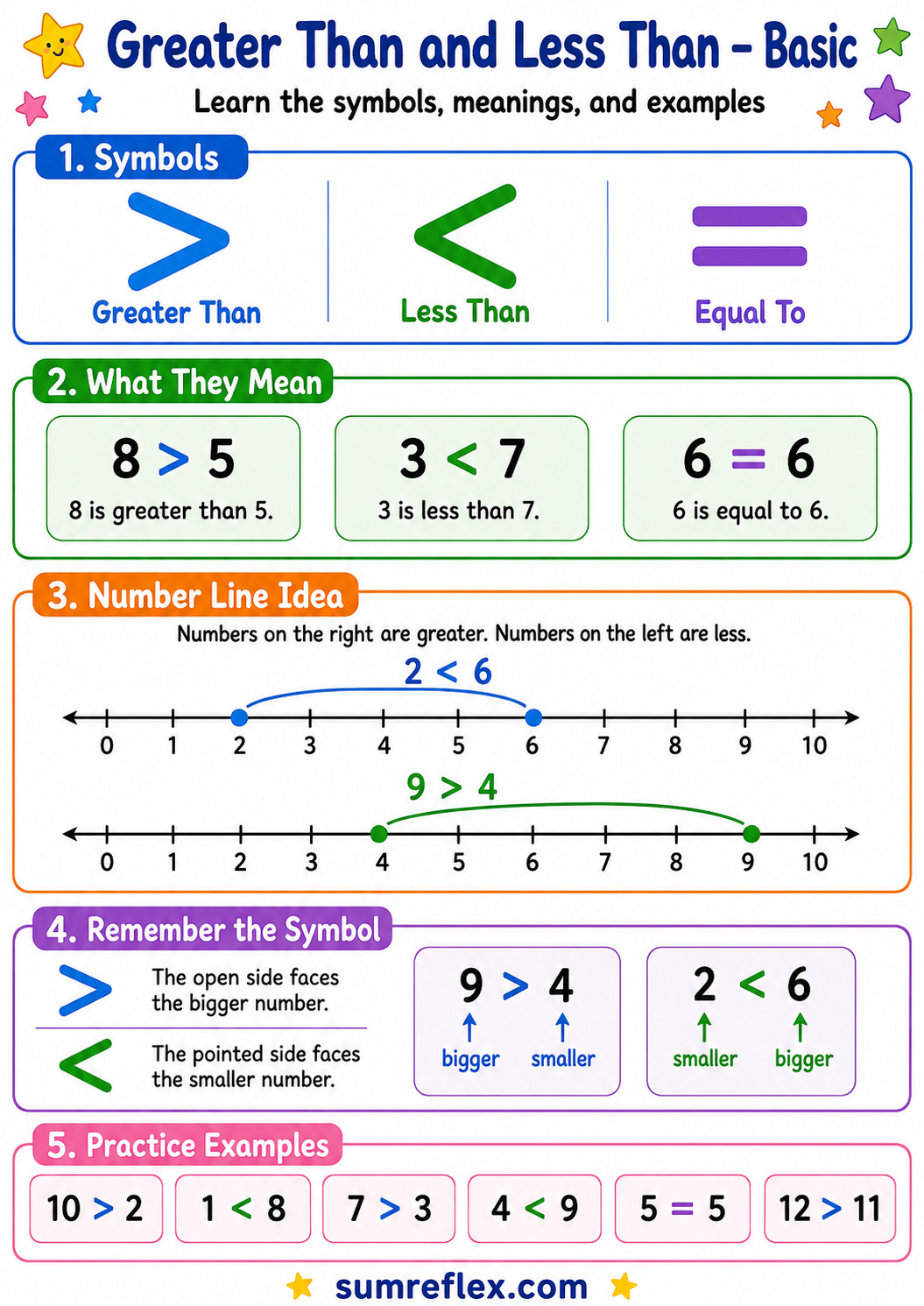
Young students usually understand comparison language before they are ready to use symbols. Ask which group has more, which group has fewer, or whether two groups match. Once that idea is clear, the symbols become a shorter way to write the sentence. The chart keeps the words greater than, less than, and equal to beside the symbols so students can connect the mark with its meaning.
The strongest first examples use small numbers that students can picture. A comparison such as 8 > 5 is easier when a learner can imagine eight counters beside five counters. The printable chart uses this simple range so the symbol lesson does not get mixed with difficult counting.
Use the open side rule carefully
The open side of the greater-than or less-than symbol faces the larger number. That rule is useful, but it should come after students decide which value is larger. If a student starts by drawing a symbol shape, the answer can become guesswork. A better routine is: compare the two numbers first, name the larger number, then point the open side toward it.
For example, in 9 > 4, the open side faces 9 because 9 is the larger value. In 2 < 6, the open side faces 6 even though 6 is written second. Reading both sentences aloud helps students hear whether the symbol matches the comparison.
Number lines make the order visible
A number line gives the chart an important second model. Numbers farther to the right are greater, and numbers farther to the left are less. This helps when the two numbers are close, such as 11 and 12, or when a student is unsure which direction the symbol should face.
Pair this page with the number line chart for extra visual practice. The number line chart focuses on order and position, while this comparison chart turns that order into greater-than, less-than, and equal-to statements.
How to use the chart during practice
A useful practice routine is to cover the answer row and ask students to explain each comparison. They should say the sentence, not only name the symbol. For 10 > 2, the student can say, "10 is greater than 2." For 4 < 9, the student can say, "4 is less than 9." The full sentence checks both reading and meaning.
After students work through the chart examples, continue with the full greater than and less than lesson. The lesson adds step-by-step examples, common mistakes, checking strategies, and more practice with small numbers.
Common classroom check
When a student reverses a symbol, avoid saying only that the symbol is wrong. Ask which number is bigger, then ask where the open side should face. That short conversation builds the habit behind the symbol. The chart is designed to support that routine because it places symbol meaning, number-line direction, and practice examples on one page.
The equal sign deserves attention too. Some students treat it as a place to put an answer, but on this chart it means the two values are the same. Statements such as 5 = 5 help students see equality as a comparison, not just the end of a problem.