



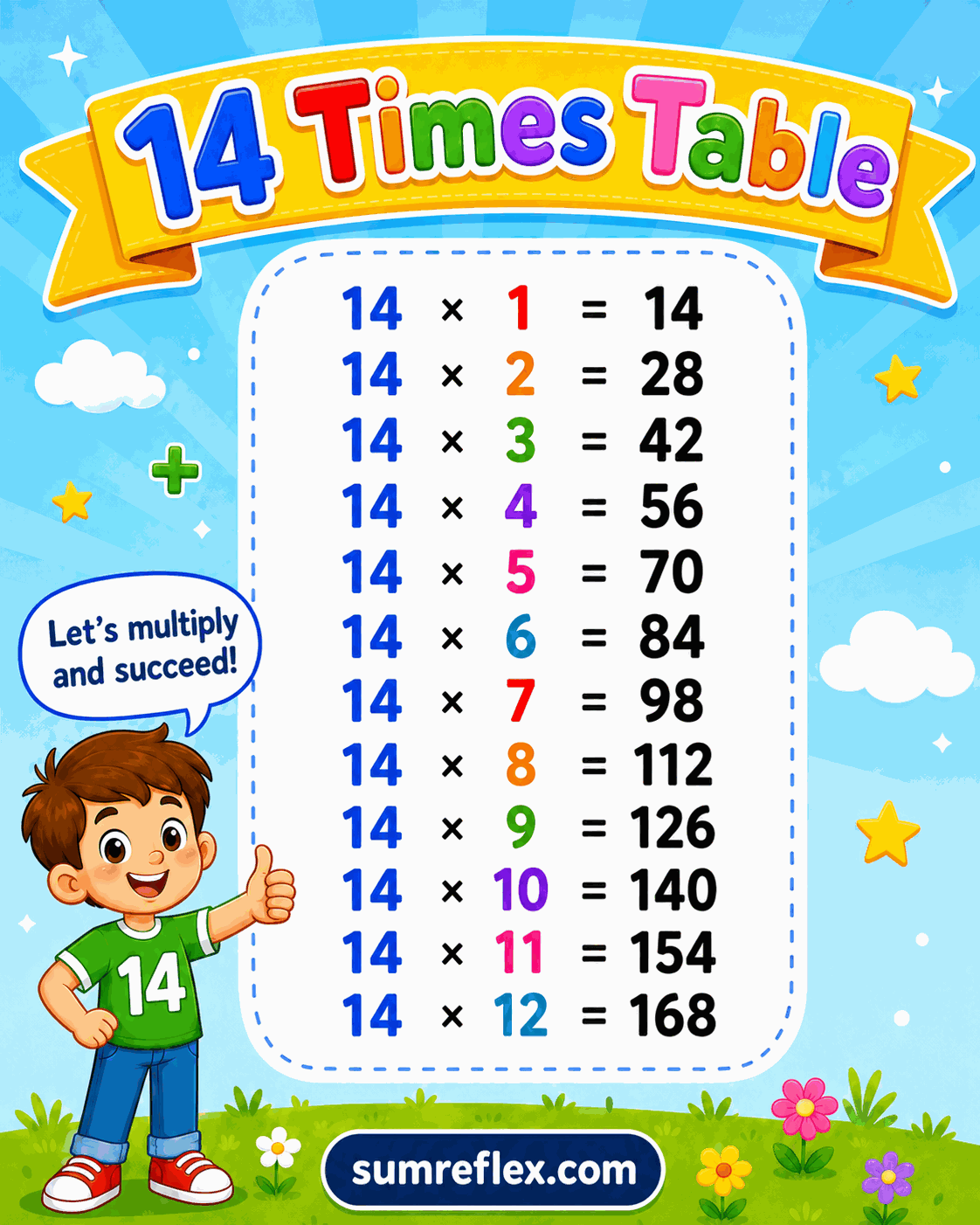
Fourteen table reasoning guide
Practicing the 14 table by doubling the sevens row
The row is twice the 7 table
The strongest entry point for the 14 table is the relationship 14 = 2 x 7. If a student knows 7 x 8 = 56, then 14 x 8 is double 56, which is 112. If 7 x 11 = 77, then 14 x 11 is double 77, which is 154. The chart gives the final row, but the doubling relationship gives students a way to build it.
Place this printable beside the 7 times table chart during early practice. Matching facts side by side makes the relationship visible instead of leaving it as a sentence students must remember.
Even answers are the first self-check
Every product in the 14 row is even because 14 itself is even. That gives students a quick error check. An answer such as 14 x 9 = 127 cannot be correct because it is odd. This does not prove the exact answer, but it tells the learner to pause before moving on.
A second check is size. Fourteen times 9 should be greater than 10 x 9 and less than 20 x 9. The correct answer, 126, sits inside that range. Estimation and parity together make the chart more than an answer list.
Doubling can happen before or after
Students can double the seven-table product, or they can double the other factor first and multiply by seven. For 14 x 6, one route is 7 x 6 = 42, then double to 84. Another route is 7 x 12 = 84. Both routes use the same factor structure, and the chart can confirm that they land in the same place.
This flexibility matters because different facts feel easier to different students. Some may know 7 x 12 quickly. Others may prefer 42 doubled. Allowing both methods builds confidence and makes the row less rigid.
A factor connection for older learners
Fourteen has factors 1, 2, 7, and 14. That means the row is connected to divisibility by 2 and by 7. When students are ready for factor language, the divisible by 7 chart can help them test whether a number belongs to the seven family before doubling enters the conversation.
This is not necessary for every learner, but it is useful in enrichment work. Students can see that multiplication facts, factors, multiples, and divisibility rules all describe the same number relationships from different directions.
A clean routine for the page
Ask students to choose a 14 fact, name the matching 7 fact, double it, and then check the chart. For example: 14 x 12, matching fact 7 x 12 = 84, doubled answer 168. Writing that chain keeps the process visible and prevents a student from copying the chart without thinking.
After several rounds, remove the 7 table and keep only this page. Students should still be able to explain how the answer can be rebuilt if memory is slow.
For an added challenge, give a product from the chart and ask students to halve it to find the related 7-table product. If the product is 154, half is 77, so the matching 7 fact is 7 x 11. This reverse step strengthens both the 14 row and the supporting 7 row.
Where fourteen appears in practice
Fourteen can appear in two-week planning, packs of 14, and extended factor questions. Those contexts are not as common as tens or dozens, so the strategy is more important than a real-world hook. The printable keeps the larger products readable while students develop that strategy.