



Large-number reading guide
Reading big numbers by counting zeros and comma groups
Zeros grow faster than number names feel
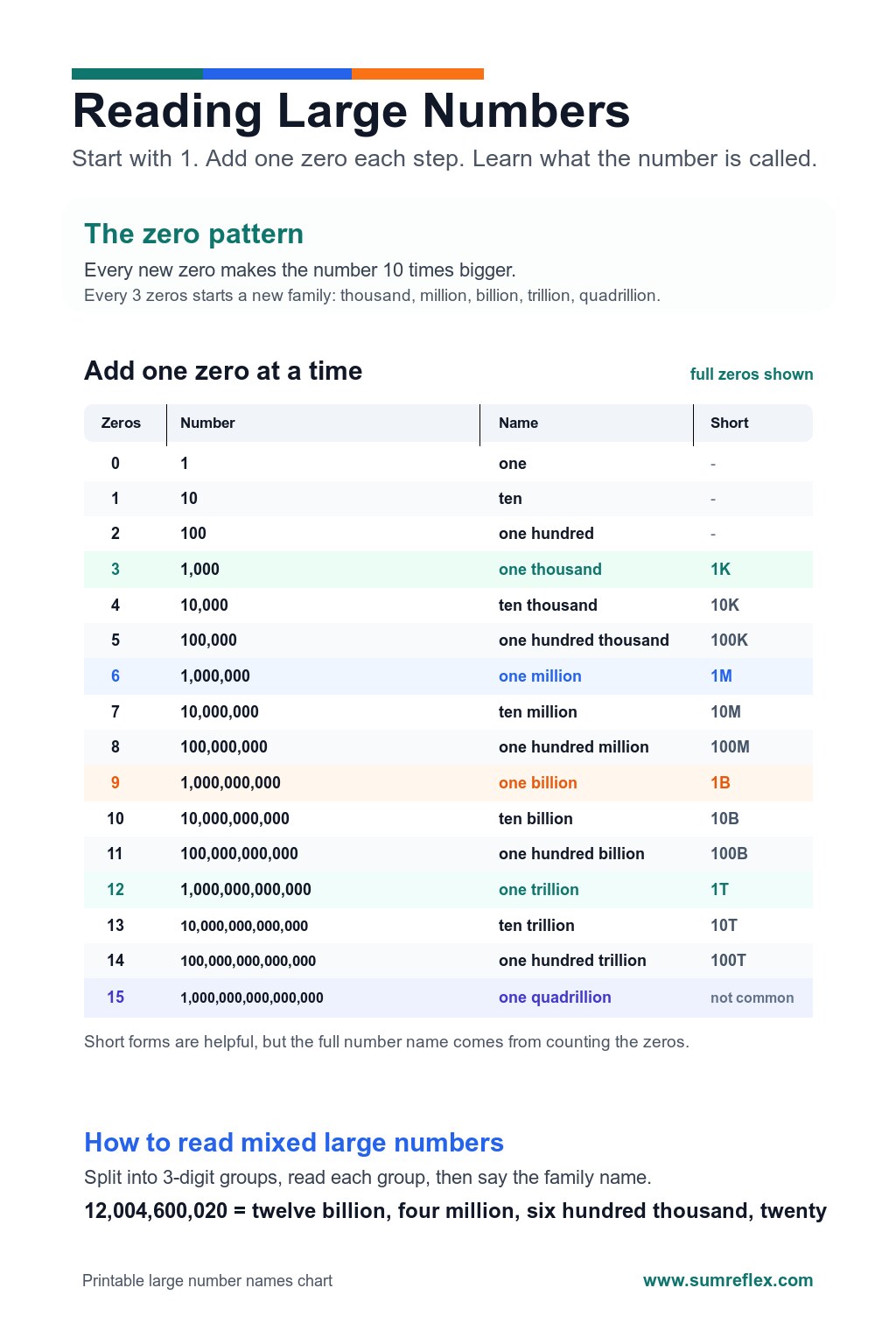
Large numbers become difficult because the written numeral grows quickly. Ten has one zero, one hundred has two zeros, one thousand has three, and one million already has six. The chart shows that growth one row at a time so students can connect the full written number with its name. Seeing the zeros build prevents million, billion, and trillion from becoming vague large words.
The zero count is especially useful when students compare powers of ten. A billion has nine zeros, while a trillion has twelve. The difference is not just a bigger word; it is three more place-value positions. The chart helps learners notice that each new comma group multiplies the size by one thousand.
Commas make the number pronounceable
Comma groups are the guide for reading large numbers aloud. Starting from the right, commas split the number into groups of three digits. Those groups are read as ones, thousands, millions, billions, trillions, and so on. A number such as 1,000,000 becomes easier to read because the comma groups show that the 1 is in the millions period.
Students should practice reading from left to right by period. They can say the number in the first group, then the period name, then continue. The place value chart is a strong companion because it shows the digit positions inside the same period structure.
Short forms need context
Short forms such as 1K, 1M, 1B, and 1T appear in money, data, social media counts, graphs, and news headlines. The chart helps students connect those compact labels to full numbers. 1K means one thousand, 1M means one million, 1B means one billion, and 1T means one trillion in many everyday contexts.
It is still important to teach that short forms depend on context and style. A math answer should usually use the full number or the requested notation. Short forms are useful for reading real-world labels, not for replacing place-value understanding. The chart gives both forms so students can translate between them.
Large-number names support estimation
When students know the names of large powers of ten, they can estimate size more intelligently. They can tell that 750,000 is less than one million, that 3,400,000 is in the millions, and that 12,000,000,000 belongs in the billions. The chart gives anchor points for those comparisons.
This skill matters when reading populations, distances in space, budgets, file sizes, and scientific quantities. Students may not calculate with every number, but they still need to know whether the number is thousands, millions, billions, or more. Naming the scale is the first step toward interpreting the value.
Where to go after the chart
After students can name powers of ten, they can practice writing ordinary large numbers in word form. The numbers and their names chart supports smaller word-form spelling, while this page handles larger scale names. For scientific notation, the Scientific Notation Calculator can help check rewritten forms after students understand the place-value scale.
A useful classroom task is to give students a large number from a real source and ask them to identify its comma groups, read it aloud, name the largest period, and compare it with the nearest power of ten on the chart. That turns the printable into a reading tool rather than a static list.