



Number word guide
Turning numerals into word form without losing spelling accuracy
Number words are a reading skill and a math skill
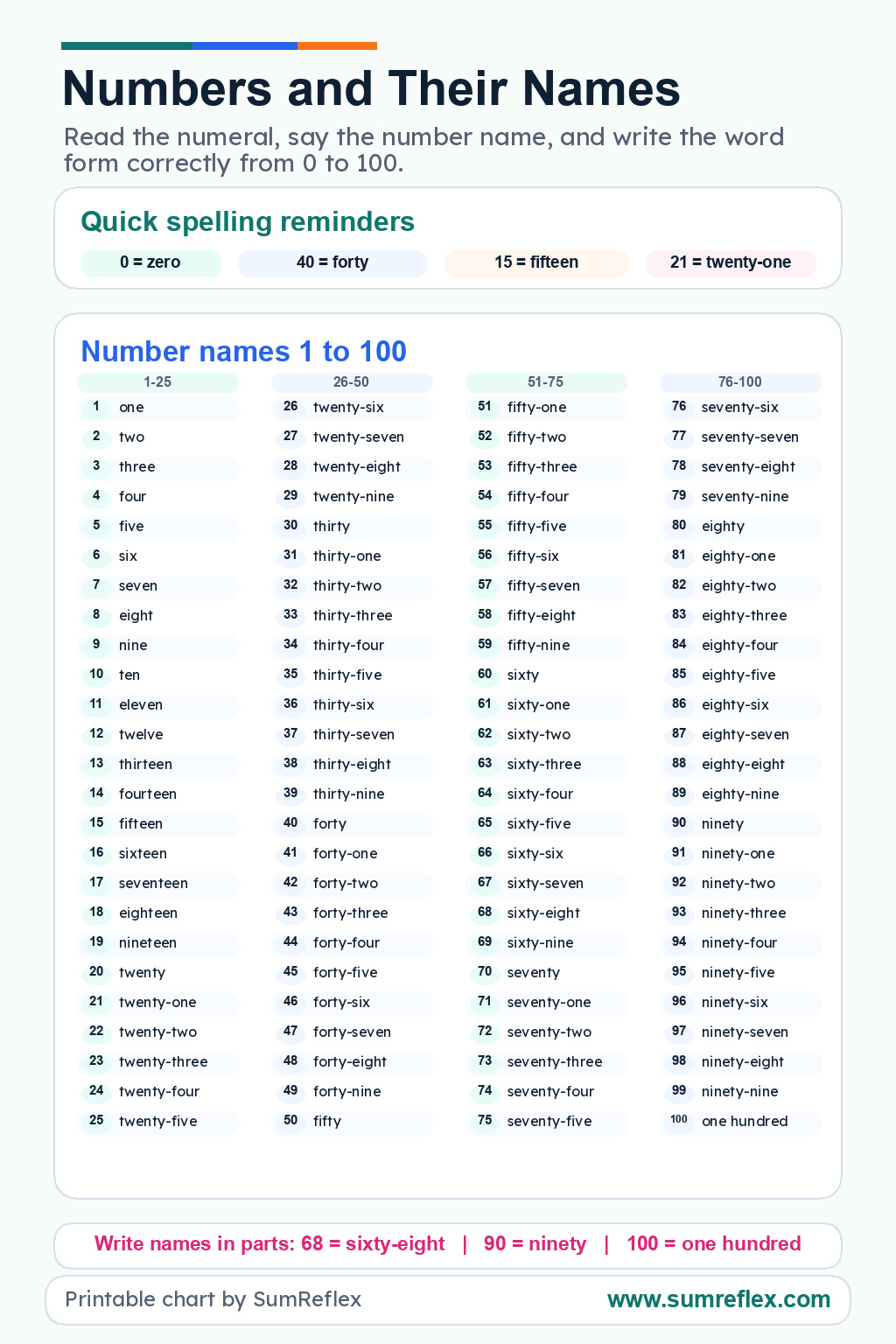
Students may be able to count to 100 aloud before they can write every number word correctly. This chart bridges that gap. A numeral such as 47 is compact, but its word form, forty-seven, carries spelling rules, place-value language, and a hyphen. The printable lets students compare the symbol and the word side by side until the connection becomes familiar.
The chart is useful in math and language work. In math, students use word form to read problems, write answers, and understand place value. In writing, they need correct spelling for number words that appear in sentences. Keeping the two forms together helps students see that 68 and sixty-eight are the same value expressed in different notation.
The teens deserve their own attention
The numbers from 11 to 19 often cause spelling and reading mistakes because they do not follow the simple tens-plus-ones pattern students see later. Eleven and twelve are special names. Thirteen, fourteen, fifteen, sixteen, seventeen, eighteen, and nineteen belong together, but several have spelling changes that students need to notice. Fifteen and eighteen are common trouble spots.
Use the chart for short spelling checks. Students can cover the word column, write the word from the numeral, and then uncover the answer. This routine works better than copying the list because it asks them to recall the spelling and then compare it with the reference.
Hyphenated numbers show tens and ones together
Most numbers from 21 through 99 use a tens word plus a ones word. Twenty-one, thirty-six, sixty-eight, and ninety-three all show that structure. The hyphen connects the tens and ones parts in standard written form. Exact tens such as 30, 40, 70, and 90 do not need a ones word because the ones digit is zero.
This is a natural place to connect number names with place value. A number such as 64 has 6 tens and 4 ones, and its word form, sixty-four, says that structure. The place value chart can help students see why the tens word comes first and the ones word comes second.
Common spellings to slow down for
Several number words should be highlighted during practice. Zero is often needed even though the chart focuses on 1 to 100. Forty is not spelled fourty. Fifteen is not fiveteen. Eighty keeps the t after eigh. Ninety drops the e from nine. These are small spelling details, but they matter when students write word form independently.
A useful activity is to ask learners to create a personal watch list of number words they miss. They can copy only those words onto a small card and use the full chart as the master reference. This keeps practice targeted instead of asking students to rewrite every word they already know.
Extending beyond one hundred
Once students can read and write numbers to 100, the same word-form habits extend to larger numbers. They will need hundreds, thousands, millions, and comma groups. The reading large numbers chart is the next reference when the number names move beyond two digits.
For daily practice, choose a few classroom numbers such as page numbers, dates, scores, or quantities. Ask students to write the numeral, read the word form, and explain any spelling rule they used. The goal is not to memorize a poster. The goal is to move comfortably between numerals and words in real math reading.