



Addition property notes
Seeing addend order as flexible while the total stays fixed
The total does not care which addend is named first
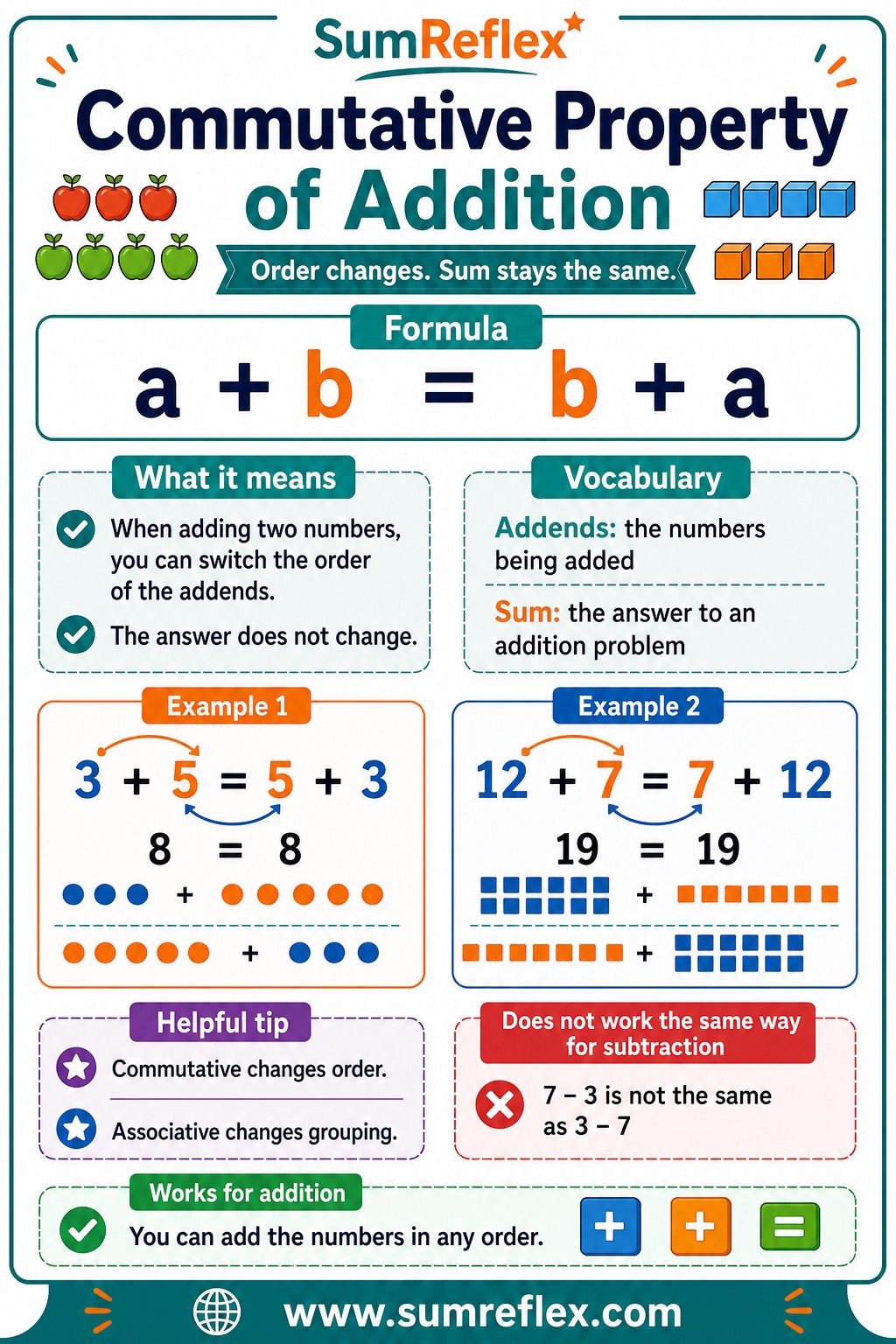
The commutative property of addition says that changing the order of addends does not change the sum. A student can count 3 + 8 or 8 + 3 and still arrive at 11. The objects being combined are the same; only the order of the written sentence has changed. This chart gives students a clear reference for that idea with the vocabulary of addends and sum attached to the examples.
This property is easy to say but worth making concrete. Use counters, dots, cubes, or drawings. Place three objects in one group and eight in another. Count the total. Then switch the groups left to right and count again. Nothing about the combined amount changed. That physical action helps students understand the chart as a statement about quantities, not only symbols.
Switching order can make facts easier
Students often know some addition facts better than others. A learner may be more comfortable counting on from 9 than from 2, so 2 + 9 becomes easier when read as 9 + 2. The commutative property gives permission to use the friendlier order. This is not a trick; it is a valid property of addition.
The chart can support mental math conversations. Ask students which order feels easier and why. Many will choose to start with the larger addend, make a ten, or group familiar facts. The answer stays the same, but the thinking route becomes more efficient. That makes the property valuable long after students can recite the formula.
Vocabulary should stay visible
The words addend and sum help students explain what is moving and what is staying fixed. In 6 + 4 = 10, both 6 and 4 are addends, and 10 is the sum. In 4 + 6 = 10, the addends have switched places, but the sum has not moved. The chart keeps those terms close to the examples so students can use mathematical language while still seeing the simple idea.
A quick notebook activity is to ask students to write one addition fact, label the addends, switch the addends, and circle the unchanged sum. That four-step routine makes the property visible in their own handwriting. It also shows whether they are preserving the same numbers or accidentally changing one addend while rewriting the equation.
Subtraction is the important non-example
The chart includes subtraction contrast because many students overgeneralize operation properties. Addition allows the addends to switch places, but subtraction does not work that way. The expression 9 - 4 gives 5, while 4 - 9 gives a different result. Even before students formally use negative numbers, they can see that the two subtraction situations are not the same.
This contrast helps students treat properties as operation-specific. A rule that works in addition may not work in subtraction. A rule that works in multiplication may not work in division. Naming the operation before applying the property is a useful habit, especially when students begin mixed-operation practice.
Natural next steps after the chart
This page connects well to number-line and fact-strategy work. The number line chart can help students see counting-on movement, while the associative property of multiplication chart gives a separate property example where grouping changes rather than order.
For checking larger sums, students can use the Basic Calculator after they have written both addition sentences. The calculator confirms the total, but the chart explains the reason both sentences are allowed to share it.