



Multiplication property notes
Using grouping to make multiplication easier without changing the product
Grouping is the main idea
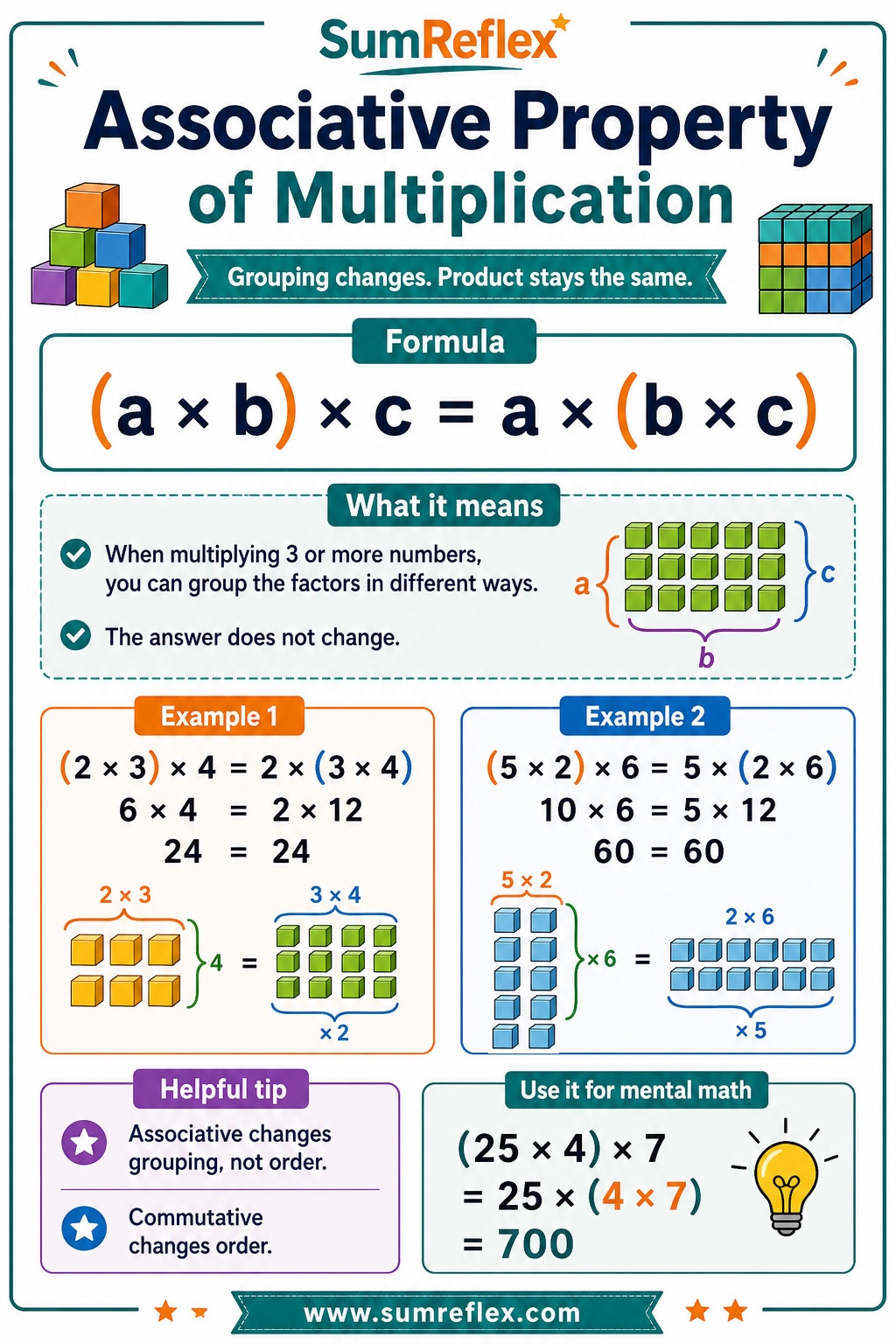
The associative property of multiplication is about grouping, not rearranging. When students see an expression such as (2 x 5) x 4 and 2 x (5 x 4), the factors appear in the same order. Only the parentheses move. That movement changes which multiplication happens first, but it does not change the final product. This chart gives students a visual way to separate those two ideas.
That separation matters because learners often mix the associative property with the commutative property. Commutative thinking changes order. Associative thinking changes grouping. If students can say "same order, different parentheses," they are using the correct property language. The chart is a quick reference for that exact distinction.
Why regrouping helps mental math
The property becomes useful when one grouping is easier than another. In 25 x 7 x 4, multiplying 25 by 7 first is possible, but grouping 25 and 4 first gives 100, and then 100 x 7 is quick. The product is the same because the factors did not change. Only the order of operations inside the multiplication chain was made friendlier.
This is a good place to connect the chart to mental math, not just vocabulary. Ask students to look for friendly pairs such as 2 and 5, 4 and 25, 8 and 125, or 10 with any whole number. When they recognize a helpful pair, they can use parentheses to show why they grouped those factors first. The notation supports the strategy instead of feeling like extra symbols.
Parentheses are proof of the chosen route
In multiplication expressions with more than two factors, parentheses tell which part is calculated first. The chart helps students understand that parentheses are not decoration. They record a decision. If two expressions have the same factors in the same order but different parentheses, students can solve both and compare the products. The equality is the evidence for the property.
A strong classroom routine is to write two grouped versions of the same expression and ask students to predict which one is easier before solving. After the work is complete, they can explain why the easier grouping helped. This turns the property into a thinking tool instead of a memorized formula.
Where students may overuse the rule
The associative property does not apply to every operation in the same way. It works for multiplication and addition, but subtraction and division do not allow regrouping freely. For example, (20 - 5) - 3 is not the same as 20 - (5 - 3). This contrast is useful because it prevents students from treating parentheses as movable in every expression.
It is also important not to change the factors while regrouping. If a number is replaced, split, or removed, the expression is no longer the same example of the associative property. Students can use the chart as a checklist: are all factors still present, are they still in the same order, and did only the grouping change?
Connecting grouping to other math pages
This chart pairs naturally with multiplication fact practice because regrouping is easier when students know basic products. The 1 to 12 times table chart gives that fact support. For property vocabulary across operations, the commutative property of addition chart helps students compare order changes with grouping changes.
If students want to check a long product after regrouping, the Basic Calculator can confirm the answer. The printed chart should still be used for the reasoning step: choosing a grouping that makes the multiplication easier while preserving the same factors.