



Logarithm rule notes
Using the logarithm rules chart without mixing rules
Start with the conditions
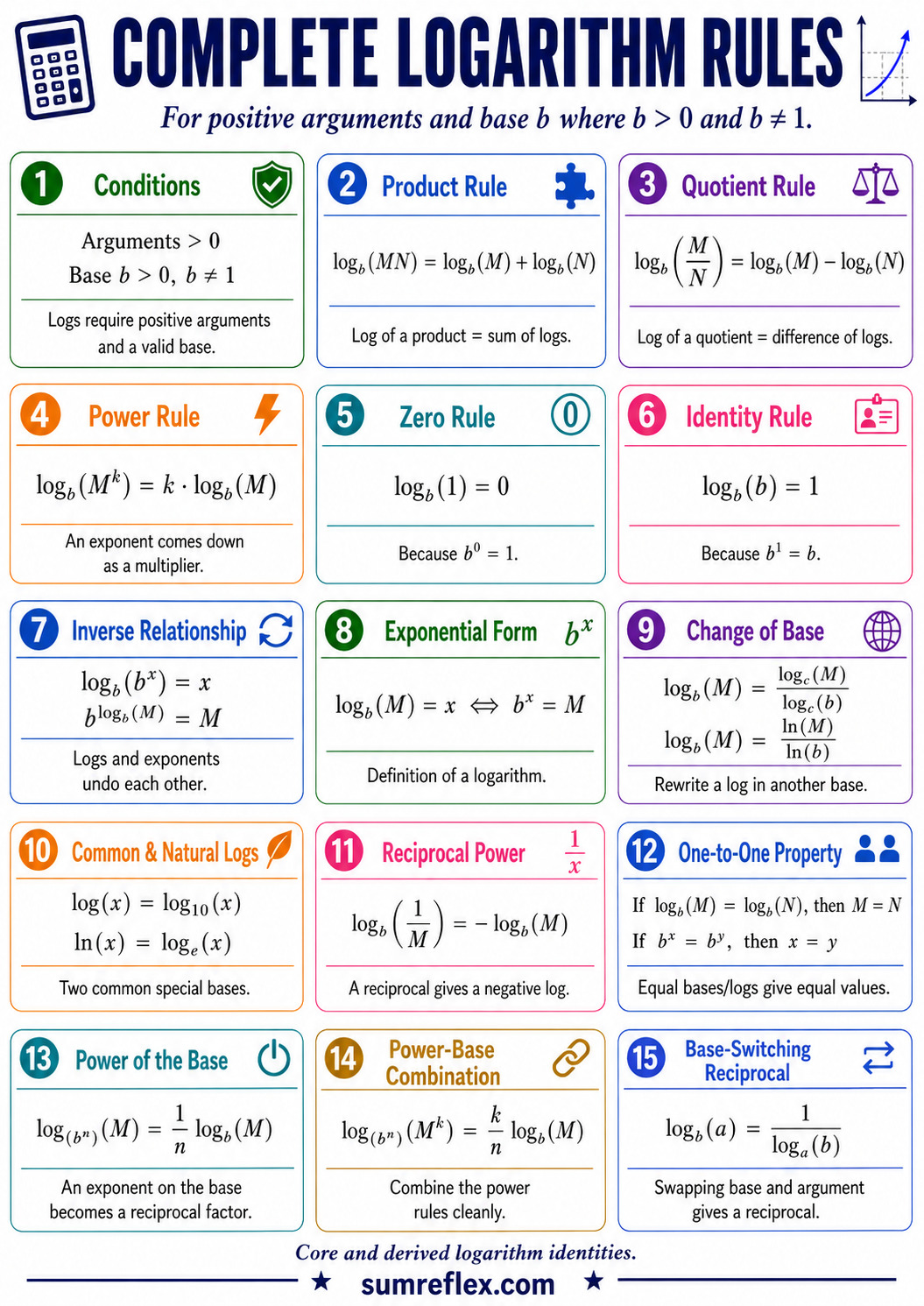
The first box matters as much as the formulas. A logarithm only works with a positive argument, and the base must be positive but not equal to 1. Before students simplify a logarithmic expression, they should quietly check whether every log input is allowed.
This is especially useful in equation work. If a problem contains log(x - 3), then x must be greater than 3 before any answer can be accepted. The chart keeps that restriction beside the rules so students do not treat logarithms like ordinary parentheses.
Use product, quotient, and power rules together
Most log simplification problems use the product, quotient, and power rules in combination. A product inside one logarithm becomes a sum of logs. A quotient becomes a difference. An exponent can move in front as a multiplier.
A good classroom routine is to ask what operation is inside the logarithm first. Multiplication points to the product rule, division points to the quotient rule, and an exponent points to the power rule. That order prevents students from inventing rules such as splitting log(M + N), which is not valid.
Connect the chart to the lesson page
Use this printable beside the Logarithm Rules lesson when students need worked examples with the same formulas. The lesson explains why the rules work, while the chart keeps the formulas visible during practice.
For quick checking, the Logarithm Calculator can evaluate a logarithm after students have chosen the correct rule or rewritten the expression by hand.
Best ways to print and use it
Print the chart for notebooks, algebra binders, tutoring sessions, or a classroom reference wall. It works best when students mark the rule they used on each homework step instead of simply copying a formula from memory.
For review, cover the formula line and leave only the rule name visible. Students can try to write the rule from memory, then uncover the chart to compare their notation and base placement.