


Cubes and cube roots notes
Using the cubes and cube roots chart with real practice
Read the two directions separately
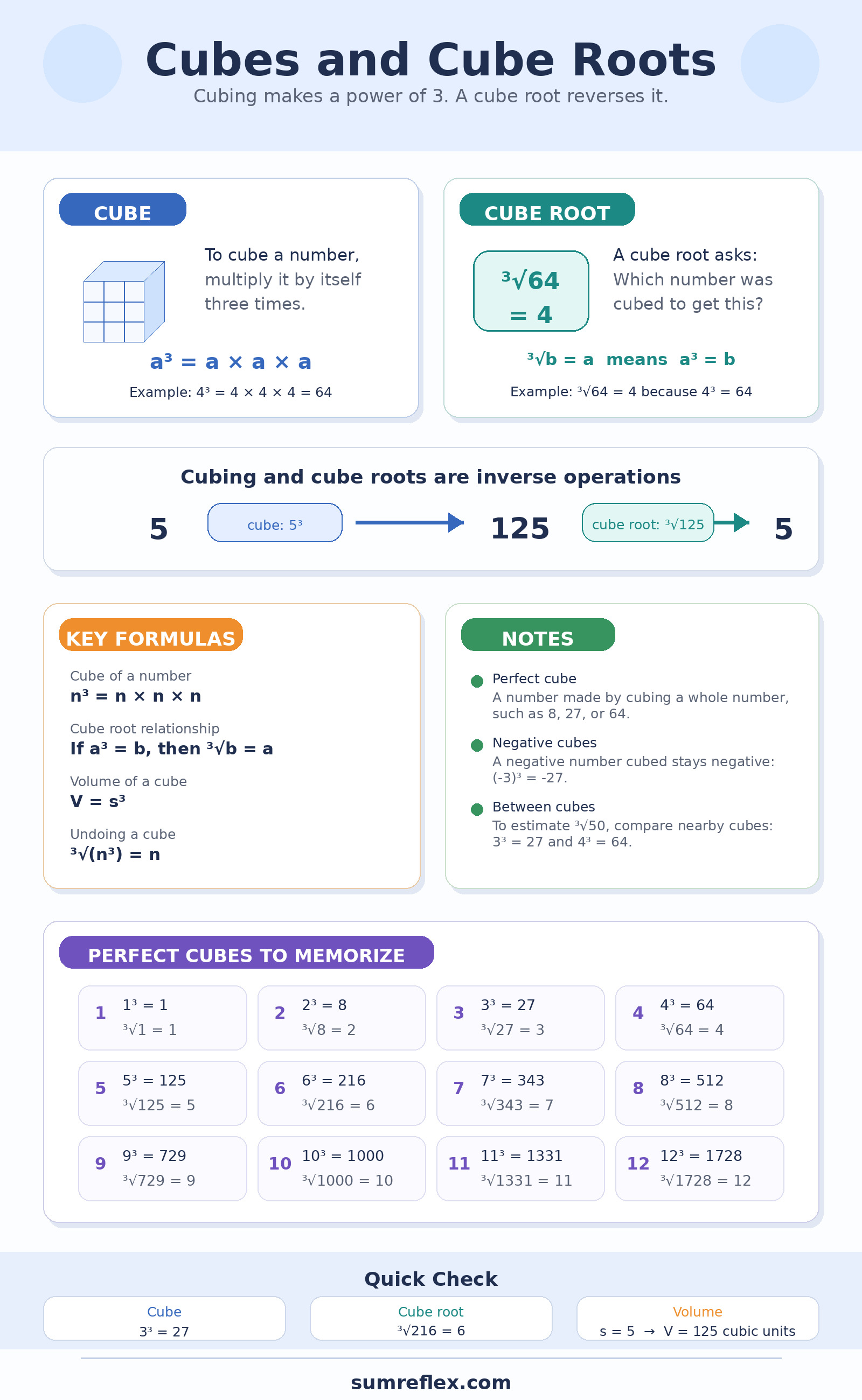
The top of the chart separates the two questions students must learn to hear. A cube asks for a result: \(a^3=a\times a\times a\). A cube root asks for the original base: \(\sqrt[3]{n}=a\) when \(a^3=n\). Keeping those directions side by side helps prevent the common mistake of treating every small \(3\) as the same instruction.
Use the chart with the full Cubes and Cube Roots lesson when students need worked examples, negative-number cases, fractions, estimates, and simplification steps beyond the quick reference.
Use perfect cubes as anchors
The perfect cube list is not only for memorizing answers. It gives students anchors for estimation. If \(27
For quick checking, ask students to cover the right side of the table and say the cube root fact from the cube fact. For example, \(8^3=512\) should lead to \(\sqrt[3]{512}=8\).
Make the check a habit
The bottom rule is the most useful habit on the page: cube a cube-root answer. If a student says \(\sqrt[3]{216}=6\), then \(6^3=216\) confirms it. If the cube does not return to the original number, the root answer needs another look.
After students finish the hand work, the Root Calculator can confirm cube roots, and the Exponent Calculator can confirm the cube-power check from the other direction.
Best ways to print and use it
Print this chart for Grade 8 algebra notebooks, exponent review, radical practice, tutoring folders, or a classroom reference wall. It works best beside written work where students must show the repeated multiplication or the cube-root check, not only write the final answer.
For review, give students a number from the chart, such as \(343\), and ask for three connected facts: \(7^3=343\), \(\sqrt[3]{343}=7\), and \(7\times7\times7=343\). The goal is to connect notation, language, and calculation.