


Grade 8 algebra lesson
Cubes and Cube Roots: Meaning, Formulas, Examples, Chart, and Checks
Cubes multiply a number by itself three times. Cube roots reverse that process by finding the number that was cubed.
What are cubes and cube roots?
A cube is the result of multiplying a number by itself three times.
For example, \(4^3\) means \(4 \times 4 \times 4\), so \(4^3 = 64\). The small \(3\) is called the exponent, and it tells you to use three equal factors.
A cube root goes in the opposite direction. It asks which number was multiplied by itself three times to make the number you see.
For example, \(\sqrt[3]{64}=4\) because \(4^3=64\).
For square roots, higher roots, simplification rules, radical operations, and equations, continue with Radicals.
Printable cubes and cube roots chart
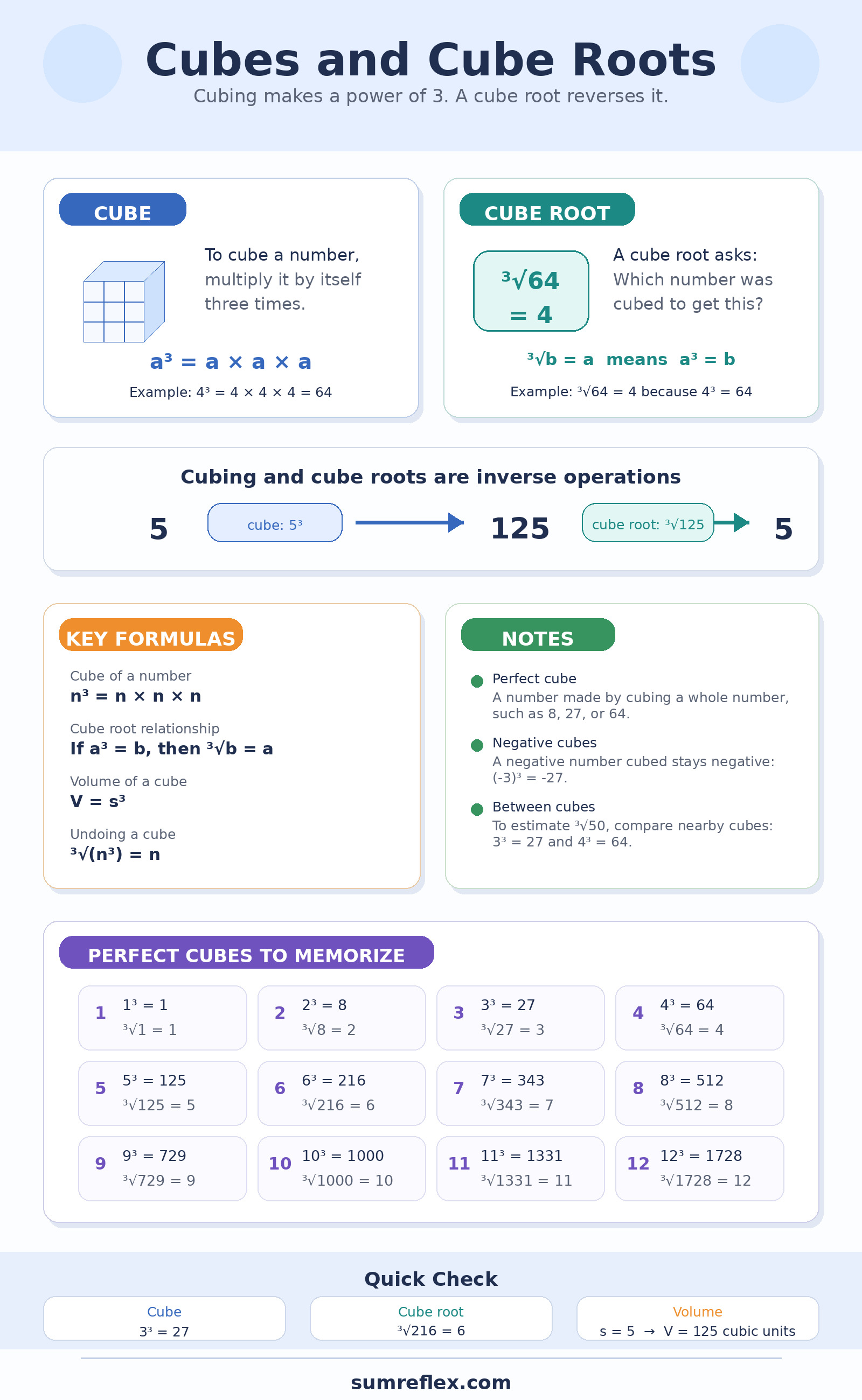
Use this SumReflex chart as a quick reference for the cube formula, cube root meaning, common perfect cubes, and the basic checking routine.
The same chart is also available in the Printable Algebra Charts section with print and download options.
Cube formula
The cube of a number \(a\) is written as \(a^3\).
\[a^3=a \times a \times a\]
The base is \(a\), and the exponent is \(3\). A cube is not the same as multiplying by \(3\). The expression \(5^3\) means \(5 \times 5 \times 5\), not \(5 \times 3\).
If you want a quick calculator check after doing the hand work, the Exponent Calculator can evaluate cube powers and other exponent expressions.
Cube root formula
The cube root of a number \(n\) is written as \(\sqrt[3]{n}\).
\[\sqrt[3]{n}=a \quad \text{means} \quad a^3=n\]
Read \(\sqrt[3]{125}=5\) as "the cube root of \(125\) is \(5\)." It is true because \(5^3=125\).
For a calculator check in root form, the Root Calculator can compare square roots, cube roots, and higher roots after students understand the setup.
Difference between cubes and cube roots
Cubes and cube roots are inverse operations. One direction starts with the base and builds the cube. The other direction starts with the cube and finds the base.
This difference matters because students often copy the \(3\) correctly but answer the wrong question.
| Feature | Cube | Cube Root |
|---|---|---|
| Main question | What is \(a^3\)? | What number cubed gives \(n\)? |
| Symbol | \(a^3\) | \(\sqrt[3]{n}\) |
| Operation | Multiply the same number three times. | Undo a cube by finding the original base. |
| Example | \(5^3=125\) | \(\sqrt[3]{125}=5\) |
| Direction | Base \(\rightarrow\) cube | Cube \(\rightarrow\) base |
| Negative numbers | \((-4)^3=-64\) | \(\sqrt[3]{-64}=-4\) |
| Best check | Multiply \(a \times a \times a\). | Cube the answer and see whether it returns to \(n\). |
Perfect cubes from 1 to 12
A perfect cube is a number that can be written as \(a^3\), where \(a\) is an integer.
These are worth knowing because many cube root questions are built from them.
| Base | Cube | Cube Root Fact |
|---|---|---|
| \(1\) | \(1^3=1\) | \(\sqrt[3]{1}=1\) |
| \(2\) | \(2^3=8\) | \(\sqrt[3]{8}=2\) |
| \(3\) | \(3^3=27\) | \(\sqrt[3]{27}=3\) |
| \(4\) | \(4^3=64\) | \(\sqrt[3]{64}=4\) |
| \(5\) | \(5^3=125\) | \(\sqrt[3]{125}=5\) |
| \(6\) | \(6^3=216\) | \(\sqrt[3]{216}=6\) |
| \(7\) | \(7^3=343\) | \(\sqrt[3]{343}=7\) |
| \(8\) | \(8^3=512\) | \(\sqrt[3]{512}=8\) |
| \(9\) | \(9^3=729\) | \(\sqrt[3]{729}=9\) |
| \(10\) | \(10^3=1000\) | \(\sqrt[3]{1000}=10\) |
| \(11\) | \(11^3=1331\) | \(\sqrt[3]{1331}=11\) |
| \(12\) | \(12^3=1728\) | \(\sqrt[3]{1728}=12\) |
Example 1: find a cube
Find \(6^3\).
Step 1: Rewrite the exponent as repeated multiplication: \(6^3=6 \times 6 \times 6\).
Step 2: Multiply the first two factors: \(6 \times 6=36\).
Step 3: Multiply by the third factor: \(36 \times 6=216\).
So \(6^3=216\).
Example 2: find a cube root
Find \(\sqrt[3]{216}\).
Step 1: Ask which number cubed equals \(216\).
Step 2: Use the perfect cube list or test likely values: \(5^3=125\) and \(6^3=216\).
Step 3: Since \(6^3=216\), the cube root is \(6\).
So \(\sqrt[3]{216}=6\).
Example 3: cube and cube root with a negative number
Cubes preserve the sign of the base. A negative number multiplied by itself three times stays negative because there are three negative factors.
Find \((-3)^3\):
\[(-3)^3=(-3)\times(-3)\times(-3)\]
\[(-3)\times(-3)=9,\quad 9\times(-3)=-27\]
So \((-3)^3=-27\).
Now reverse it: \(\sqrt[3]{-27}=-3\), because \((-3)^3=-27\).
Example 4: cube root of a fraction
A cube root can be taken from the numerator and denominator when both are perfect cubes.
Find \(\sqrt[3]{\frac{8}{27}}\).
Step 1: Split the fraction into two cube roots: \(\sqrt[3]{\frac{8}{27}}=\frac{\sqrt[3]{8}}{\sqrt[3]{27}}\).
Step 2: Use known cubes: \(\sqrt[3]{8}=2\) and \(\sqrt[3]{27}=3\).
So \(\sqrt[3]{\frac{8}{27}}=\frac{2}{3}\).
Example 5: estimate a cube root that is not perfect
Not every number is a perfect cube. When that happens, estimate between two known cube numbers.
Estimate \(\sqrt[3]{50}\).
The nearby perfect cubes are \(3^3=27\) and \(4^3=64\). Since \(50\) is between \(27\) and \(64\), \(\sqrt[3]{50}\) is between \(3\) and \(4\).
Because \(50\) is closer to \(64\) than to \(27\), the answer is closer to \(4\). A decimal estimate is about \(3.7\).
The exact answer stays as \(\sqrt[3]{50}\) unless the problem asks for a decimal approximation.
Example 6: simplify a cube root
Some cube roots are not whole numbers, but they can still be simplified by taking out a perfect cube factor.
Simplify \(\sqrt[3]{54}\).
Step 1: Factor \(54\) so that a perfect cube appears: \(54=27 \times 2\).
Step 2: Split the cube root: \(\sqrt[3]{54}=\sqrt[3]{27 \times 2}\).
Step 3: Take out the perfect cube: \(\sqrt[3]{27 \times 2}=3\sqrt[3]{2}\).
So \(\sqrt[3]{54}=3\sqrt[3]{2}\).
Cubes and volume of a cube
The word cube also appears in geometry because the volume of a cube uses the third power of its side length.
If a cube has side length \(s\), its volume is \[V=s^3\]
Example: a cube with side length \(7\text{ cm}\) has volume \(7^3=343\text{ cm}^3\).
If the volume is known instead, the side length is found with a cube root: \[s=\sqrt[3]{V}\]
Example: if \(V=512\text{ cm}^3\), then \(s=\sqrt[3]{512}=8\text{ cm}\). For broader shape practice, the Volume Calculator can check cube, cuboid, cylinder, cone, and sphere volume work after the formula is chosen.
Important cube rules
Rule 1: \(a^3=a \times a \times a\). The exponent \(3\) tells how many equal factors are used.
Rule 2: \(\sqrt[3]{a^3}=a\) for every real number \(a\).
Rule 3: \((ab)^3=a^3b^3\). For example, \((2\cdot5)^3=2^3\cdot5^3=8\cdot125=1000\).
Rule 4: \(\left(\frac{a}{b}\right)^3=\frac{a^3}{b^3}\), as long as \(b\ne0\).
Rule 5: Do not split addition: \((a+b)^3\ne a^3+b^3\) in general.
How to check if a cube root answer is correct
The cleanest check is to cube your answer.
If you claim \(\sqrt[3]{343}=7\), check by calculating \(7^3\).
\[7^3=7\times7\times7=343\]
Because the check returns to \(343\), the answer is correct.
For a negative example, if you claim \(\sqrt[3]{-125}=-5\), check \((-5)^3=-125\). That also returns to the original number.
Common mistakes students make
Mistake 1: Treating \(4^3\) as \(4\times3\). The correct meaning is \(4\times4\times4\).
Mistake 2: Forgetting that \((-2)^3=-8\). An odd number of negative factors gives a negative product.
Mistake 3: Writing \(\sqrt[3]{64}=8\). This confuses cube roots with square roots. Since \(4^3=64\), \(\sqrt[3]{64}=4\).
Mistake 4: Splitting sums incorrectly. \((2+3)^3=5^3=125\), but \(2^3+3^3=8+27=35\).
Mistake 5: Dropping the small \(3\) on the radical. \(\sqrt{64}\) means square root, while \(\sqrt[3]{64}\) means cube root.
Practice questions
1. Find \(3^3\).
2. Find \(9^3\).
3. Find \(\sqrt[3]{512}\).
4. Find \(\sqrt[3]{-216}\).
5. Simplify \(\sqrt[3]{81}\).
6. Estimate \(\sqrt[3]{20}\) between two whole numbers.
7. A cube has side length \(5\text{ in}\). What is its volume?
8. A cube has volume \(1000\text{ cm}^3\). What is its side length?
Practice answers
1. \(3^3=3\times3\times3=27\).
2. \(9^3=729\).
3. \(\sqrt[3]{512}=8\), because \(8^3=512\).
4. \(\sqrt[3]{-216}=-6\), because \((-6)^3=-216\).
5. \(81=27\times3\), so \(\sqrt[3]{81}=3\sqrt[3]{3}\).
6. \(2^3=8\) and \(3^3=27\), so \(\sqrt[3]{20}\) is between \(2\) and \(3\).
7. \(V=5^3=125\text{ in}^3\).
8. \(s=\sqrt[3]{1000}=10\text{ cm}\).
The big idea
A cube is a third power: \(a^3\). A cube root is the inverse question: \(\sqrt[3]{n}\).
When a problem asks for a cube, multiply the base three times. When it asks for a cube root, look for the base that produces the number.
The best habit is simple: after finding a cube root, cube your answer. If it returns to the original number, your answer fits.