


Grade 8 algebra lesson
Graphs of Simple Functions: Tables, Ordered Pairs, and Lines
A simple function graph shows how y changes when x changes. Make a table, turn the table into ordered pairs, plot the points, join them, and read values from the graph.
What is a simple function?
A function is a rule that takes an input and gives exactly one output.
In many beginner graphing problems, the input is called x and the output is called y.
For example, the rule y = 3x means: choose an x-value, multiply it by 3, and the answer is the y-value.
So if x = 4, then y = 3 * 4 = 12. The ordered pair is (4, 12).
The basic graphing plan
Most simple function graphs can be made with the same four-step plan.
Step 1: Choose a few easy x-values.
Step 2: Use the function rule to calculate each y-value.
Step 3: Write the answers as ordered pairs: (x, y).
Step 4: Plot the points on a coordinate plane and join them with a smooth straight line when the pattern is linear.
Printable simple function graph chart
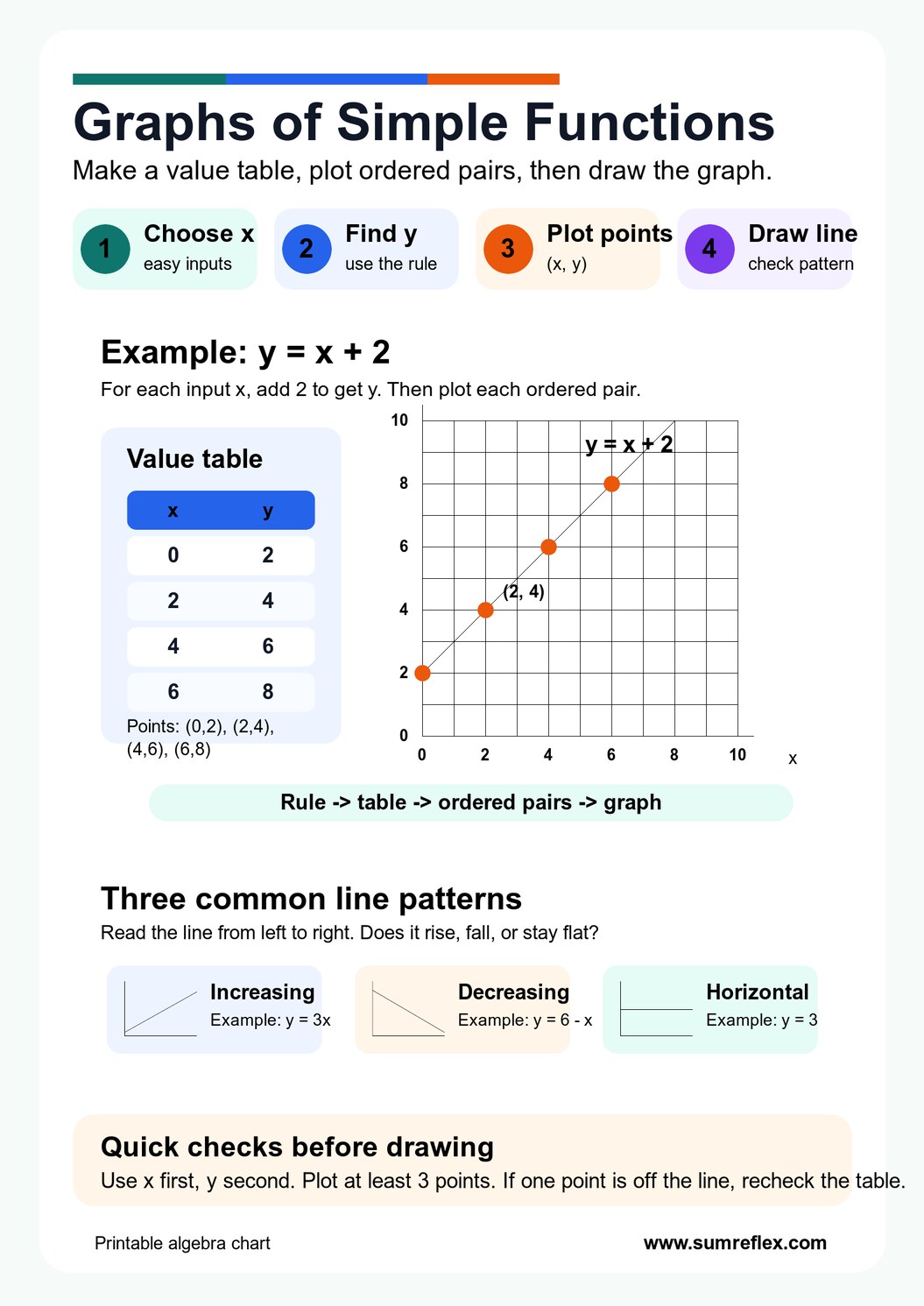
Use this SumReflex chart as a quick visual reminder of the full graphing path: rule, value table, ordered pairs, plotted points, and line graph.
The same chart is also available in the Printable Algebra Charts section with print and download options.
Why we use a value table
A value table keeps the work organized.
Instead of guessing where the line goes, you calculate several matching x and y values.
Every row in the table becomes one point on the graph.
A row with x = 2 and y = 6 becomes the ordered pair (2, 6).
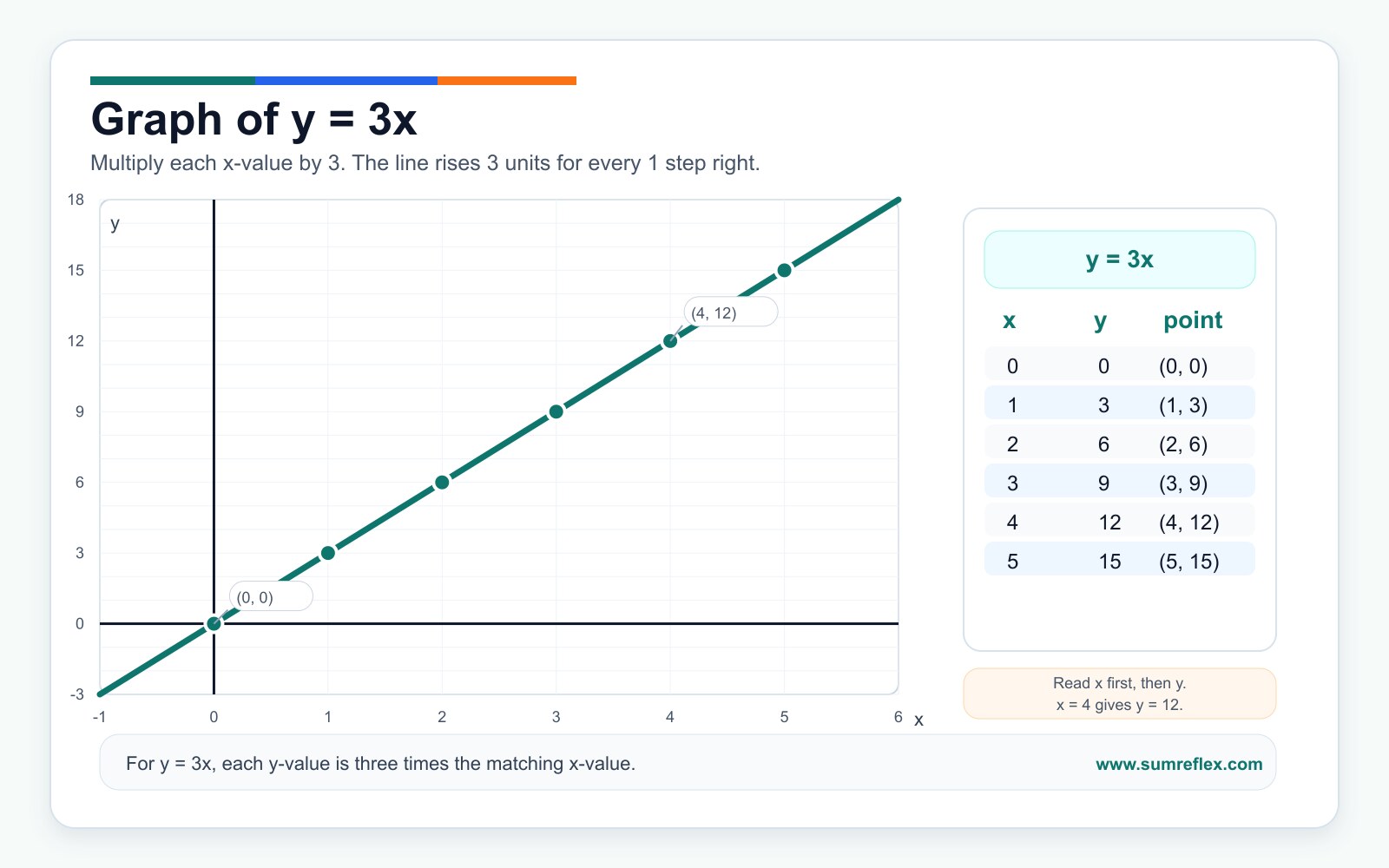
Example 1: graph y = 3x
Rule: y = 3x.
Choose x = 0, 1, 2, 3, 4, 5 because these are easy to multiply.
Use the rule: 0 -> 0, 1 -> 3, 2 -> 6, 3 -> 9, 4 -> 12, 5 -> 15.
The ordered pairs are (0, 0), (1, 3), (2, 6), (3, 9), (4, 12), and (5, 15).
After plotting the points, they line up. Join them to show the graph of the function.
Reading a value from the graph
A graph can answer a question without recalculating every time.
For y = 3x, look at x = 4. Move up from x = 4 until you reach the line. Then move across to the y-axis.
The graph shows y = 12, so the point is (4, 12).
This matches the rule because 3 * 4 = 12.
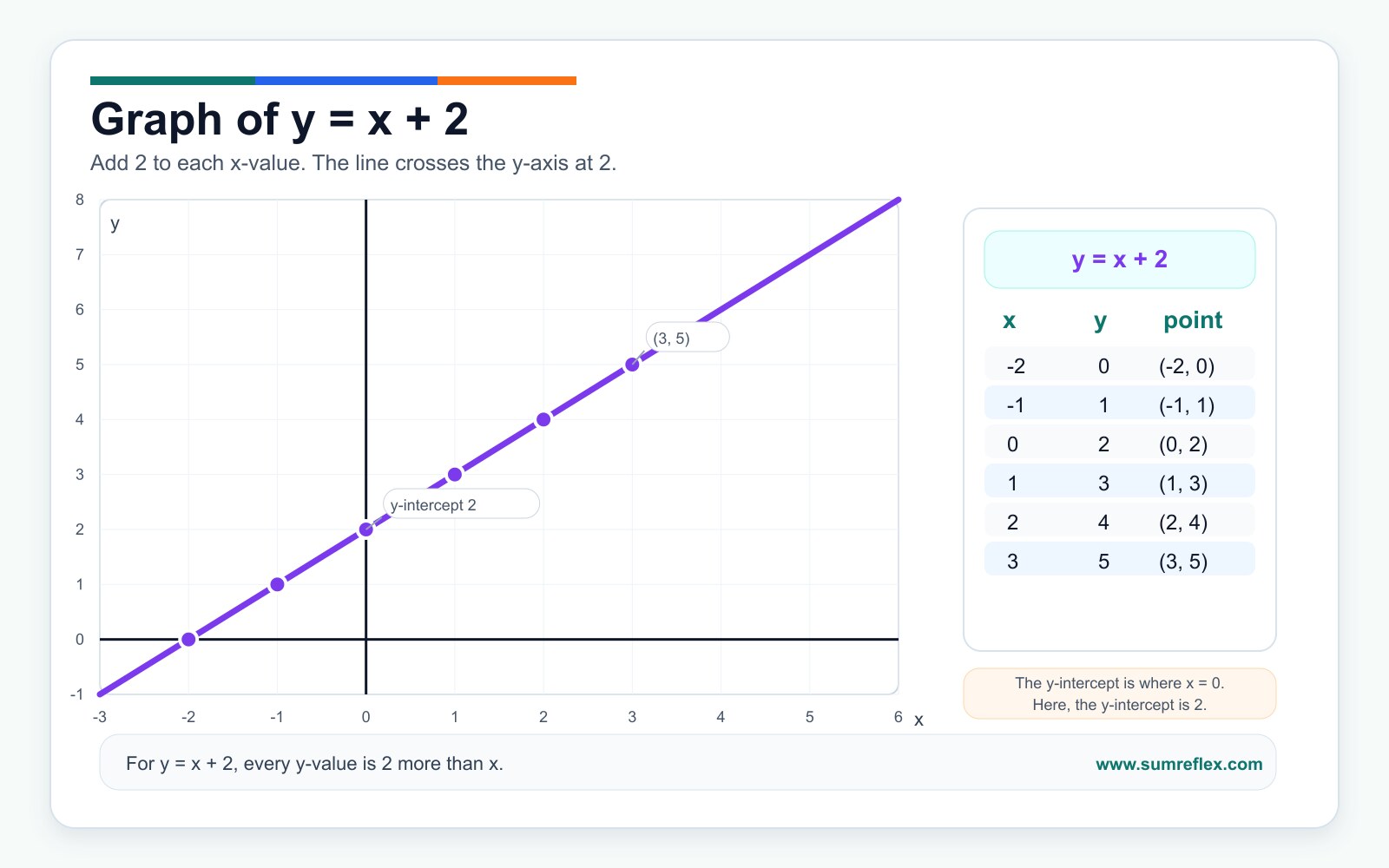
Example 2: graph y = x + 2
Rule: y = x + 2.
This rule means: take the x-value and add 2.
If x = -2, then y = -2 + 2 = 0, so the point is (-2, 0).
If x = 3, then y = 3 + 2 = 5, so the point is (3, 5).
The line crosses the y-axis at 2 because when x = 0, y = 2.
What the y-intercept means
The y-intercept is where the graph crosses the y-axis.
At the y-axis, x = 0.
In y = x + 2, when x = 0, y = 2. So the y-intercept is 2.
This is useful because it gives you one point immediately: (0, 2).
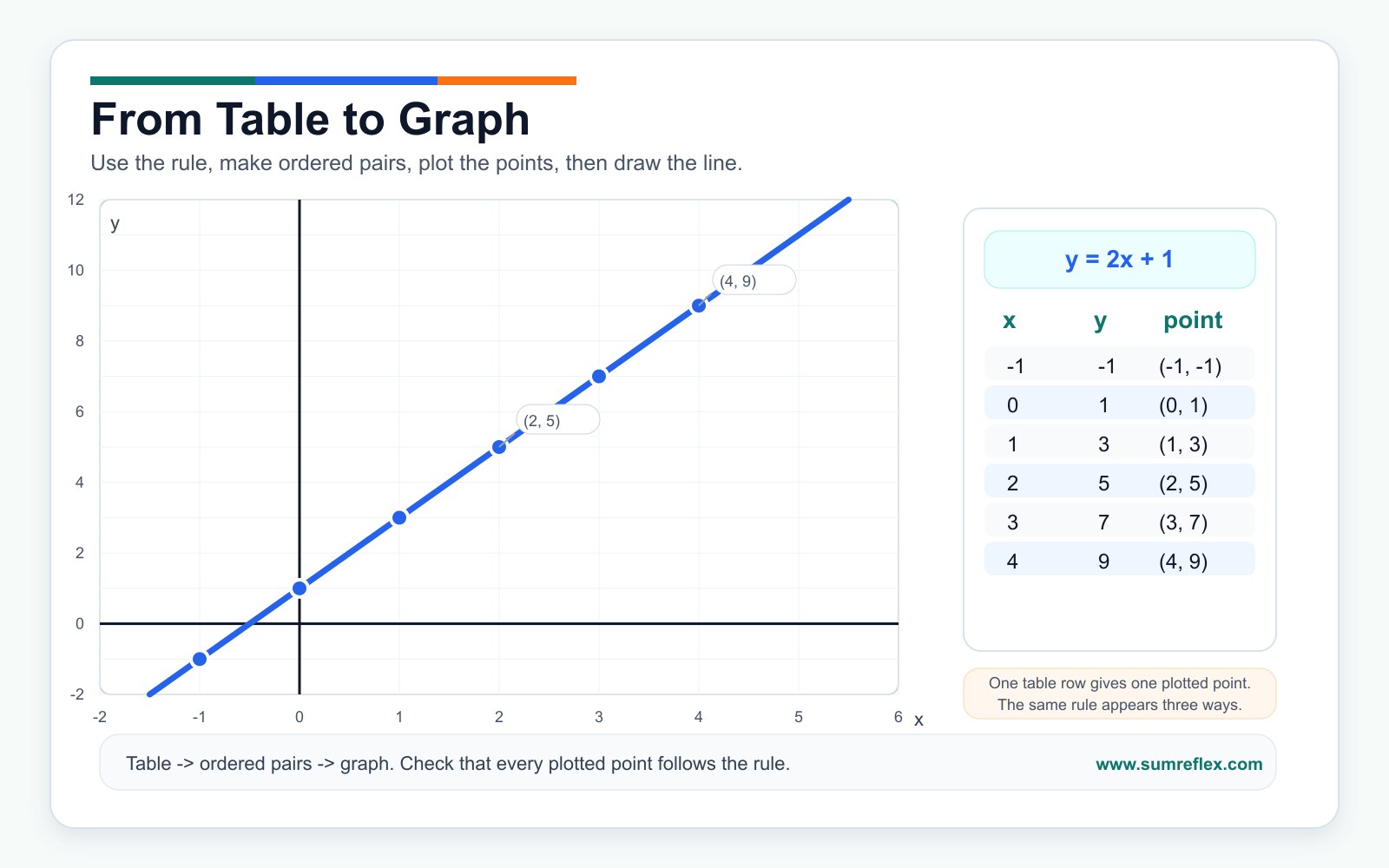
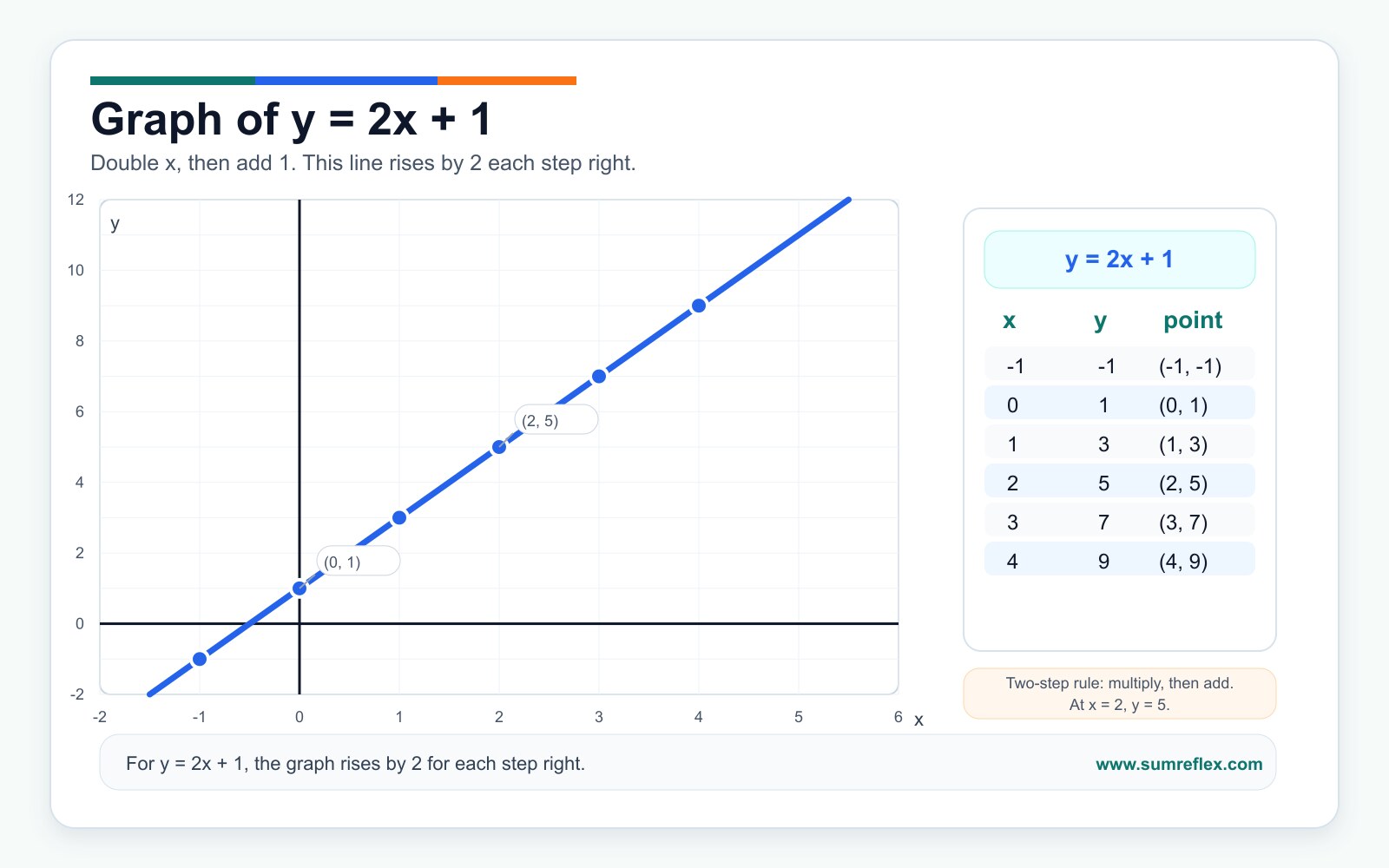
Example 3: graph y = 2x + 1
Rule: y = 2x + 1.
This is a two-step rule. First double x. Then add 1.
If x = 2, then y = 2 * 2 + 1 = 5.
If x = 4, then y = 2 * 4 + 1 = 9.
Because the output increases by 2 each time x increases by 1, the line rises faster than y = x + 2.
The slope idea in simple words
The steepness of a line tells how quickly y changes as x changes.
In y = 3x, the line rises 3 units when x moves 1 unit right.
In y = 2x + 1, the line rises 2 units when x moves 1 unit right.
A bigger rise makes a steeper line.
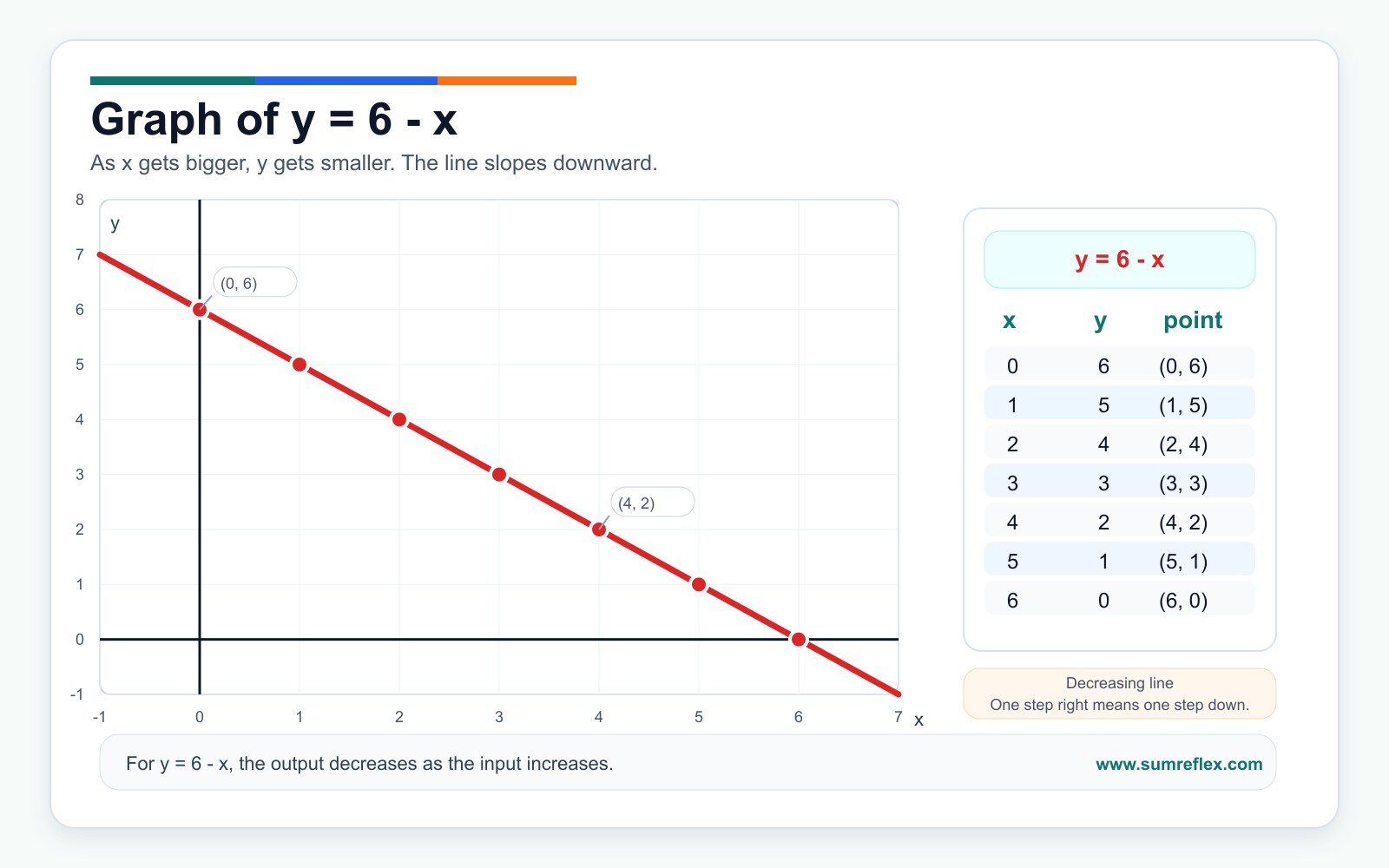
Example 4: graph y = 6 - x
Rule: y = 6 - x.
This rule means: start at 6 and subtract the x-value.
If x = 0, then y = 6.
If x = 4, then y = 6 - 4 = 2.
As x gets larger, y gets smaller. That is why the line slopes downward.
Increasing and decreasing graphs
A graph is increasing when it rises as you move from left to right.
y = 3x, y = x + 2, and y = 2x + 1 are increasing lines.
A graph is decreasing when it falls as you move from left to right.
y = 6 - x is decreasing because each larger x-value gives a smaller y-value.
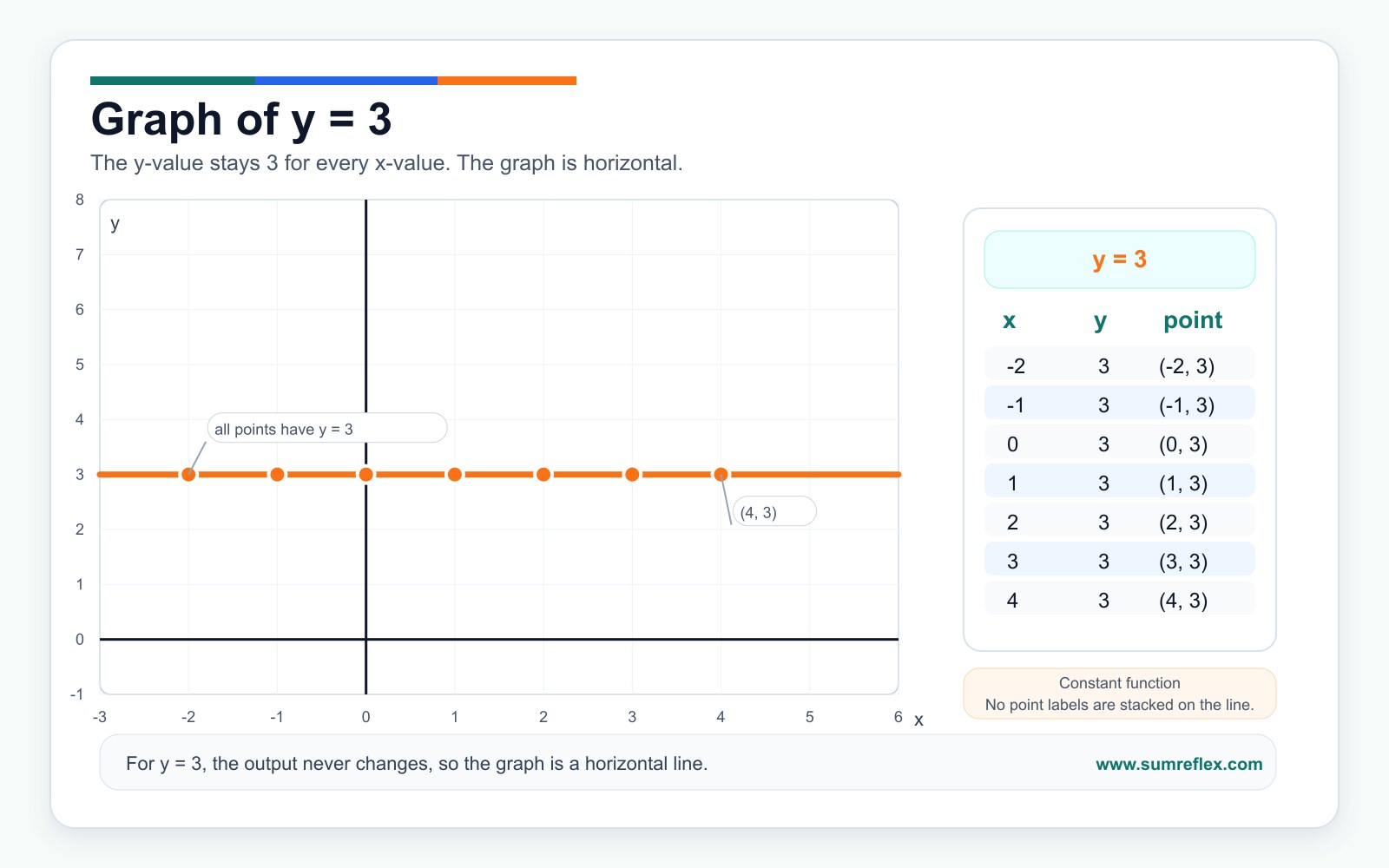
Example 5: graph y = 3
Rule: y = 3.
This rule does not use x. That means the y-value is always 3.
The points could be (-2, 3), (0, 3), (2, 3), and (4, 3).
All the points sit on the same horizontal line.
This kind of function is called a constant function.
Do all simple function graphs make a straight line?
Many beginner simple functions make straight lines, especially rules like y = 3x, y = x + 2, and y = 6 - x.
These are linear functions.
Not every function in math is a straight line. Later, students meet curved graphs such as y = x^2.
For this lesson, the focus is on simple linear graphs because they are the best starting point for learning tables, ordered pairs, and coordinate graphing.
How to choose x-values
Choose values that are easy to calculate and easy to plot.
For a beginner graph, x = 0, 1, 2, 3, 4 is often enough.
If the graph uses negative numbers, include values such as -2, -1, 0, 1, 2.
You do not need every possible point. You need enough points to see the pattern and draw the line correctly.
How to plot ordered pairs correctly
An ordered pair is written as (x, y).
Read the x-value first. Move right for positive x and left for negative x.
Then read the y-value. Move up for positive y and down for negative y.
If you need a coordinate plane refresher, review positive quadrant plotting first, then all four quadrants.
Worked word problem: ticket cost
A school event charges $4 per ticket. Let x be the number of tickets and y be the total cost.
The function is y = 4x.
If x = 0, the cost is $0. If x = 1, the cost is $4. If x = 5, the cost is $20.
The graph would be a straight line that goes through (0, 0), (1, 4), and (5, 20).
The graph helps you see the cost rising by $4 for each extra ticket.
Common mistakes
Mistake 1: Switching the coordinates. The point (2, 6) is not the same as (6, 2).
Mistake 2: Forgetting the order of operations. In y = 2x + 1, multiply first, then add 1.
Mistake 3: Drawing a line before checking points. Plot at least three points so one wrong point is easier to spot.
Mistake 4: Reading only the dots. A line graph also lets you read values between plotted points when the pattern is continuous.
Quick check: which graph is steeper?
Compare y = 2x and y = 5x.
For every 1 step right, y = 2x rises 2.
For every 1 step right, y = 5x rises 5.
So y = 5x is steeper.
Practice questions
1. Complete the table for y = 2x when x = 0, 1, 2, 3.
2. For y = x + 5, what is y when x = 4?
3. For y = 10 - x, what is y when x = 6?
4. Does y = 4 make a rising line, falling line, or horizontal line?
5. Which point is on the graph of y = 3x + 1: (2, 6) or (2, 7)?
Practice answers
1. The y-values are 0, 2, 4, 6. The points are (0, 0), (1, 2), (2, 4), and (3, 6).
2. y = 4 + 5 = 9.
3. y = 10 - 6 = 4.
4. y = 4 is horizontal because y is always 4.
5. (2, 7) is on the graph because 3 * 2 + 1 = 7.
The big idea
A simple function graph is not just a picture. It is the same rule shown visually.
The equation tells the rule, the table organizes values, the ordered pairs locate points, and the graph shows the whole pattern.
Once students understand that connection, graphing becomes much easier to read and explain.