



Grade 7 probability lesson
Probability: Types, Formulas, Examples, and Solved Problems
Probability measures how likely an event is. It can be written as a fraction, decimal, or percent from 0 to 1.
What is probability?
Probability is a number that tells how likely an event is to happen.
A probability of 0 means the event is impossible. A probability of 1 means the event is certain.
Most probabilities are between 0 and 1. They can be written as fractions, decimals, or percents.
Example: If a fair coin is flipped, the probability of heads is 1 / 2 = 0.5 = 50%.
Probability reference chart
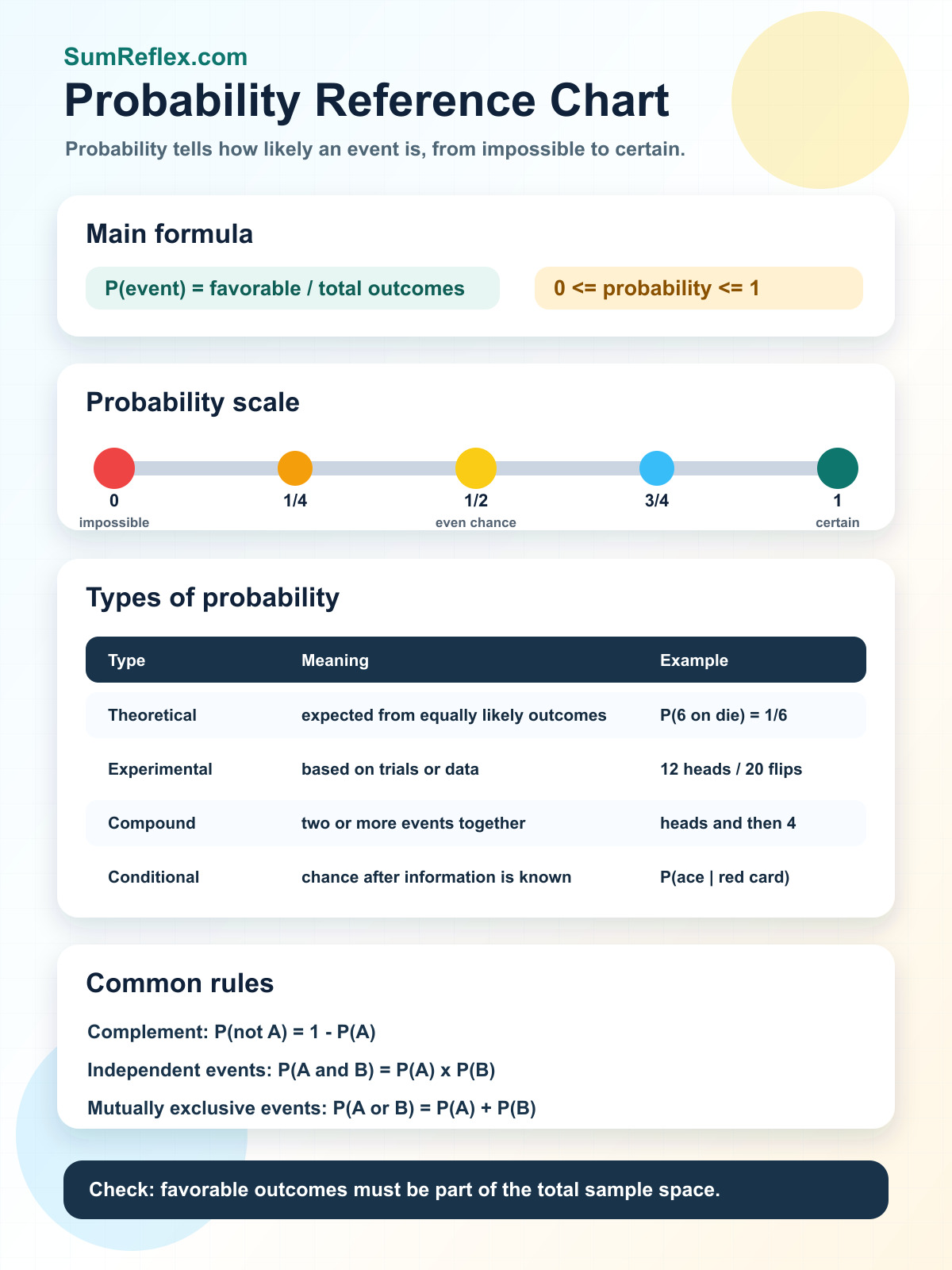
Use this SumReflex chart to remember the main formula, the probability scale, common types of probability, and important rules.
The key formula is P(event) = favorable outcomes / total outcomes when all outcomes are equally likely.
Probability vocabulary
An experiment is an action with an uncertain result, such as rolling a die, flipping a coin, or choosing a card.
An outcome is one possible result. Rolling a 4 is an outcome.
The sample space is the set of all possible outcomes.
An event is the outcome or group of outcomes we care about. Rolling an even number is an event because it includes 2, 4, and 6.
The probability formula
When outcomes are equally likely, use this formula: P(event) = favorable outcomes / total outcomes.
Favorable outcomes are the outcomes that make the event happen.
Total outcomes are all possible outcomes in the sample space.
Example: A die has 6 total outcomes: 1, 2, 3, 4, 5, and 6. The favorable outcomes for rolling an even number are 2, 4, and 6. So P(even) = 3 / 6 = 1 / 2.
Probability scale
A probability is always from 0 to 1.
0 means impossible. Example: rolling a 7 on a standard six-sided die.
1 / 2 means equally likely to happen or not happen. Example: flipping heads on a fair coin.
1 means certain. Example: rolling a number less than 7 on a standard die.
A probability close to 1 is very likely. A probability close to 0 is very unlikely.
Theoretical probability
Theoretical probability is the probability we expect from the structure of the situation.
It is often used when outcomes are equally likely, such as a fair die, fair coin, or well-shuffled deck.
Example: A fair die has 6 equally likely outcomes. The probability of rolling a 5 is 1 / 6.
Example: The probability of drawing a heart from a standard 52-card deck is 13 / 52 = 1 / 4.
Experimental probability
Experimental probability is based on what actually happens in trials or collected data.
Formula: experimental probability = number of times event happens / number of trials.
Example: If a coin lands on heads 27 times in 50 flips, the experimental probability of heads is 27 / 50 = 0.54 = 54%.
Experimental probability may not match theoretical probability exactly, especially with a small number of trials.
Empirical probability
Empirical probability is probability based on observed real-world data.
It is very close to experimental probability, but the data often comes from surveys, records, or past events instead of a classroom experiment.
Example: If it rained on 18 of the last 60 school days, an empirical estimate for rain on a school day is 18 / 60 = 0.30 = 30%.
Empirical probability is useful when theoretical probabilities are not obvious.
Subjective probability
Subjective probability is a reasoned estimate based on judgment, experience, or available clues.
It is not the same as guessing randomly. It should be based on evidence.
Example: A coach may say a team has a 70% chance to win after considering injuries, past games, and current performance.
Subjective probability is common in forecasts, predictions, and decisions where exact counts are not available.
Simple probability
Simple probability is the probability of one event.
Example: Roll one die. What is the probability of rolling a 3?
There is 1 favorable outcome and 6 total outcomes, so P(3) = 1 / 6.
Example: Choose one card. What is the probability of drawing a red card? There are 26 red cards out of 52, so 26 / 52 = 1 / 2.
Compound probability
Compound probability involves two or more events.
Examples include flipping two coins, rolling two dice, drawing two cards, or spinning a spinner and rolling a die.
Compound events often use the words and or or.
And usually means both events happen. Or usually means at least one event happens.
Independent events
Independent events do not affect each other.
Example: Flipping a coin and rolling a die are independent. The coin result does not change the die result.
Rule: P(A and B) = P(A) * P(B) for independent events.
Example: Probability of heads and rolling a 6 is 1 / 2 * 1 / 6 = 1 / 12.
Dependent events
Dependent events affect each other.
This often happens when items are chosen without replacement.
Example: Draw one card from a deck and keep it out. The probability for the second draw changes because the deck now has 51 cards.
Example: Probability of drawing two aces without replacement is 4 / 52 * 3 / 51 = 12 / 2652 = 1 / 221.
Mutually exclusive events
Mutually exclusive events cannot happen at the same time in one trial.
Example: When one die is rolled, rolling a 2 and rolling a 5 are mutually exclusive because one roll cannot be both 2 and 5.
Rule: P(A or B) = P(A) + P(B) when A and B are mutually exclusive.
Example: P(2 or 5) = 1 / 6 + 1 / 6 = 2 / 6 = 1 / 3.
Overlapping events
Some events can happen at the same time. These are not mutually exclusive.
Example: In one card draw, the event red card and the event queen can overlap because the queen of hearts and queen of diamonds are both red queens.
Rule: P(A or B) = P(A) + P(B) - P(A and B).
We subtract the overlap so it is not counted twice.
Complementary probability
The complement of an event is everything that is not the event.
Rule: P(not A) = 1 - P(A).
Example: If the probability of rain is 0.30, then the probability of no rain is 1 - 0.30 = 0.70.
Complements are useful when it is easier to count what you do not want.
Conditional probability
Conditional probability is the probability of an event after some information is already known.
It is written like this: P(A | B), which means probability of A given B.
Example: A card is known to be red. What is the probability it is a heart?
There are 26 red cards. Of those, 13 are hearts. So P(heart | red) = 13 / 26 = 1 / 2.
Probability from frequency tables
Probability can be estimated from data in a frequency table.
Use the same idea as relative frequency: probability estimate = category frequency / total frequency.
Example: If 18 out of 60 students choose soccer, the probability estimate for choosing soccer is 18 / 60 = 3 / 10 = 30%.
This connects probability with the lesson on absolute frequency and relative frequency.
Step-by-step solved problem 1: die probability
Problem: A fair six-sided die is rolled. What is the probability of rolling an even number?
Step 1: Write the sample space: {1, 2, 3, 4, 5, 6}.
Step 2: Count total outcomes: 6.
Step 3: Count favorable outcomes: {2, 4, 6}, so there are 3.
Step 4: Use the formula: P(even) = 3 / 6 = 1 / 2 = 50%.
Answer: The probability of rolling an even number is 1 / 2.
Step-by-step solved problem 2: spinner probability
Problem: A spinner has 8 equal sections: 3 red, 2 blue, 2 green, and 1 yellow. What is the probability of landing on red?
Step 1: Total sections: 3 + 2 + 2 + 1 = 8.
Step 2: Favorable red sections: 3.
Step 3: Use the formula: P(red) = 3 / 8.
Step 4: Convert if needed: 3 / 8 = 0.375 = 37.5%.
Answer: The probability is 3 / 8 or 37.5%.
Step-by-step solved problem 3: complement
Problem: A bag has 5 red marbles, 7 blue marbles, and 8 green marbles. What is the probability of not choosing a blue marble?
Step 1: Total marbles: 5 + 7 + 8 = 20.
Step 2: Probability of blue: 7 / 20.
Step 3: Use the complement rule: P(not blue) = 1 - 7 / 20.
Step 4: Calculate: 20 / 20 - 7 / 20 = 13 / 20.
Answer: The probability of not choosing blue is 13 / 20 = 65%.
Step-by-step solved problem 4: independent events
Problem: A coin is flipped and a die is rolled. What is the probability of heads and a number greater than 4?
Step 1: Probability of heads is 1 / 2.
Step 2: Numbers greater than 4 on a die are 5 and 6, so P(greater than 4) = 2 / 6 = 1 / 3.
Step 3: The events are independent, so multiply: 1 / 2 * 1 / 3 = 1 / 6.
Answer: The probability is 1 / 6.
Step-by-step solved problem 5: dependent events
Problem: A bag has 4 red marbles and 6 blue marbles. Two marbles are chosen without replacement. What is the probability both are red?
Step 1: On the first draw, there are 4 red marbles out of 10 total, so P(first red) = 4 / 10.
Step 2: If the first marble is red and kept out, there are 3 red marbles left out of 9 total.
Step 3: Multiply: 4 / 10 * 3 / 9 = 12 / 90.
Step 4: Simplify: 12 / 90 = 2 / 15.
Answer: The probability both are red is 2 / 15.
Step-by-step solved problem 6: mutually exclusive events
Problem: One die is rolled. What is the probability of rolling a 1 or a 6?
Step 1: Rolling a 1 and rolling a 6 cannot happen at the same time on one die roll.
Step 2: So the events are mutually exclusive.
Step 3: Add the probabilities: 1 / 6 + 1 / 6 = 2 / 6.
Step 4: Simplify: 2 / 6 = 1 / 3.
Answer: The probability is 1 / 3.
Step-by-step solved problem 7: overlapping events
Problem: One card is drawn from a standard deck. What is the probability of drawing a red card or a queen?
Step 1: There are 26 red cards, so P(red) = 26 / 52.
Step 2: There are 4 queens, so P(queen) = 4 / 52.
Step 3: The overlap is red queens. There are 2 red queens, so subtract 2 / 52.
Step 4: P(red or queen) = 26 / 52 + 4 / 52 - 2 / 52 = 28 / 52 = 7 / 13.
Answer: The probability is 7 / 13.
Step-by-step solved problem 8: conditional probability
Problem: A card is drawn from a deck and you are told it is a face card. What is the probability it is a king?
Step 1: The condition is that the card is a face card.
Step 2: Face cards are jacks, queens, and kings. There are 12 face cards total.
Step 3: Of those 12 face cards, 4 are kings.
Step 4: P(king | face card) = 4 / 12 = 1 / 3.
Answer: The probability is 1 / 3.
Common probability mistakes
Do not count favorable outcomes that are not part of the sample space.
Do not add probabilities for and problems unless the question really means or.
Do not multiply without checking whether events are independent or dependent.
Do not forget to subtract overlap when events can happen together.
Do not write a probability greater than 1 or less than 0.
Practice problems
1. A die is rolled. What is the probability of rolling a number less than 3?
2. A coin is flipped twice. What is the probability of getting heads both times?
3. A bag has 3 red, 5 blue, and 2 yellow marbles. What is the probability of choosing yellow?
4. A card is drawn. What is the probability of drawing a club?
5. A card is drawn. What is the probability of drawing an ace or a king?
6. A spinner has 10 equal sections, 4 green and 6 purple. What is the probability of not landing on green?
Practice answers
1. Numbers less than 3 are 1 and 2, so 2 / 6 = 1 / 3.
2. 1 / 2 * 1 / 2 = 1 / 4.
3. Total marbles are 10, so P(yellow) = 2 / 10 = 1 / 5.
4. There are 13 clubs out of 52 cards, so 13 / 52 = 1 / 4.
5. Aces and kings do not overlap in one card draw, so 4 / 52 + 4 / 52 = 8 / 52 = 2 / 13.
6. Not green means purple, so 6 / 10 = 3 / 5.
Final summary
Probability measures likelihood from 0 to 1.
Use P(event) = favorable outcomes / total outcomes when outcomes are equally likely.
Theoretical probability is expected from the sample space. Experimental and empirical probability come from data.
Compound probability may involve independent, dependent, mutually exclusive, overlapping, complementary, or conditional events.
Use the probability playground below to compare theoretical probability with experimental results from repeated trials.
Probability playground
Compare theoretical and experimental probability
Choose an experiment, choose the event, run trials, and compare the experimental result with the theoretical probability.
Select an experiment, then run trials.