



Grade 7 statistics lesson
Absolute Frequency and Relative Frequency
Absolute frequency is the count in a category. Relative frequency compares that count to the total by writing it as a fraction, decimal, or percent.
What is frequency in statistics?
In statistics, frequency means how many times something happens or how many times a value appears in a data set.
If 6 students choose apples in a survey, the frequency for apples is 6.
Frequency can describe categories such as favorite fruit, transport method, and eye color. It can also describe numbers such as quiz scores, shoe sizes, and number of books read.
Absolute frequency and relative frequency chart
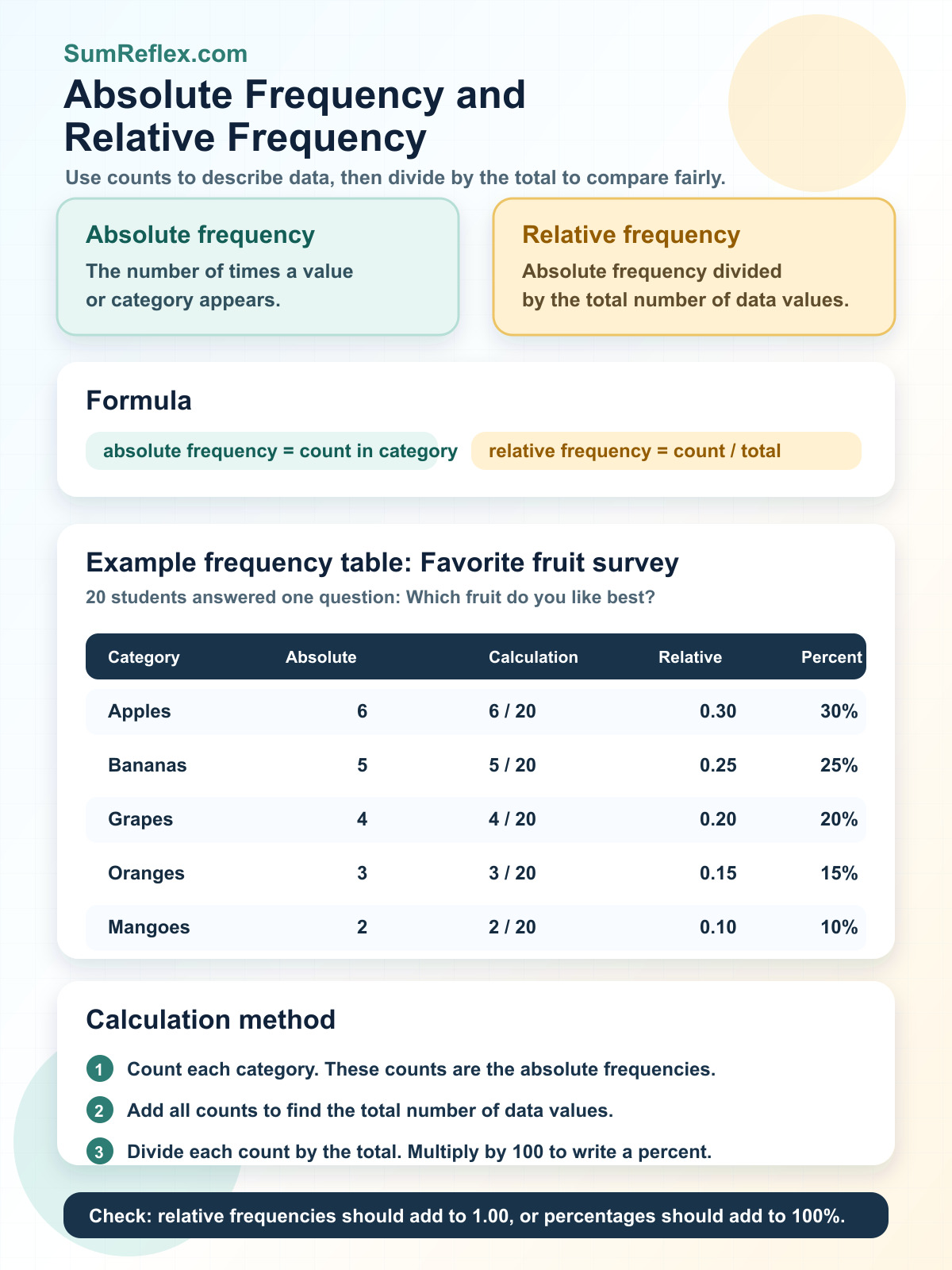
Use this SumReflex chart as a quick reference. It shows the difference between a count and a comparison to the whole group.
In the fruit survey, 20 students answered. Apples have an absolute frequency of 6. The relative frequency is 6 / 20 = 0.30 = 30%.
What is absolute frequency?
Absolute frequency is the actual count for one value or category.
It answers the question: How many?
Example: In a class survey, 9 students walk to school. The absolute frequency for walk is 9.
Example: In a quiz score list, the score 8 appears 4 times. The absolute frequency of 8 is 4.
What is relative frequency?
Relative frequency compares one absolute frequency to the total number of observations.
It answers the question: What part of the whole group?
Relative frequency can be written as a fraction, decimal, or percent.
Example: If 9 out of 30 students walk to school, the relative frequency is 9 / 30 = 0.30 = 30%.
Formula for absolute frequency
Absolute frequency is found by counting.
Formula: absolute frequency = number of times the value or category appears.
If the category is apples and apples appears 6 times, then the absolute frequency for apples is 6.
The total number of observations is found by adding all absolute frequencies.
Formula for relative frequency
Formula: relative frequency = absolute frequency / total number of observations.
Percent formula: percent relative frequency = (absolute frequency / total) * 100%.
If the absolute frequency is 6 and the total is 20, then 6 / 20 = 0.30.
To write the answer as a percent, multiply by 100: 0.30 * 100% = 30%.
Calculation method
Step 1: Write the categories or values you want to count.
Step 2: Count how many times each category or value appears. These are the absolute frequencies.
Step 3: Add all the absolute frequencies to find the total number of observations.
Step 4: Divide each absolute frequency by the total to get the relative frequency.
Step 5: Convert the decimal to a percent if needed. Decimals should add to about 1.00, and percents should add to about 100%.
Example 1: favorite fruit survey
A class survey asks 20 students to choose one favorite fruit.
The counts are apples 6, bananas 5, grapes 4, oranges 3, and mangoes 2.
These counts are the absolute frequencies: 6, 5, 4, 3, and 2.
The total is 6 + 5 + 4 + 3 + 2 = 20.
Apples: 6 / 20 = 0.30 = 30%. Bananas: 5 / 20 = 0.25 = 25%. Grapes: 4 / 20 = 0.20 = 20%.
Oranges: 3 / 20 = 0.15 = 15%. Mangoes: 2 / 20 = 0.10 = 10%.
Check: 30% + 25% + 20% + 15% + 10% = 100%.
Example 2: quiz scores
A teacher records these quiz scores: 8, 7, 9, 8, 10, 7, 8, 9, 8, 10.
The score 7 appears 2 times, so its absolute frequency is 2.
The score 8 appears 4 times, so its absolute frequency is 4.
The score 9 appears 2 times, and the score 10 appears 2 times.
There are 10 scores in total. The relative frequency for score 8 is 4 / 10 = 0.40 = 40%.
The relative frequency for score 7 is 2 / 10 = 0.20 = 20%. Scores 9 and 10 also have relative frequencies of 20% each.
Example 3: colors of marbles
A bag has 12 red marbles, 8 blue marbles, and 5 green marbles.
The absolute frequencies are red 12, blue 8, and green 5.
The total number of marbles is 12 + 8 + 5 = 25.
Red relative frequency: 12 / 25 = 0.48 = 48%.
Blue relative frequency: 8 / 25 = 0.32 = 32%.
Green relative frequency: 5 / 25 = 0.20 = 20%.
Example 4: heads and tails
A coin is flipped 40 times. Heads appears 22 times and tails appears 18 times.
The absolute frequency of heads is 22. The absolute frequency of tails is 18.
The relative frequency of heads is 22 / 40 = 0.55 = 55%.
The relative frequency of tails is 18 / 40 = 0.45 = 45%.
This means heads happened a little more often than tails in this set of 40 flips.
Step-by-step solved example 1: raw pet data
Problem: Twelve students name a favorite pet: dog, cat, dog, fish, cat, dog, bird, cat, dog, fish, dog, cat.
Step 1: List the categories: dog, cat, fish, bird.
Step 2: Count each category. Dog appears 5 times, cat appears 4 times, fish appears 2 times, and bird appears 1 time.
Step 3: Find the total: 5 + 4 + 2 + 1 = 12.
Step 4: Divide each count by 12. Dog: 5 / 12 = 0.4167, cat: 4 / 12 = 0.3333, fish: 2 / 12 = 0.1667, bird: 1 / 12 = 0.0833.
Step 5: Write percents. Dog is about 41.7%, cat is about 33.3%, fish is about 16.7%, and bird is about 8.3%.
Step-by-step solved example 2: transport to school
Problem: In a group of 30 students, 9 walk, 12 take the bus, 6 come by car, and 3 ride a bike.
Step 1: The absolute frequencies are walk 9, bus 12, car 6, and bike 3.
Step 2: Check the total: 9 + 12 + 6 + 3 = 30.
Step 3: Calculate each relative frequency. Walk: 9 / 30 = 0.30 = 30%. Bus: 12 / 30 = 0.40 = 40%.
Step 4: Car: 6 / 30 = 0.20 = 20%. Bike: 3 / 30 = 0.10 = 10%.
Answer: The most common transport method is bus because it has the largest absolute frequency, 12, and the largest relative frequency, 40%.
Step-by-step solved example 3: find the missing count
Problem: In a survey of 80 students, the relative frequency for soccer is 25%. How many students chose soccer?
Step 1: Change the percent to a decimal: 25% = 0.25.
Step 2: Use the relationship absolute frequency = relative frequency * total.
Step 3: Substitute the values: absolute frequency = 0.25 * 80.
Step 4: Calculate: 0.25 * 80 = 20.
Answer: 20 students chose soccer.
How to read a frequency table
First, read the category or value in the left column.
Next, read the absolute frequency as the count for that row.
Then read or calculate the relative frequency by dividing that row count by the total.
A row with count 15 in a total of 60 has relative frequency 15 / 60 = 0.25 = 25%.
Absolute frequency table vs relative frequency table
An absolute frequency table uses counts. It is best when you need to know exactly how many observations are in each group.
A relative frequency table uses fractions, decimals, or percentages. It is best when you need to compare groups of different sizes.
For example, 18 students choosing basketball may sound large, but it depends on the total. If the total is 20, that is 90%. If the total is 100, that is 18%.
Common mistakes to avoid
Do not call a percent the absolute frequency. Absolute frequency is a count, not a percent.
Do not divide by the number of categories. Divide by the total number of observations.
Do not use different totals for different rows in the same table.
Do not worry if rounded percentages add to 99.9% or 100.1%. Small differences can happen because of rounding.
Quick practice examples
Practice 1: A color appears 14 times in a data set of 50. Relative frequency is 14 / 50 = 0.28 = 28%.
Practice 2: A score appears 6 times in 24 scores. Relative frequency is 6 / 24 = 0.25 = 25%.
Practice 3: A category has relative frequency 0.15 in a total of 200. Absolute frequency is 0.15 * 200 = 30.
Practice 4: A table has counts 4, 10, 6, and 5. The total is 4 + 10 + 6 + 5 = 25.
Final summary
Absolute frequency is the count in a category or value.
Relative frequency is the count divided by the total.
Use relative frequency = absolute frequency / total to write a fraction or decimal.
Use (absolute frequency / total) * 100% to write a percent.
Always check that the relative frequencies add to about 1.00 or that the percentages add to about 100%.