



Grade 4 number sense lesson
How to Write Roman Numbers: Roman Numerals Rules, Examples, Chart, and FAQ
Roman numerals use letters such as I, V, X, L, C, D, and M to write numbers. The main skill is writing values from largest to smallest and using subtraction for 4 and 9 patterns.
What are Roman numbers?
Roman numbers, more commonly called Roman numerals, are a way of writing numbers with letters.
Instead of using the digits 0, 1, 2, 3, 4, 5, 6, 7, 8, and 9, Roman numerals use a small set of capital letters. Each letter has a value, and the letters are combined to make a number.
You may see Roman numerals on clocks, book chapters, movie titles, building dates, outlines, sports events, monuments, and names of kings, queens, and popes.
Printable Roman Numerals chart
Use this SumReflex Roman numerals chart as a quick reference while learning the symbols, rules, and common examples.
The same chart is also available in the dedicated Printable Number Reference Charts section with print and download buttons.
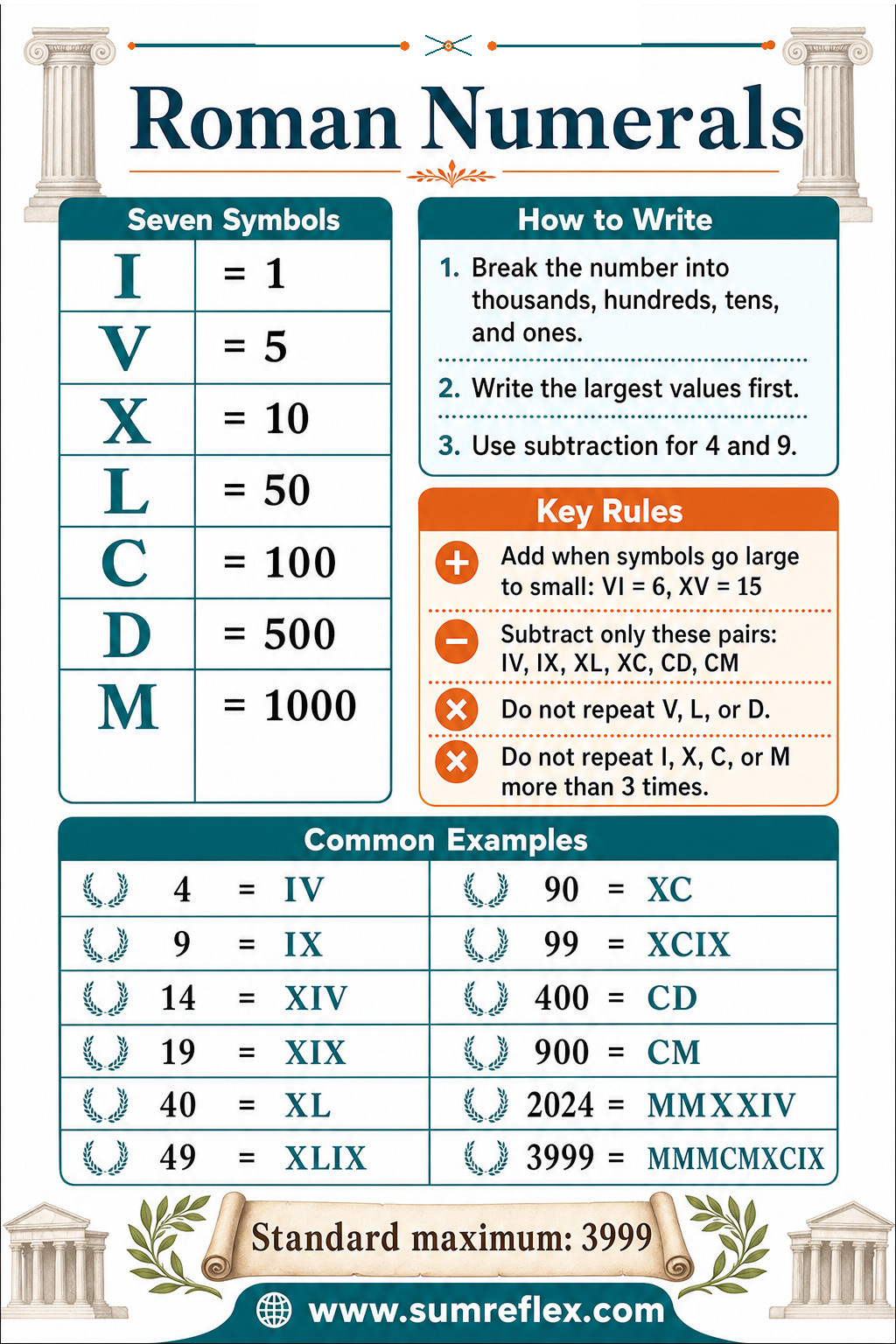
The seven basic Roman numeral symbols
There are seven basic Roman numeral symbols: I, V, X, L, C, D, and M.
I = 1. Example: II means 2 and III means 3.
V = 5. Example: VI means 6 because 5 + 1 = 6.
X = 10. Example: XII means 12 because 10 + 1 + 1 = 12.
L = 50. Example: LX means 60 because 50 + 10 = 60.
C = 100. Example: CXX means 120 because 100 + 10 + 10 = 120.
D = 500. Example: DCC means 700 because 500 + 100 + 100 = 700.
M = 1000. Example: MM means 2000 and MMM means 3000.
The big idea: order changes the value
Roman numerals are mostly written from largest value to smallest value.
When a smaller or equal symbol comes after a larger symbol, you add it. For example, VI = 5 + 1 = 6, XV = 10 + 5 = 15, and CL = 100 + 50 = 150.
When a smaller symbol comes before a larger symbol in an allowed subtraction pair, you subtract it. For example, IV = 5 - 1 = 4 and IX = 10 - 1 = 9.
That is why VI and IV use the same two letters but mean different numbers. The order matters.
Additive format
The additive format means the symbols are placed from large to small and their values are added.
Examples: II = 2, III = 3, VI = 6, VII = 7, VIII = 8, XI = 11, XII = 12, XV = 15, XVI = 16, LX = 60, CX = 110, and MDC = 1600.
This format is the easiest part of Roman numerals. If the letters move from bigger values to smaller values, add them.
Subtractive format
The subtractive format is used to avoid writing four of the same symbol in a row. It is mainly used for numbers that include 4 or 9.
There are six standard subtraction pairs: IV = 4, IX = 9, XL = 40, XC = 90, CD = 400, and CM = 900.
The smaller symbol is placed before the larger symbol, so its value is subtracted. XL means 50 - 10 = 40. CM means 1000 - 100 = 900.
Only these subtraction pairs are standard. For example, IL is not the standard way to write 49. The correct standard form is XLIX.
Repeat rules
Some Roman numeral symbols can repeat, but not all of them.
I, X, C, and M can repeat up to three times in standard Roman numerals. Examples: III = 3, XXX = 30, CCC = 300, and MMM = 3000.
V, L, and D are not repeated in standard Roman numerals. You do not write VV for 10 because X already means 10. You do not write LL for 100 because C already means 100.
The usual rule is simple: do not write the same symbol four times in a row. Use the correct subtraction form instead, such as IV for 4, XL for 40, and CD for 400.
How to write a number as Roman numerals
Step 1: Break the number into thousands, hundreds, tens, and ones.
Step 2: Convert each place value into Roman numerals.
Step 3: Join the parts from left to right.
Example: 2024 = 2000 + 20 + 4. The Roman parts are MM, XX, and IV, so 2024 = MMXXIV.
Example: 1987 = 1000 + 900 + 80 + 7. The Roman parts are M, CM, LXXX, and VII, so 1987 = MCMLXXXVII.
Place-value guide for ones, tens, hundreds, and thousands
Ones: 1 = I, 2 = II, 3 = III, 4 = IV, 5 = V, 6 = VI, 7 = VII, 8 = VIII, 9 = IX.
Tens: 10 = X, 20 = XX, 30 = XXX, 40 = XL, 50 = L, 60 = LX, 70 = LXX, 80 = LXXX, 90 = XC.
Hundreds: 100 = C, 200 = CC, 300 = CCC, 400 = CD, 500 = D, 600 = DC, 700 = DCC, 800 = DCCC, 900 = CM.
Thousands: 1000 = M, 2000 = MM, and 3000 = MMM in standard school Roman numerals.
Examples from 1 to 20
1 = I, 2 = II, 3 = III, 4 = IV, 5 = V.
6 = VI, 7 = VII, 8 = VIII, 9 = IX, 10 = X.
11 = XI, 12 = XII, 13 = XIII, 14 = XIV, 15 = XV.
16 = XVI, 17 = XVII, 18 = XVIII, 19 = XIX, 20 = XX.
Notice the pattern: after 10, the Roman numeral starts with X, then adds the ones part.
More worked examples
34: 30 + 4 = XXX + IV, so 34 = XXXIV.
49: 40 + 9 = XL + IX, so 49 = XLIX. Do not write IL.
58: 50 + 8 = L + VIII, so 58 = LVIII.
94: 90 + 4 = XC + IV, so 94 = XCIV.
144: 100 + 40 + 4 = C + XL + IV, so 144 = CXLIV.
399: 300 + 90 + 9 = CCC + XC + IX, so 399 = CCCXCIX.
944: 900 + 40 + 4 = CM + XL + IV, so 944 = CMXLIV.
2026: 2000 + 20 + 6 = MM + XX + VI, so 2026 = MMXXVI.
How to read Roman numerals back into numbers
Read from left to right. Compare each symbol with the symbol after it.
If the current symbol is equal to or larger than the next symbol, add it. If the current symbol is smaller than the next symbol, subtract it.
Example: XIV is X + IV. X = 10 and IV = 4, so XIV = 14.
Example: MCMXCIX is M + CM + XC + IX. That is 1000 + 900 + 90 + 9 = 1999.
Example: MMXXIV is MM + XX + IV. That is 2000 + 20 + 4 = 2024.
Standard form and non-standard form
The standard school form uses the subtractive pairs IV, IX, XL, XC, CD, and CM.
Sometimes you may see older or decorative forms. For example, some clock faces use IIII for 4 instead of IV. This is common on clock designs, but it is not the usual standard form taught in math class.
You may also see additive forms such as VIIII for 9 in historical writing. In modern schoolwork, the standard form is IX.
When a worksheet, test, or math lesson asks for Roman numerals, use the standard form unless the question clearly says it is studying historical or decorative forms.
Large Roman numerals and overline format
Standard school Roman numerals usually go up to 3999 because 3999 is MMMCMXCIX. Writing 4000 would require four Ms in a row, which breaks the standard repeat rule.
For larger values, some systems use a line over a Roman numeral, called an overline or vinculum. The overline means multiply that symbol by 1000.
For example, V with an overline can mean 5000, X with an overline can mean 10000, and M with an overline can mean 1000000.
Because overline notation is not easy to type in plain text, many school lessons stop at 3999. If a lesson includes larger values, it should explain the overline system first.
Where Roman numerals are used
Roman numerals are used for book chapters and section numbers, such as Chapter IV or Part II.
They are used in outlines to organize information: I, II, III, then A, B, C, and so on.
They appear on some clocks and watches, especially decorative clock faces.
They are used in movie copyright dates, building dates, monuments, sporting events such as the Super Bowl, and names such as King Charles III or Pope John Paul II.
They are also useful in math because they show how a number system can work without the usual base-ten digits.
Common mistakes
Do not write IIII for 4 in standard school Roman numerals. Write IV.
Do not write VIIII for 9. Write IX.
Do not write IC for 99. Write XCIX because 99 = 90 + 9.
Do not write XD for 490. Write CDXC because 490 = 400 + 90.
Do not repeat V, L, or D. Write X instead of VV, C instead of LL, and M instead of DD.
Do not put a smaller symbol before any larger symbol you want. Only IV, IX, XL, XC, CD, and CM are standard subtraction pairs.
FAQ: What is the maximum Roman number value?
In the standard school system without overlines, the maximum usual Roman numeral is 3999, written as MMMCMXCIX.
The reason is that M = 1000, and M can repeat up to three times. Four Ms in a row would break the standard repeat rule.
Larger values are possible with overline notation, where a line above a symbol means multiply by 1000, but that is a different extended format.
FAQ: Is zero written in Roman numerals?
Classical Roman numerals do not have a standard symbol for zero.
Roman numerals were mainly used for counting, ordering, dates, and records, not for the place-value calculations we do with modern digits.
If a math problem asks for Roman numerals, it usually starts at 1 and avoids zero.
FAQ: Can Roman numerals be lowercase?
Yes, Roman numerals can appear in lowercase, such as i, ii, iii, iv, and v, especially in book pages, outlines, or lists.
In math lessons, uppercase letters are clearer and more common: I, II, III, IV, V.
The value is the same, but uppercase is usually best when learning.
FAQ: Why is 49 XLIX and not IL?
Roman numerals are written by place value. The number 49 is 40 + 9.
40 is XL and 9 is IX, so 49 is XLIX.
IL tries to subtract 1 from 50, but I can only be used before V and X in standard subtraction. That makes IL non-standard.
FAQ: Why do some clocks use IIII instead of IV?
Some clock faces use IIII for 4 because it can look balanced with VIII on the other side of the clock face.
It is a decorative clock tradition, not the usual school rule.
For standard Roman numeral writing, use IV for 4.
Quick practice
Write 27 in Roman numerals: 20 + 7 = XX + VII, so 27 = XXVII.
Write 64 in Roman numerals: 60 + 4 = LX + IV, so 64 = LXIV.
Write 89 in Roman numerals: 80 + 9 = LXXX + IX, so 89 = LXXXIX.
Write 402 in Roman numerals: 400 + 2 = CD + II, so 402 = CDII.
Write 1492 in Roman numerals: 1000 + 400 + 90 + 2 = M + CD + XC + II, so 1492 = MCDXCII.
The big idea
Roman numerals are not random letters. They follow a clear system.
Learn the seven symbols first, then use place value, largest-to-smallest order, and the six subtraction pairs.
Once those rules feel familiar, writing Roman numerals becomes much easier: break the number apart, write each part, and join the Roman numeral pieces together.