



Roman numeral guide
Reading Roman numerals as a symbol system, not a base-ten chart
Seven symbols do most of the work
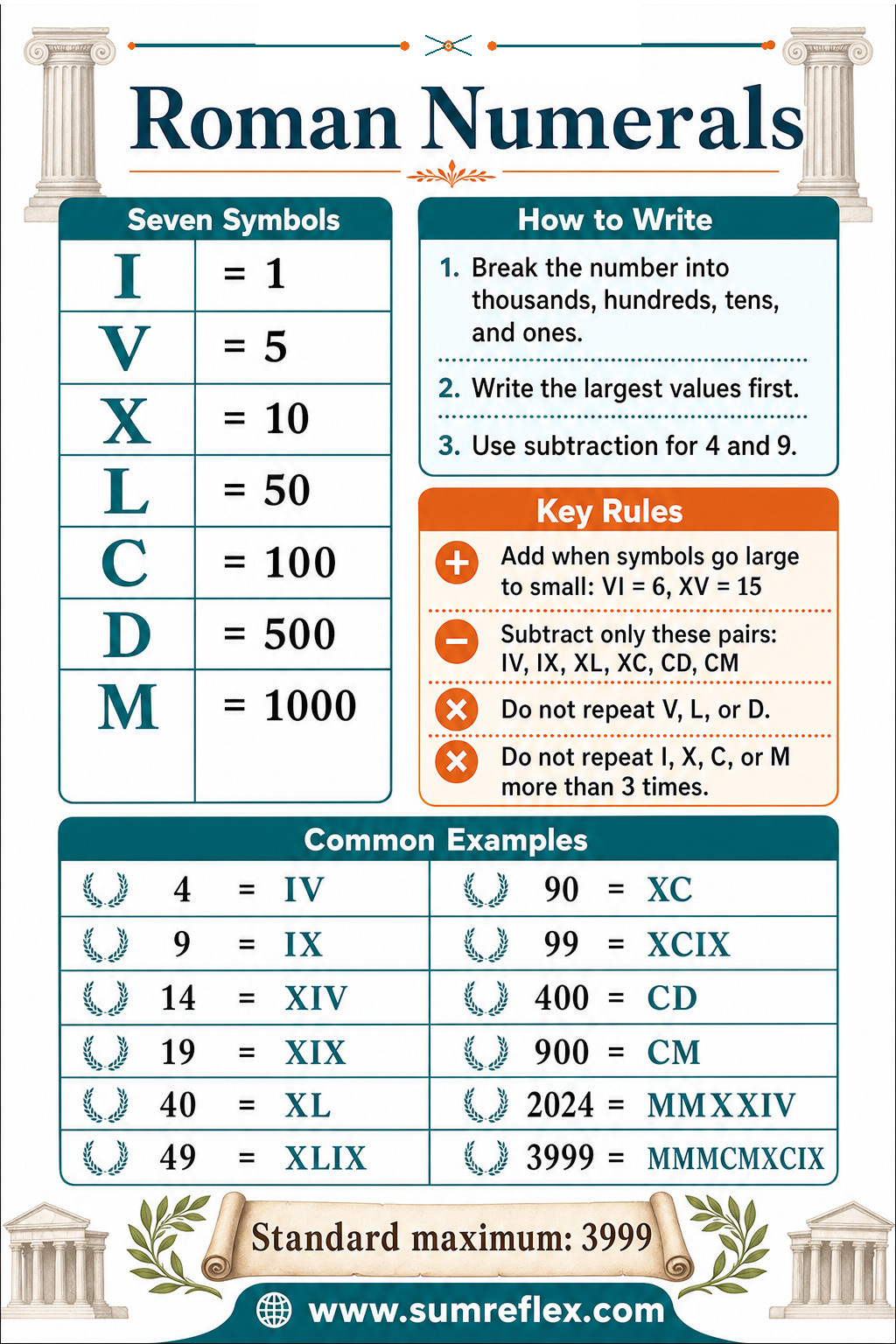
Roman numerals use I, V, X, L, C, D, and M instead of the ten digits used in our base-ten system. Each symbol has a fixed value: I is 1, V is 5, X is 10, L is 50, C is 100, D is 500, and M is 1000. The chart helps students keep those values visible while they learn how the symbols combine.
The first habit is to read from left to right and look for the largest values. When symbols are written from larger to smaller, the values are added. VI is 6 because V plus I equals 5 plus 1. XV is 15 because X plus V equals 10 plus 5. This additive pattern is the easiest entry point before subtraction pairs appear.
Subtraction pairs prevent four repeats
Roman numerals use special subtraction pairs for many 4 and 9 patterns. IV means 4 because I comes before V and is subtracted. IX means 9 because I comes before X. The same idea appears in XL for 40, XC for 90, CD for 400, and CM for 900. The chart groups these pairs so students do not invent unsupported combinations.
This is where many mistakes happen. Students may try to write 49 as IL, but standard Roman numerals use XLIX: 40 plus 9. The subtraction pair only works with specific symbols. Keeping the allowed pairs visible helps learners write standard forms instead of creating shortcuts that look plausible but are not accepted.
Convert by place value first
A reliable way to write Roman numerals is to break the number into thousands, hundreds, tens, and ones. The number 2024 becomes 2000 + 20 + 4. Those parts become MM, XX, and IV, so 2024 is written as MMXXIV. This place-value breakdown keeps the work organized even though Roman numerals do not use place value the same way our digits do.
The place value chart can help students split an ordinary number before converting it. After the split, the Roman numerals chart tells how each part should be written. This two-chart routine is especially helpful for numbers with hundreds and tens that use subtraction pairs.
Reading Roman numerals in real contexts
Roman numerals still appear on clocks, book chapters, outlines, movie credits, monuments, building dates, and event names. Students may not use them for everyday calculation, but they do need to recognize them in text and on objects. The chart gives enough rules to decode most school examples and many real-world labels.
A good practice activity is to collect examples from books, clocks, or building images and ask students to translate them into ordinary numerals. They should also explain which rule they used. For example, XIV is 14 because X is 10 and IV is 4. The explanation prevents pure symbol matching.
Checking answers after the written method
The standard school range usually stops at 3999, written as MMMCMXCIX, because larger values often require overline notation. That limit is useful to state clearly so students do not keep adding unlimited Ms in formal work. The chart focuses on the notation most classrooms expect.
For checking conversions after students attempt the place-value method, the Roman Numeral Converter can confirm the result. The converter should be used after the chart work, not before it, because students still need to learn why symbols are added or subtracted.