



Calendar day-count guide
Using month lengths to read calendars and reject impossible dates
Month length is a calendar rule
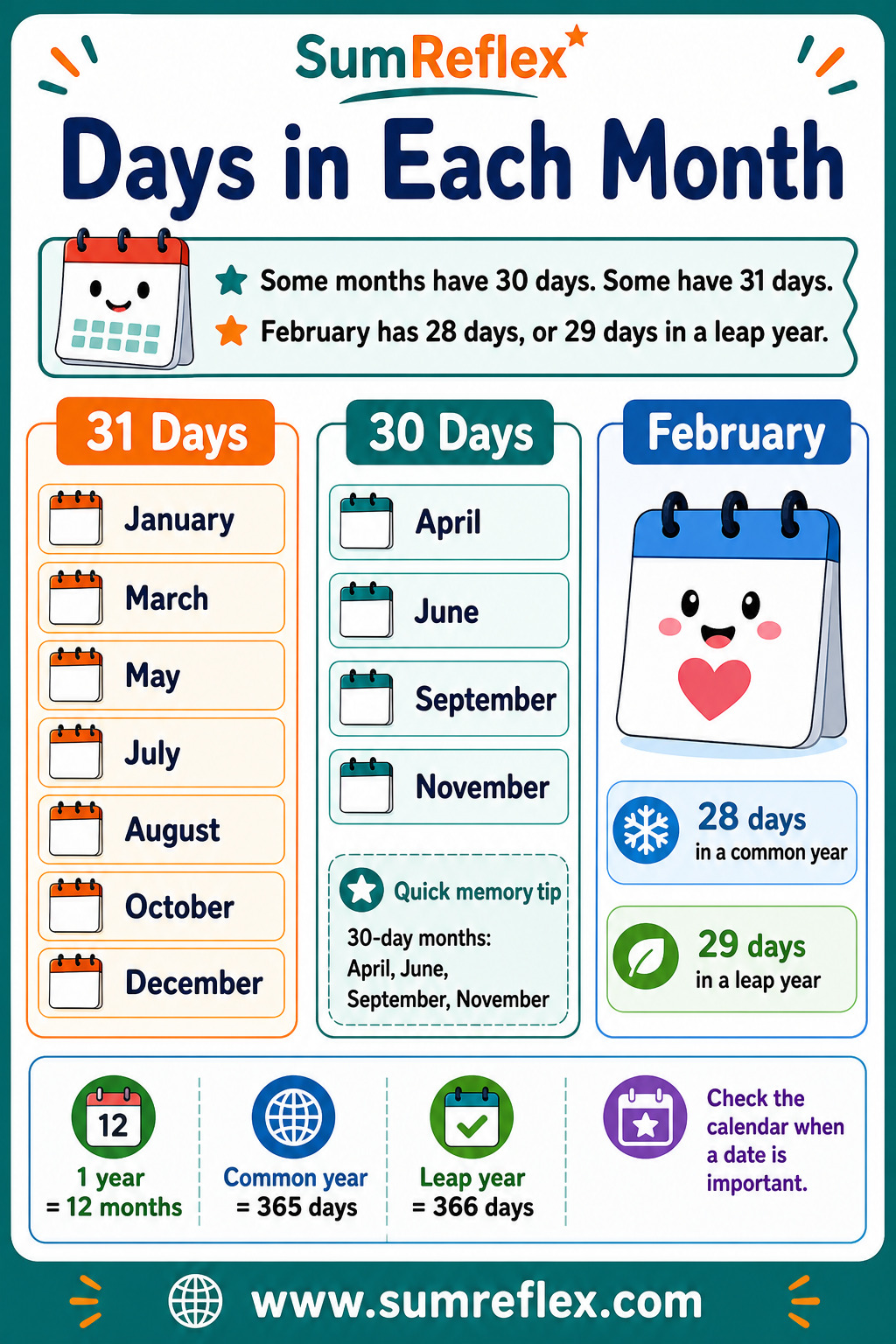
Students often memorize month names before they understand that each month has a fixed length pattern. This chart puts the pattern in groups. January, March, May, July, August, October, and December have 31 days. April, June, September, and November have 30 days. February usually has 28 days, but it has 29 days in a leap year. Grouping the months this way is faster than checking all twelve individually.
The chart is useful whenever students read dates, write schedules, count days, or answer questions about a calendar. If they know the month length, they can decide whether a date such as April 31 or June 31 is impossible. That kind of reasoning turns the chart into more than a memory page; it becomes a calendar-checking tool.
February needs special attention
February is the month that interrupts the otherwise simple 30-day and 31-day pattern. In a common year, February has 28 days. In a leap year, it has 29 days. Students do not need the full leap-year rule immediately, but they should understand that February can change while the other month lengths stay the same.
A helpful classroom question is, "Can February 29 appear every year?" The answer is no. That date appears only in leap years. A second question is, "Can February 30 appear in any regular calendar?" The answer is also no. These questions help students separate rare dates from impossible dates.
Use the chart to test real dates
Give students a mixed list of dates and ask them to mark each one as valid or not valid: September 30, September 31, January 31, February 29, February 30, November 31, and December 31. The chart gives the evidence for every decision. Students should point to the month group before answering so the response is based on a rule, not a guess.
This also supports word problems. If an event begins on April 28 and lasts four days, students need to know that April ends at 30 before moving into May. If a library book is due on the last day of June, the answer is June 30, not June 31. Month length affects small calendar tasks all the time.
How it connects with year and month references
The months of the year chart is the broader reference because it lists the months in order with abbreviations and seasonal context. This days-in-each-month page answers a narrower question: how many days does the selected month contain? Keeping both pages near a calendar center gives students order and length support at the same time.
For older students or practical date work, the Date Calculator can check date differences after students understand month boundaries. The Day Counter can also confirm elapsed-day questions. The printed chart remains useful because it explains why a date rollover happens.
A memory method without relying on a chant
Some learners use a rhyme or knuckle method to remember month lengths. Those can help, but the grouped chart is clearer for students who need to see the information. Have students color-code the 31-day group, the 30-day group, and February. Then ask them to rebuild the groups from memory on a blank page. Rebuilding the groups is stronger than repeating a chant because it requires them to organize the months by rule.