



Grade 8 geometry lesson
Isosceles Trapezium (Isosceles Trapezoid): Definition, Properties, and Practice
An isosceles trapezium has one pair of parallel sides and two equal non-parallel sides.
What is an isosceles trapezium?
An isosceles trapezium is a four-sided shape with one pair of parallel sides.
The two sides that are not parallel are equal in length.
Because those two side lengths match, the shape is balanced from left to right.
Name note: trapezium or trapezoid?
The word changes by textbook and country.
Many U.S. textbooks call this shape an isosceles trapezoid.
Many other textbooks call the same shape an isosceles trapezium.
On this page, isosceles trapezium means a quadrilateral with one pair of parallel sides and equal non-parallel sides. If your teacher says trapezoid, use that word for the same idea.
Isosceles trapezium rule
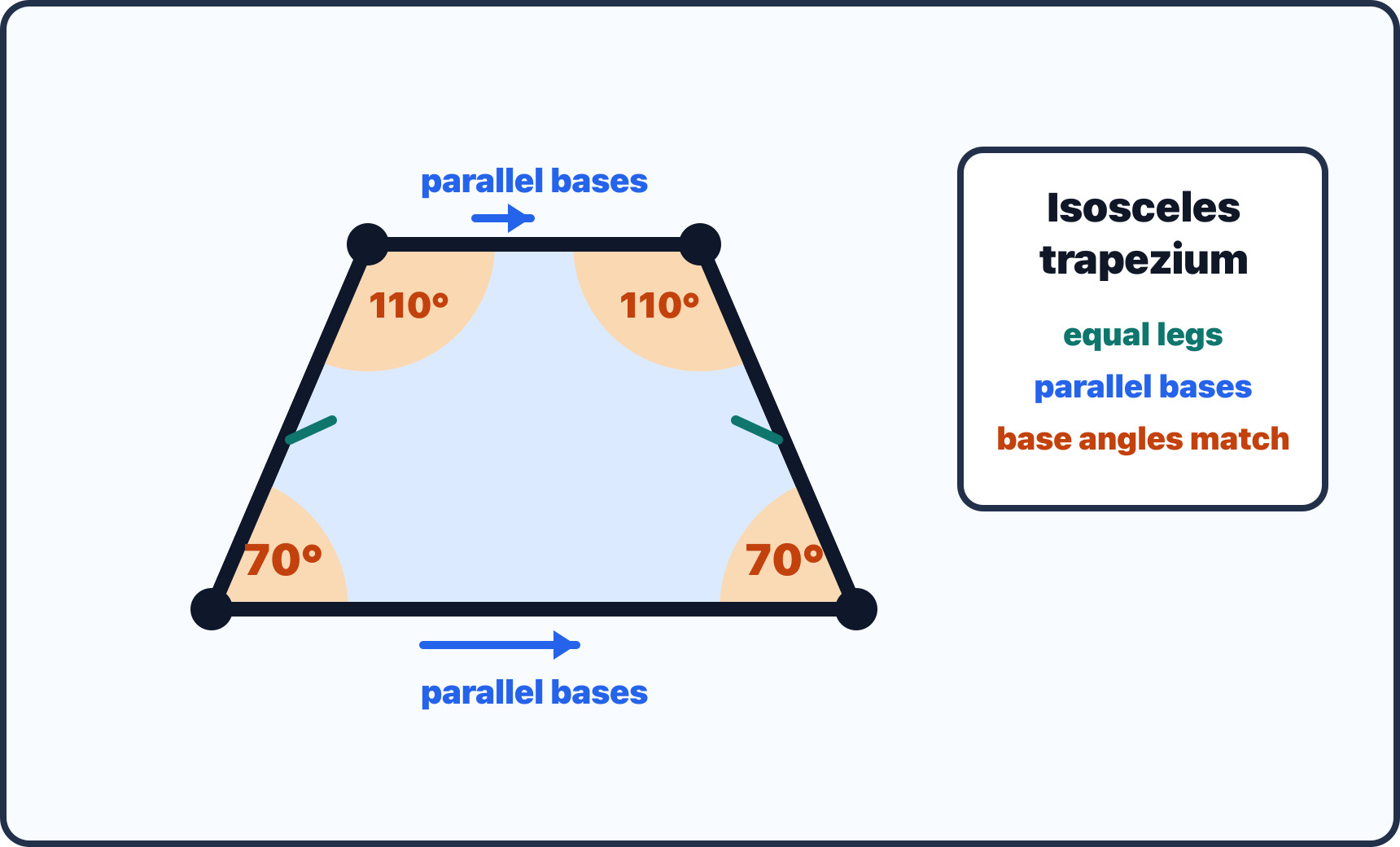
Use these clues to recognize the shape.
The bases are parallel.
The two legs are equal.
The base angles match in pairs.
If you need help seeing the base direction, review parallel lines first.
Important properties
An isosceles trapezium has useful matching parts.
The two legs are congruent because they have the same length.
The two angles on the lower base are congruent. The two angles on the upper base are also congruent. This uses the same meaning of congruent as congruent angles.
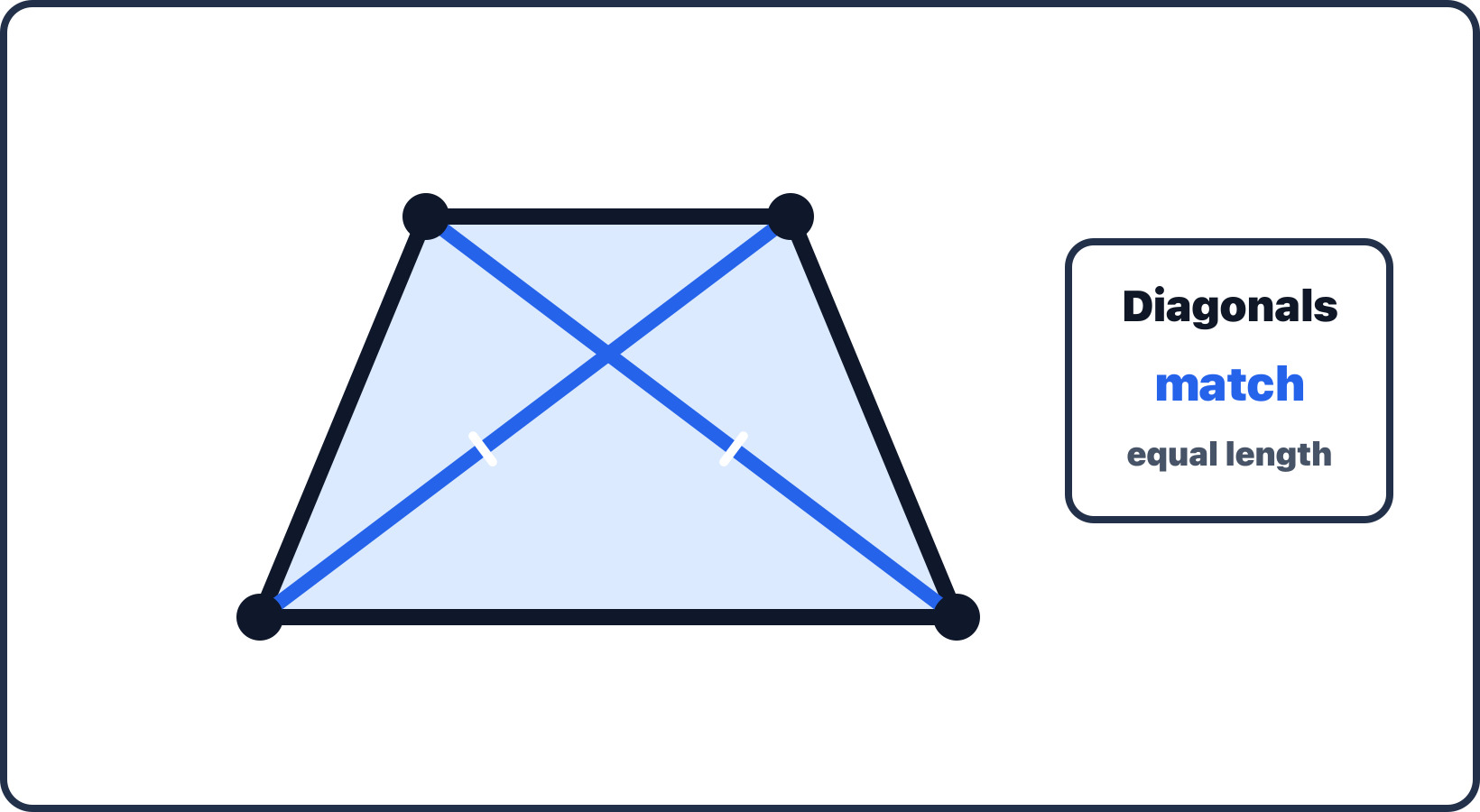
The diagonals are equal in length too. If you draw both diagonals, they should match.
Property chart
Use this chart to check the shape quickly.
A plain trapezium has a pair of parallel sides. An isosceles trapezium has that same parallel pair plus equal legs.

Angle example
Problem: The lower-left base angle of an isosceles trapezium is 72°. What are the other angles?
Step 1: The lower base angles match, so the lower-right angle is also 72°.
Step 2: The bases are parallel, so the angles along one leg add to 180°. This is the same idea used in consecutive interior angles.
Step 3: 180° - 72° = 108°.
Answer: The four angles are 72°, 72°, 108°, and 108°.

Side example
Problem: An isosceles trapezium has bases of 14 cm and 22 cm. Each leg is 9 cm. What is the perimeter?
Step 1: Perimeter means add all side lengths.
Step 2: Add the bases and the two equal legs: 14 + 22 + 9 + 9.
Answer: The perimeter is 54 cm.
Diagonals in an isosceles trapezium
A diagonal joins two opposite corners.
In an isosceles trapezium, the two diagonals are equal in length.
This diagonal fact is another way to check whether the shape is balanced.
Common mistakes
Do not call every trapezium isosceles. The legs must be equal.
Do not match the left and right angles on the same leg. Those two angles add to 180°; they are not usually equal.
Do not forget the naming difference. Isosceles trapezium and isosceles trapezoid may name the same shape in different classrooms.
Quick practice
1. An isosceles trapezium has one pair of parallel bases.
2. Its two legs are equal.
3. If one lower base angle is 65°, the other lower base angle is 65°.
4. If one lower base angle is 65°, the top angle on the same leg is 115°.
5. The diagonals of an isosceles trapezium are equal.
Interactive playground
Change the base angle
Move the lower base angle. The matching angle stays equal, and the top angles complete 180° along each leg.