


Grade 6 number sense lesson
Greater Than, Less Than, and Equal To: Comparing Numbers, Negatives, and Fractions
Advanced comparison means choosing the correct symbol for whole numbers, integers, and fractions by using number-line position, value size, and reliable fraction methods.
What comparison means in advanced number work
A comparison statement tells how two values are ordered.
In Grade 6, comparison is no longer only about small counting numbers. Students also compare numbers below zero and fractions that may not have matching denominators.
The symbols still have the same meaning: \( \gt \) means greater than, \( \lt \) means less than, and \(=\) means equal to.
The skill is choosing the symbol from the value of each number, not from how large the digits look.
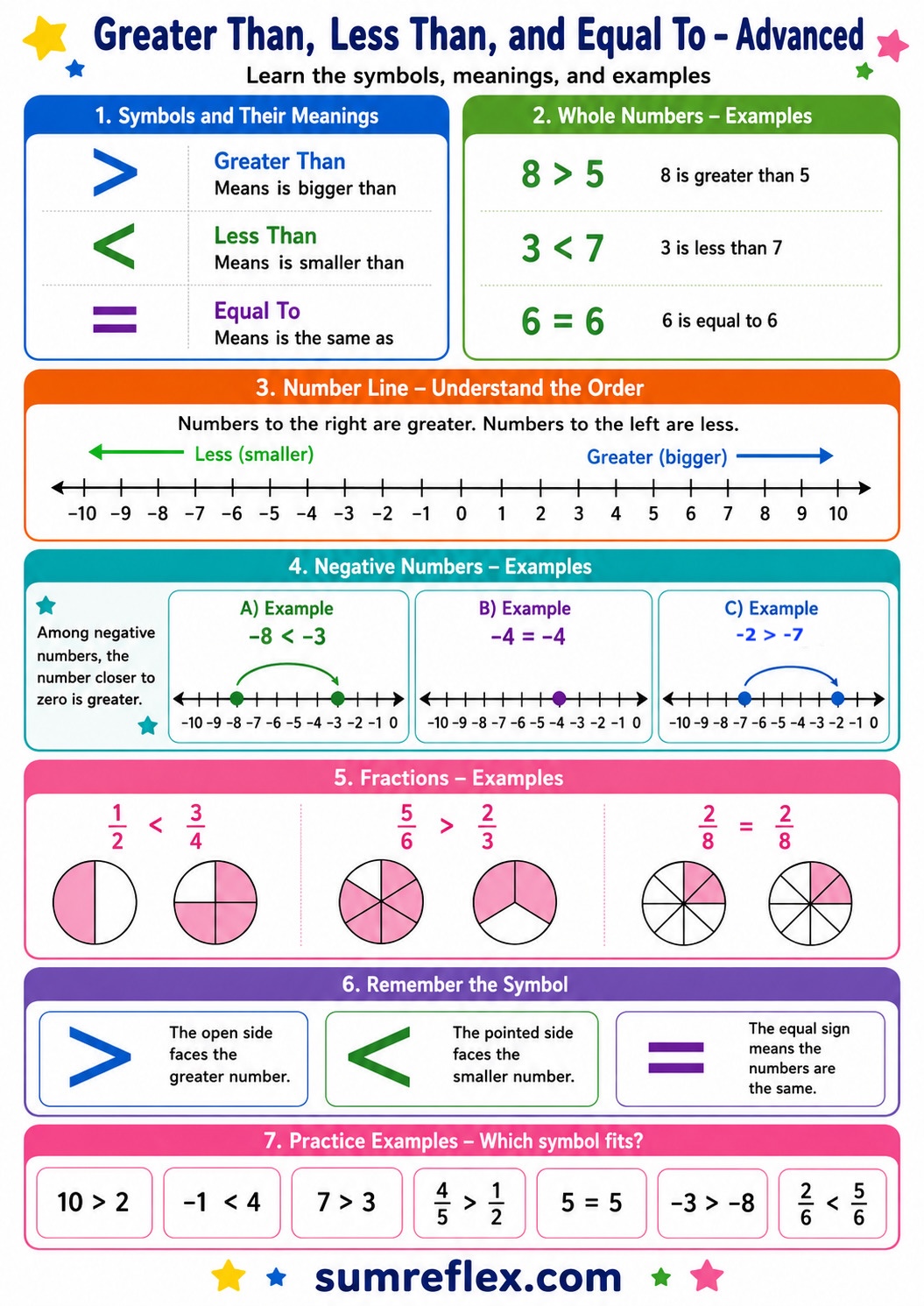
Printable advanced comparison chart
Use this chart as a visual summary for whole-number comparisons, integer comparisons, and fraction comparisons.
The same chart is also available in the Printable Number Reference Charts section with print and download options.
If the comparison only uses small positive numbers, the basic greater than and less than lesson gives a simpler starting point before moving into negatives and fractions.
Comparison symbols and formulas
Let \(a\) and \(b\) be two numbers.
Write \(a \gt b\) when \(a\) has a greater value than \(b\).
Write \(a \lt b\) when \(a\) has a smaller value than \(b\).
Write \(a = b\) when both expressions represent the same value.
On a number line, the rule is: if \(a\) is to the right of \(b\), then \(a \gt b\). If \(a\) is to the left of \(b\), then \(a \lt b\).
| Symbol | Meaning | Example |
|---|---|---|
| \(\gt\) | greater than | \(-2 \gt -5\) |
| \(\lt\) | less than | \(\frac{1}{2} \lt \frac{3}{4}\) |
| \(=\) | equal to | \(\frac{3}{8} = \frac{3}{8}\) |
Whole-number comparisons
Whole numbers are the easiest part of this topic because their order follows counting order.
A larger whole number is greater than a smaller whole number.
Example: \(28 \gt 19\) because twenty-eight comes after nineteen.
Example: \(406 \lt 460\) because both numbers have 4 hundreds, but \(406\) has 0 tens while \(460\) has 6 tens.
Place-value check for whole numbers
When numbers have more than one digit, compare from left to right.
First compare the hundreds, thousands, or largest place shown. If they match, move to the next place.
For \(752\) and \(725\), both numbers have 7 hundreds. Compare the tens: \(5\) tens is greater than \(2\) tens, so \(752 \gt 725\).
For \(3,084\) and \(3,104\), both have 3 thousands. Compare hundreds: \(0\) hundreds is less than \(1\) hundred, so \(3,084 \lt 3,104\).
Negative numbers on a number line
Negative numbers sit to the left of zero.
The farther left a number is, the smaller it is.
This is why \(-8\) is less than \(-3\), even though \(8\) is greater than \(3\) when both are positive.
Among negative numbers, the one closer to zero is greater.
Example 1: Compare -7 and -3
Problem: Fill in the symbol: \(-7 \; \square \; -3\).
On the number line, \(-7\) is to the left of \(-3\).
A number farther left has a smaller value.
Answer: \(-7 \lt -3\).
Example 2: Compare -2 and -5
Problem: Fill in the symbol: \(-2 \; \square \; -5\).
Both numbers are negative, so think about which one is closer to zero.
The number \(-2\) is closer to zero than \(-5\).
Answer: \(-2 \gt -5\).
Example 3: Compare -4 and -4
Problem: Fill in the symbol: \(-4 \; \square \; -4\).
Both sides show exactly the same integer.
No side is greater or less.
Answer: \(-4 = -4\).
Compare a negative number with a positive number
Any positive number is greater than any negative number.
Example: \(1 \gt -9\) because \(1\) is to the right of zero and \(-9\) is to the left of zero.
Example: \(-1 \lt 4\) because \(-1\) is below zero while \(4\) is above zero.
Zero is also greater than every negative number, so \(0 \gt -6\).
Fractions with the same denominator
When fractions have the same denominator, the pieces are the same size.
Then you only compare the numerators.
Example: \(\frac{2}{7} \lt \frac{5}{7}\) because both fractions use sevenths, and \(2\) sevenths is less than \(5\) sevenths.
Example: \(\frac{9}{10} \gt \frac{3}{10}\) because \(9\) tenths is more than \(3\) tenths.
Fractions with the same numerator
When fractions have the same numerator, compare the size of the parts.
A smaller denominator makes larger pieces.
Example: \(\frac{3}{4} \gt \frac{3}{8}\) because fourths are larger pieces than eighths.
Example: \(\frac{1}{6} \lt \frac{1}{3}\) because one sixth is a smaller piece than one third.
Fractions with different denominators
If neither the numerator nor denominator matches, make a fair comparison first.
One method is to rewrite both fractions with a common denominator.
Example: Compare \(\frac{1}{2}\) and \(\frac{3}{4}\). Rewrite \(\frac{1}{2}\) as \(\frac{2}{4}\). Since \(\frac{2}{4} \lt \frac{3}{4}\), the answer is \(\frac{1}{2} \lt \frac{3}{4}\).
Another method is to use cross products for positive fractions: compare \(a \times d\) and \(b \times c\) for \(\frac{a}{b}\) and \(\frac{c}{d}\).
Cross-product formula for positive fractions
For positive fractions \(\frac{a}{b}\) and \(\frac{c}{d}\), where \(b \gt 0\) and \(d \gt 0\), compare the cross products \(a \times d\) and \(c \times b\).
If \(a \times d \gt c \times b\), then \(\frac{a}{b} \gt \frac{c}{d}\).
If \(a \times d \lt c \times b\), then \(\frac{a}{b} \lt \frac{c}{d}\).
If \(a \times d = c \times b\), then the fractions are equal.
Example 4: Compare 5/6 and 2/3
Problem: Fill in the symbol: \(\frac{5}{6} \; \square \; \frac{2}{3}\).
Use a common denominator of \(6\).
The fraction \(\frac{2}{3}\) is equal to \(\frac{4}{6}\).
Now compare \(\frac{5}{6}\) and \(\frac{4}{6}\). Since \(5\) sixths is more than \(4\) sixths, answer: \(\frac{5}{6} \gt \frac{2}{3}\).
Example 5: Compare 2/6 and 5/6
Problem: Fill in the symbol: \(\frac{2}{6} \; \square \; \frac{5}{6}\).
Both fractions use sixths, so the denominator is already the same.
Compare the numerators: \(2 \lt 5\).
Answer: \(\frac{2}{6} \lt \frac{5}{6}\).
Example 6: Compare 4/5 and 1/2
Problem: Fill in the symbol: \(\frac{4}{5} \; \square \; \frac{1}{2}\).
Use cross products because both fractions are positive.
Calculate \(4 \times 2 = 8\) and \(1 \times 5 = 5\).
Since \(8 \gt 5\), answer: \(\frac{4}{5} \gt \frac{1}{2}\).
Mixed comparison examples
Here are several comparison statements that use different kinds of numbers.
\(10 \gt 2\) because ten is farther right than two.
\(-1 \lt 4\) because every negative number is less than every positive number.
\(-3 \gt -8\) because negative three is closer to zero.
\(\frac{4}{5} \gt \frac{1}{2}\) because \(4 \times 2\) is greater than \(1 \times 5\).
\(\frac{3}{8} = \frac{3}{8}\) because both fractions name the same amount.
\(\frac{7}{12} \lt \frac{3}{4}\) because \(\frac{3}{4} = \frac{9}{12}\).
Decision table
Different types of comparisons need different first moves.
Use the table to choose a method before choosing a symbol.
| Type of pair | Best first move | Example result |
|---|---|---|
| Whole numbers | Compare place value from left to right | \(604 \gt 460\) |
| Two negative integers | Use number-line position or closeness to zero | \(-6 \lt -2\) |
| Negative and positive | Positive is greater than negative | \(-5 \lt 3\) |
| Same denominator fractions | Compare numerators | \(\frac{4}{9} \gt \frac{2}{9}\) |
| Different denominator fractions | Use common denominators or cross products | \(\frac{2}{3} \gt \frac{3}{7}\) |
How to check your comparison
First, read the statement as a sentence. For example, \(-2 \gt -5\) says "negative two is greater than negative five." That is true because \(-2\) is closer to zero.
Second, use a number line when integers are involved. The value on the right is greater.
Third, for fractions, check with a common denominator or cross products so both quantities are being compared fairly.
If the spoken sentence sounds false or the number-line position disagrees, the symbol is probably reversed.
Mistakes that flip the meaning
Do not treat \(-8\) as greater than \(-3\) just because \(8\) is greater than \(3\). Negative values reverse that habit because the farther-left number is smaller.
Do not compare unlike fractions by looking only at the numerators. \(\frac{3}{4}\) and \(\frac{5}{8}\) need equal-size parts before the comparison is safe.
Do not use the equal sign for fractions that only look similar. \(\frac{2}{3}\) and \(\frac{2}{5}\) are not equal because thirds and fifths are different-size parts.
Do not forget that zero is greater than any negative number and less than any positive number.
Advanced practice set
Choose the symbol that makes each statement true: \( \gt \), \( \lt \), or \(=\).
1. \(48 \; \square \; 84\)
2. \(302 \; \square \; 320\)
3. \(-6 \; \square \; -1\)
4. \(-4 \; \square \; -9\)
5. \(0 \; \square \; -2\)
6. \(\frac{3}{5} \; \square \; \frac{4}{5}\)
7. \(\frac{2}{3} \; \square \; \frac{5}{6}\)
8. \(\frac{5}{8} \; \square \; \frac{5}{8}\)
9. \(\frac{7}{10} \; \square \; \frac{2}{5}\)
10. \(-12 \; \square \; 3\)
Advanced practice answers
1. \(48 \lt 84\)
2. \(302 \lt 320\)
3. \(-6 \lt -1\)
4. \(-4 \gt -9\)
5. \(0 \gt -2\)
6. \(\frac{3}{5} \lt \frac{4}{5}\)
7. \(\frac{2}{3} \lt \frac{5}{6}\)
8. \(\frac{5}{8} = \frac{5}{8}\)
9. \(\frac{7}{10} \gt \frac{2}{5}\)
10. \(-12 \lt 3\)
Final comparison idea
The symbols do not change, but the reasoning does.
Whole numbers can be compared with place value. Integers can be checked on a number line. Fractions need equal-size parts or a reliable cross-product check.
A correct comparison is one that stays true when you read it aloud and verify it with the right model.