



Grade 5 number sense lesson
Reading Large Numbers: Names, Zeros, Short Forms, Examples, and Chart
Large number names are easier when students start with 1 and watch what happens each time one zero is added.
Start with 1 and add zeros
The easiest way to understand large numbers is to start with 1, then add one zero at a time.
Each new zero makes the number 10 times bigger. That means 10 is ten times bigger than 1, 100 is ten times bigger than 10, and 1,000 is ten times bigger than 100.
Once students see this pattern, names like million, billion, and trillion feel much less random.
Printable large number names chart
Use this SumReflex chart to see every zero in each number. It starts at 1 and adds one zero at a time through quadrillion.
The same chart is also available in the Printable Number Reference Charts section with print and download options.
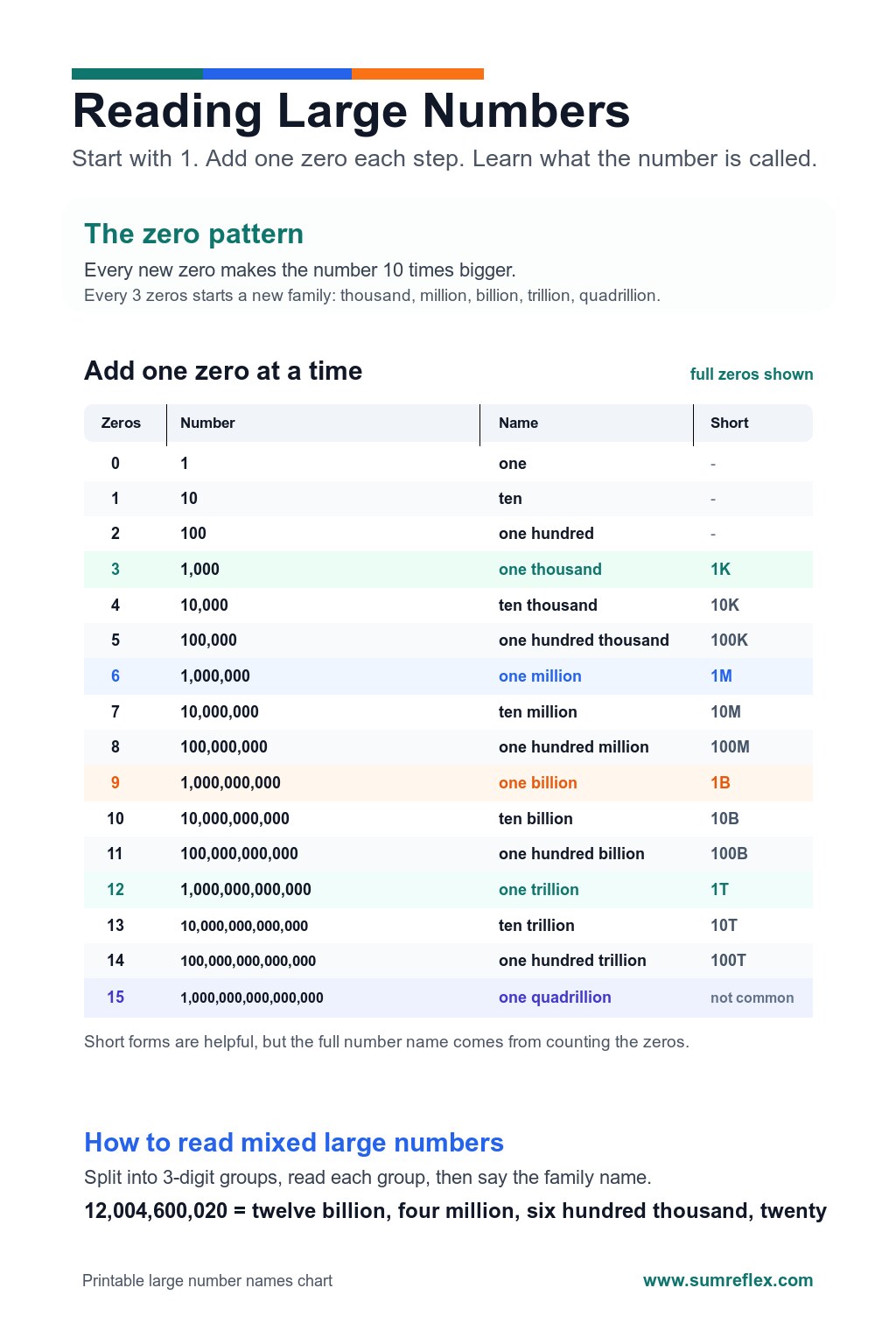
The first three names
1 is called one. It has no zeros.
10 is called ten. It has 1 zero.
100 is called one hundred. It has 2 zeros.
These first three names are important because the same one-ten-hundred pattern repeats inside thousands, millions, billions, and trillions.
Thousands: 3, 4, and 5 zeros
1,000 is called one thousand. It has 3 zeros.
10,000 is called ten thousand. It has 4 zeros.
100,000 is called one hundred thousand. It has 5 zeros.
Notice the pattern: one thousand, ten thousand, one hundred thousand. After that, the next zero starts a new family: millions.
Millions: 6, 7, and 8 zeros
1,000,000 is called one million. It has 6 zeros. A common short form is 1M.
10,000,000 is called ten million. It has 7 zeros. A common short form is 10M.
100,000,000 is called one hundred million. It has 8 zeros. A common short form is 100M.
Billions: 9, 10, and 11 zeros
1,000,000,000 is called one billion. It has 9 zeros. A common short form is 1B.
10,000,000,000 is called ten billion. It has 10 zeros. A common short form is 10B.
100,000,000,000 is called one hundred billion. It has 11 zeros. A common short form is 100B.
This is why a billion is much larger than a million. One million has 6 zeros, but one billion has 9 zeros.
Trillions: 12, 13, and 14 zeros
1,000,000,000,000 is called one trillion. It has 12 zeros. A common short form is 1T.
10,000,000,000,000 is called ten trillion. It has 13 zeros. A common short form is 10T.
100,000,000,000,000 is called one hundred trillion. It has 14 zeros. A common short form is 100T.
The full zeros matter. Writing 1T is short, but the full number is 1,000,000,000,000.
After trillions
After one hundred trillion, adding one more zero gives 1,000,000,000,000,000.
That number is called one quadrillion. It has 15 zeros.
Most Grade 5 work stays around thousands, millions, billions, and sometimes trillions, but the same zero pattern continues.
Why commas make large numbers easier
Commas split a large number into groups of 3 digits. Each group is called a period.
From right to left, the period names are ones, thousands, millions, billions, trillions, and quadrillions.
Example: 1,000,000,000 is easier to read than 1000000000 because the commas show the billion group clearly.
The 3-zero rule
A big-name family changes every 3 zeros.
3 zeros makes thousands: 1,000.
6 zeros makes millions: 1,000,000.
9 zeros makes billions: 1,000,000,000.
12 zeros makes trillions: 1,000,000,000,000.
15 zeros makes quadrillions: 1,000,000,000,000,000.
How to read a mixed large number
Numbers are not always a 1 followed by zeros. Many large numbers have different digits in different periods.
Use this method: split the number into 3-digit groups, read each group, then say the period name.
Example: 4,520,000 becomes 4 | 520 | 000. Read it as four million five hundred twenty thousand.
The last group is 000, so you do not say zero.
Example: Read 70,000
70,000 has 4 zeros, so it belongs in the thousands family.
Read 70 first, then say thousand.
Word form: seventy thousand.
Example: Read 8,000,000
8,000,000 has 6 zeros after 8, so it is in the millions family.
Read 8 first, then say million.
Word form: eight million.
Example: Read 35,000,000
35,000,000 is in the millions family because the number ends with two groups of 000.
Read 35 first, then say million.
Word form: thirty-five million.
Example: Read 2,400,000,000
Split the number into periods: 2 | 400 | 000 | 000.
The 2 is in the billions period, so say two billion.
The 400 is in the millions period, so say four hundred million.
The last two groups are 000, so skip them.
Word form: two billion four hundred million.
Example: Read 12,004,600,020
Split the number into periods: 12 | 004 | 600 | 020.
Read 12 in the billions period: twelve billion.
Read 004 in the millions period as 4: four million.
Read 600 in the thousands period: six hundred thousand.
Read 020 in the ones period as 20: twenty.
Word form: twelve billion four million six hundred thousand twenty.
Short forms such as 1K, 1M, 1B, and 1T
Short forms are used when people want to save space.
1K often means 1,000. 1M means 1,000,000. 1B means 1,000,000,000. 1T means 1,000,000,000,000.
Short forms are useful on charts, money reports, videos, and headlines, but students should still learn the full number with all zeros.
Common mistakes to avoid
Do not count zeros too quickly. Group the zeros in sets of 3 from the right.
Do not call 1,000,000 a billion. It is one million because it has 6 zeros.
Do not call 1,000,000,000 a million. It is one billion because it has 9 zeros.
Do not read every zero out loud. In 5,000,000, say five million, not five zero zero zero zero zero zero.
Quick practice with answers
1. 1,000 = one thousand.
2. 10,000 = ten thousand.
3. 100,000 = one hundred thousand.
4. 1,000,000 = one million.
5. 1,000,000,000 = one billion.
6. 1,000,000,000,000 = one trillion.
7. 30,000,000,000 = thirty billion.
8. 6,200,000,000,000 = six trillion two hundred billion.
The big idea
Large number names are built from a simple pattern.
Start with 1. Add one zero at a time. Every 3 zeros, a new big-name family begins: thousand, million, billion, trillion, quadrillion.
When the number is not just 1 followed by zeros, split it into 3-digit groups and read each group with the correct period name.