



Grade 3 time lesson
24-Hour Clock: Meaning, Uses, Conversion, Examples, and Quiz
The 24-hour clock writes each time as the number of hours and minutes after midnight, so 18:10 means 6:10 p.m. and 06:10 means 6:10 a.m.
What is the 24-hour clock?
The 24-hour clock is a way to write time by counting the hours from midnight through the whole day.
Instead of starting again after 12 noon, the hour keeps going: 13, 14, 15, and so on until 23. After 23:59, the next minute is 00:00, which starts the next day.
This means every time in the day has one clear written form. For example, 06:30 is morning, but 18:30 is evening.
Printable 24-Hour Clock chart
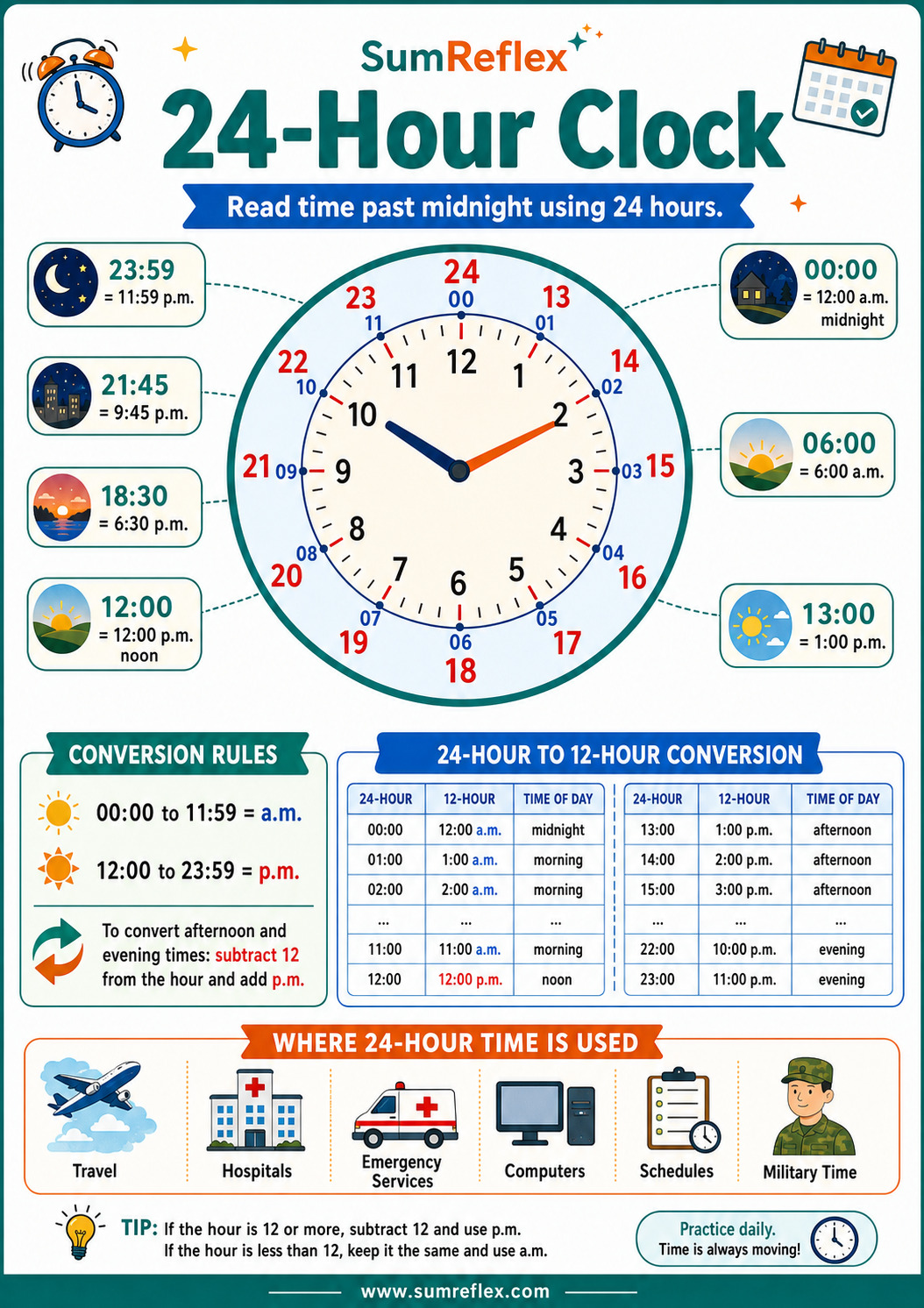
Use this SumReflex chart as a quick reference while learning the 24-hour clock. It shows the 1 to 12 clock face, the 13 to 24 hour ring, useful conversion examples, and places where 24-hour time is used.
The same chart is also available in the dedicated Printable Measurement Unit Charts section.
How a 24-hour clock face works
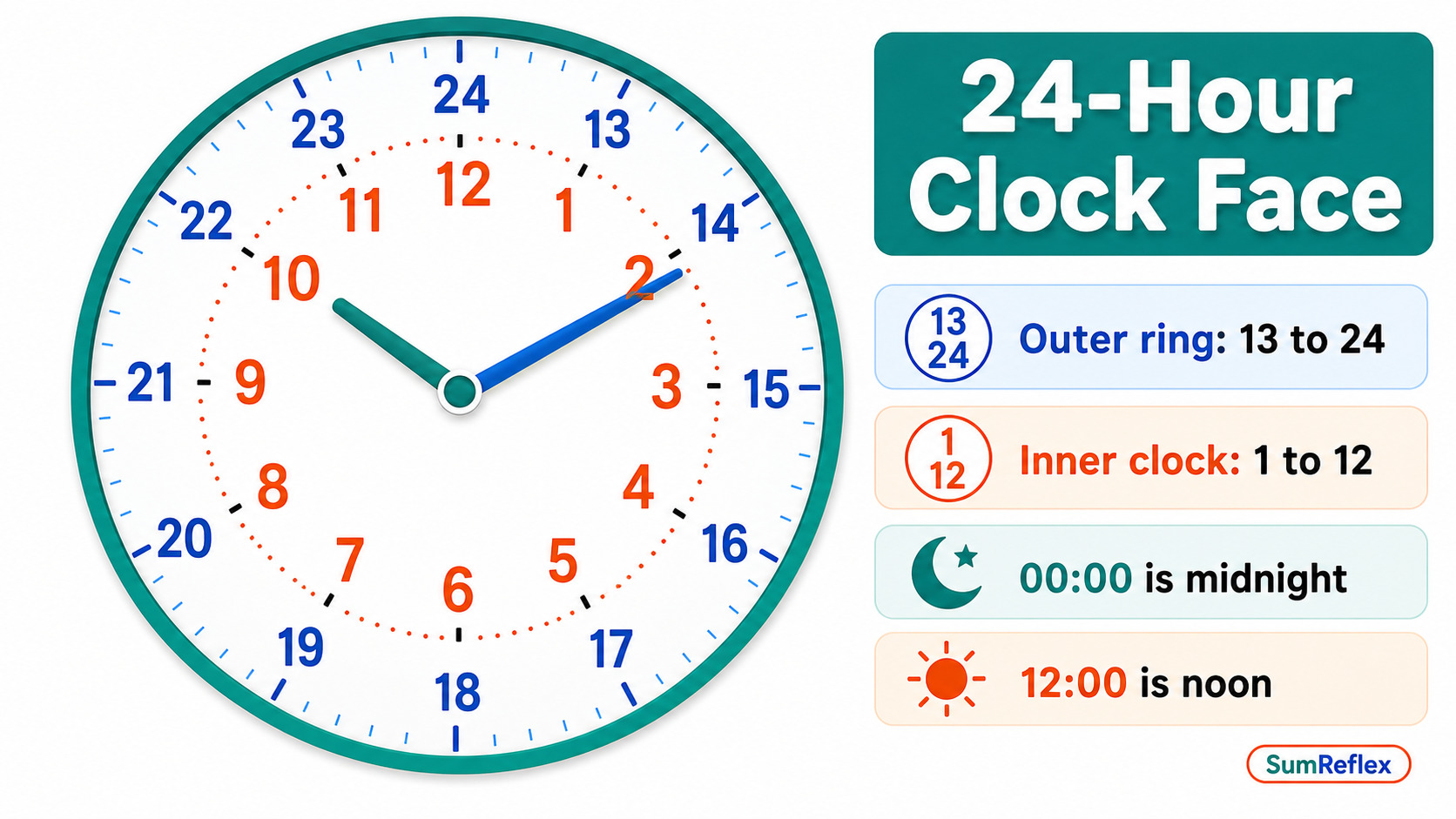
A normal clock face shows the numbers 1 to 12. A 24-hour clock chart often adds another ring for afternoon and evening times.
On that outer ring, 13 is the same position as 1 p.m., 14 is the same position as 2 p.m., 15 is the same position as 3 p.m., and the pattern continues all the way to 23.
The minutes do not change. Only the hour is written differently.
Why is the 24-hour clock used?
The biggest reason is clarity. With the 12-hour clock, 7:00 could mean 7:00 a.m. or 7:00 p.m. unless you add the letters a.m. or p.m.
With the 24-hour clock, 07:00 is morning and 19:00 is evening. There is no guessing.
This is useful when a mistake would cause trouble. A missed flight, a medicine given at the wrong time, or an emergency message read incorrectly can matter a lot.
Where the 24-hour clock is used
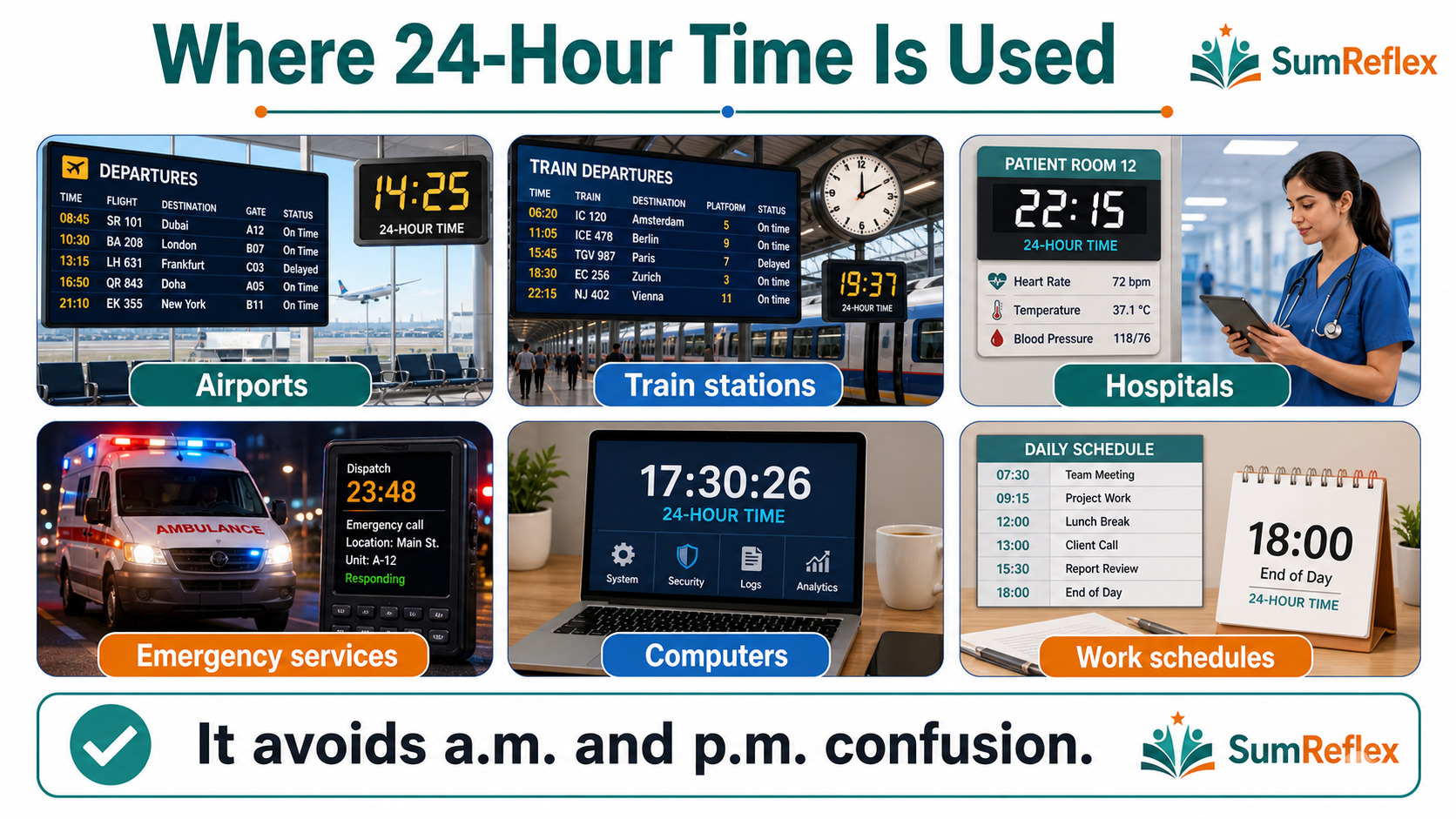
Airports and airlines use 24-hour time because flights leave at exact times and passengers may travel across time zones.
Train stations, bus stations, and public transport schedules use it so people can tell morning trips from evening trips quickly.
Hospitals use it for patient care, medicine times, surgery schedules, and medical notes. Writing 22:15 is clearer than writing 10:15 p.m.
Emergency services, police, firefighters, and dispatch teams use it because every minute matters and messages must be exact.
Computers, phones, calendars, work schedules, security logs, delivery tracking, and military time often use 24-hour time for the same reason: it avoids a.m. and p.m. confusion.
A full day in 24-hour time
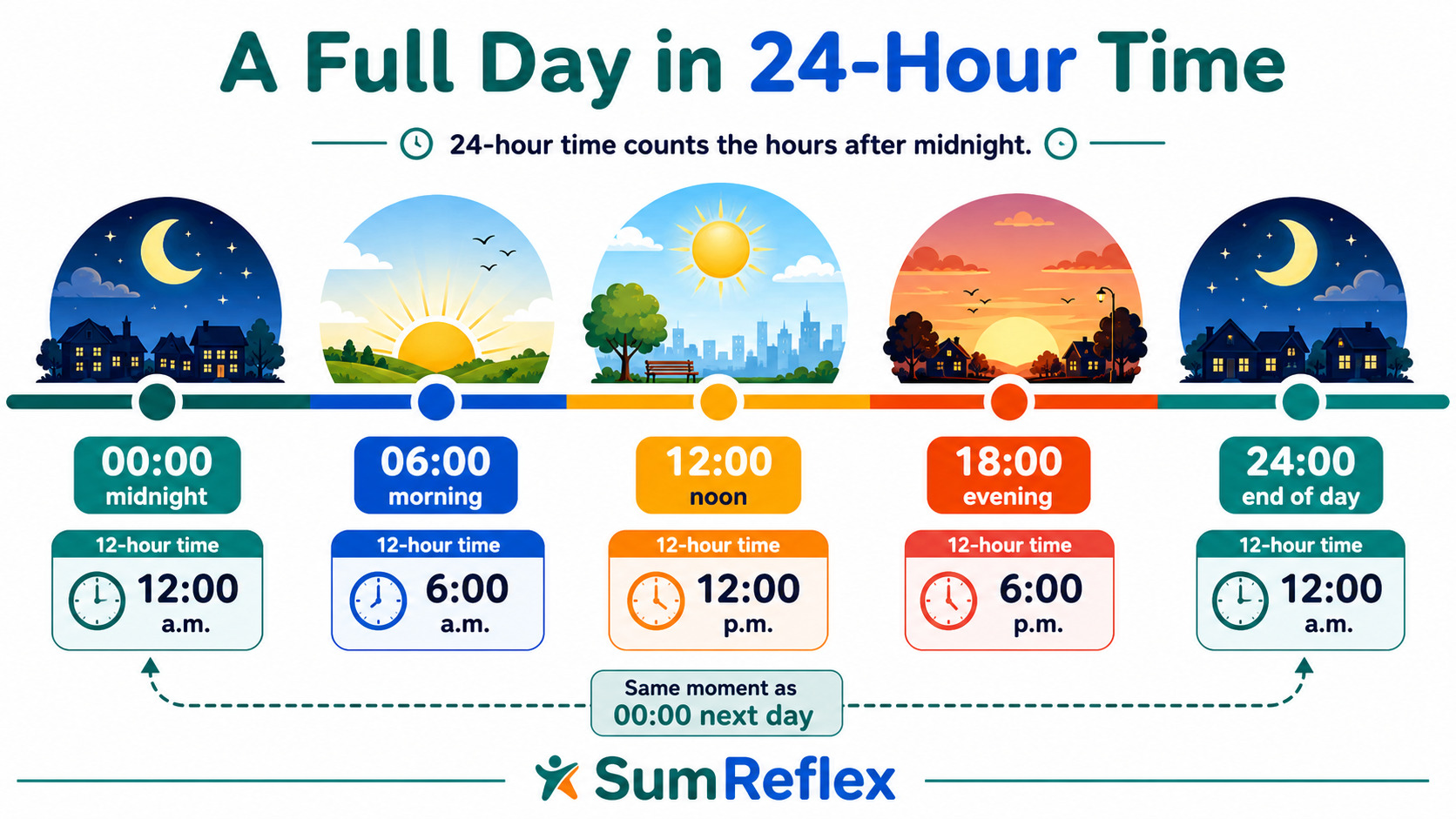
The day begins at 00:00, which means midnight at the start of the day.
Morning hours run from 00:00 to 11:59. Noon is 12:00. Afternoon and evening hours run from 12:00 to 23:59.
Some schedules write 24:00 to mean the end of a day. It is the same moment as 00:00 on the next day. In most daily time writing, 00:00 is the cleaner way to write midnight at the start of a day.
How to convert 24-hour time to 12-hour time
The minutes stay the same. Most of the work is deciding what to do with the hour.
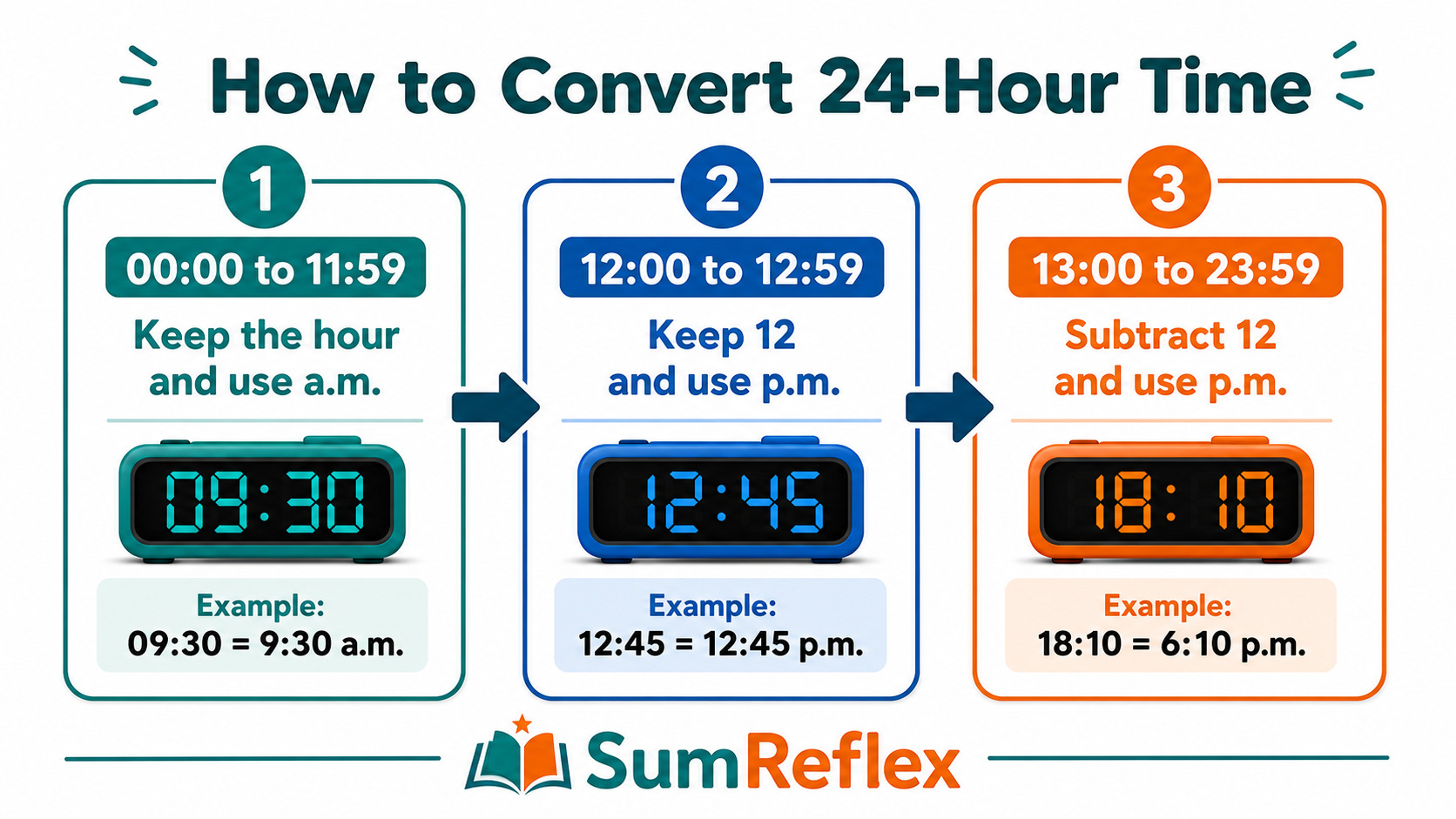
Rule 1: From 00:00 to 00:59, write the hour as 12 and use a.m. Example: 00:20 = 12:20 a.m.
Rule 2: From 01:00 to 11:59, keep the hour and use a.m. Example: 09:45 = 9:45 a.m.
Rule 3: From 12:00 to 12:59, keep 12 and use p.m. Example: 12:30 = 12:30 p.m.
Rule 4: From 13:00 to 23:59, subtract 12 from the hour and use p.m. Example: 18:10 = 6:10 p.m.
Worked conversion examples
06:00 is 6:00 a.m. because 06 is a morning hour.
11:35 is 11:35 a.m. because it is still before noon.
12:00 is 12:00 p.m. noon. Do not call it 12:00 a.m.
13:00 is 1:00 p.m. because 13 - 12 = 1.
14:25 is 2:25 p.m. because 14 - 12 = 2.
16:40 is 4:40 p.m. because 16 - 12 = 4.
18:10 is 6:10 p.m. because 18 - 12 = 6.
21:45 is 9:45 p.m. because 21 - 12 = 9.
23:59 is 11:59 p.m., the last minute before the next day begins.
00:00 is 12:00 a.m. midnight, the start of a new day.
How to convert 12-hour time to 24-hour time
To go the other way, look at a.m. or p.m.
For most a.m. times, keep the hour. Example: 7:15 a.m. = 07:15. Use a leading zero when the hour is 1 to 9.
For 12:00 a.m. to 12:59 a.m., change the hour to 00. Example: 12:30 a.m. = 00:30.
For 12:00 p.m. to 12:59 p.m., keep 12. Example: 12:05 p.m. = 12:05.
For 1:00 p.m. to 11:59 p.m., add 12 to the hour. Example: 8:30 p.m. = 20:30 because 8 + 12 = 20.
Common mistakes to avoid
Do not subtract 12 from morning times. 09:20 is 9:20 a.m., not p.m.
Do not change the minutes. 18:45 becomes 6:45 p.m., not 6:33 p.m. or 6:00 p.m.
Do not mix up midnight and noon. 00:00 is midnight at the start of the day. 12:00 is noon.
Do not write 24:30 for everyday time. After 23:59, the next time is 00:00 on the next day.
Do not forget the leading zero when writing early 24-hour times. 7:05 a.m. is usually written as 07:05.
Quick reference table
00:00 = 12:00 a.m. midnight
01:00 = 1:00 a.m.
06:30 = 6:30 a.m.
09:15 = 9:15 a.m.
12:00 = 12:00 p.m. noon
13:20 = 1:20 p.m.
15:45 = 3:45 p.m.
18:30 = 6:30 p.m.
20:05 = 8:05 p.m.
22:45 = 10:45 p.m.
23:59 = 11:59 p.m.
Practice before the quiz
Try these in your head first. 07:10 is 7:10 a.m. because the hour is before 12.
Try 12:40. It is 12:40 p.m. because 12 stays 12 and noon begins p.m. time.
Try 19:25. Since 19 is greater than 12, subtract 12. 19 - 12 = 7, so 19:25 is 7:25 p.m.
Now use the quiz below. It gives you a 24-hour time and asks for the matching 12-hour time.
Practice quiz
24-hour clock conversion quiz
Convert the 24-hour time into normal 12-hour time. Include a.m. or p.m. in your answer.