
Grade 11 statistics lesson
Joint Probability: Formula, Table, Chart, and Examples
Joint probability is the probability that two events happen together in the same outcome.
Is joint probability already covered?
Not as a dedicated Grade 11 lesson. Joint probability appears inside the conditional probability distribution page because conditional probability often starts from a joint value.
This page focuses on joint probability itself: how to read it, how to calculate it, and how it connects to tables, independence, union probability, and conditional probability.
Joint probability definition
A joint probability is the probability that two events happen together.
For events \(A\) and \(B\), joint probability is written as:
\[P(A\cap B)\]
The symbol \(\cap\) means intersection. In probability language, \(P(A\cap B)\) means the probability that both \(A\) and \(B\) happen.
Joint probability formula
The general multiplication rule is:
\[P(A\cap B)=P(A)P(B\mid A)\]
It can also be written as:
\[P(A\cap B)=P(B)P(A\mid B)\]
These formulas say that the probability of both events equals the probability of the first event multiplied by the probability of the second event after the first is known.
Joint probability chart
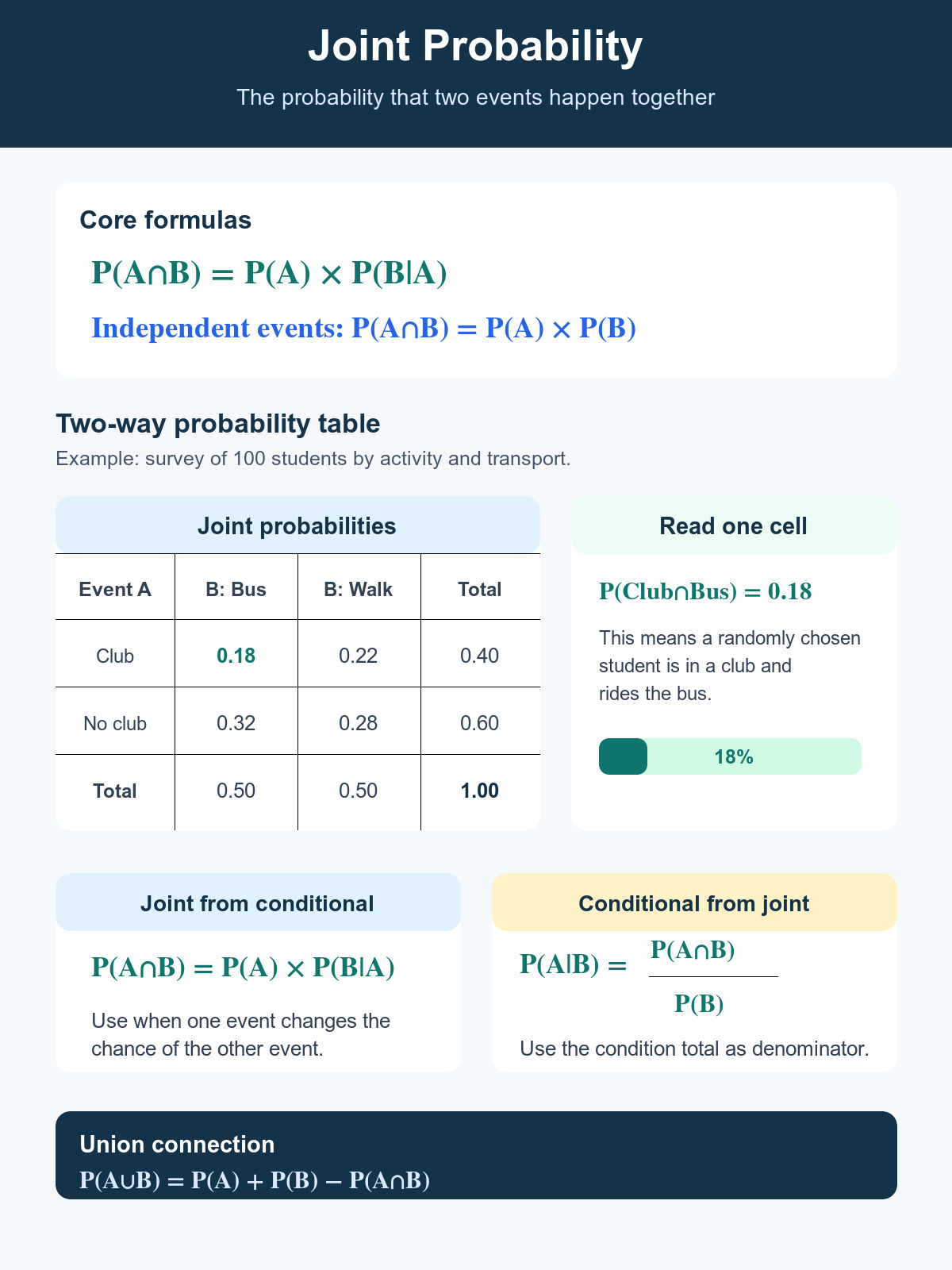
Use this chart to connect the formula, a two-way table, a highlighted joint probability cell, and the conditional probability link.
The formulas in the chart use proper math symbols: intersection, union, multiplication, and a stacked fraction for the conditional probability rule.
Example 1: read joint probability from a table
A survey of 100 students records whether each student is in a club and whether each student rides the bus.
The table uses probabilities rather than counts:
\[P(\text{club}\cap\text{bus})=0.18,\quad P(\text{club}\cap\text{walk})=0.22\]
\[P(\text{no club}\cap\text{bus})=0.32,\quad P(\text{no club}\cap\text{walk})=0.28\]
Find the probability that a randomly chosen student is in a club and rides the bus.
Step 1: Identify the two events: \(A=\text{club}\) and \(B=\text{bus}\).
Step 2: Look for the table cell where the club row and bus column overlap.
Step 3: Read the value: \[P(A\cap B)=P(\text{club}\cap\text{bus})=0.18\]
Answer: The joint probability is \(0.18\), or \(18\%\).
Marginal probability from a joint table
A marginal probability describes one event by itself. In a two-way table, it is found by adding across a row or down a column.
Using the same table, the probability that a student rides the bus is:
\[P(\text{bus})=P(\text{club}\cap\text{bus})+P(\text{no club}\cap\text{bus})\]
\[P(\text{bus})=0.18+0.32=0.50\]
The probability that a student is in a club is:
\[P(\text{club})=0.18+0.22=0.40\]
Marginal probabilities are important because they often become denominators in conditional probability.
Joint probability for independent events
If events \(A\) and \(B\) are independent, one event does not change the chance of the other.
For independent events, the joint probability formula becomes:
\[P(A\cap B)=P(A)P(B)\]
Example: a fair coin is flipped and a fair six-sided die is rolled. Let \(A\) be heads and \(B\) be rolling a 6.
Step 1: Write each probability: \[P(A)=\frac{1}{2},\qquad P(B)=\frac{1}{6}\]
Step 2: Multiply because the events are independent: \[P(A\cap B)=\frac{1}{2}\cdot\frac{1}{6}\]
Step 3: Simplify: \[P(A\cap B)=\frac{1}{12}\]
Answer: The probability of heads and a 6 is \(\frac{1}{12}\).
Joint probability when events are dependent
When events are dependent, use the conditional version of the multiplication rule.
\[P(A\cap B)=P(A)P(B\mid A)\]
Example: a bag has 5 red marbles and 3 blue marbles. Two marbles are drawn without replacement. Find the probability that both marbles are red.
Step 1: The probability the first marble is red is: \[P(A)=\frac{5}{8}\]
Step 2: After one red marble is removed, 4 red marbles remain out of 7 marbles: \[P(B\mid A)=\frac{4}{7}\]
Step 3: Multiply: \[P(A\cap B)=\frac{5}{8}\cdot\frac{4}{7}=\frac{20}{56}=\frac{5}{14}\]
Answer: The probability of two red marbles is \(\frac{5}{14}\).
Joint probability and conditional probability
Joint probability and conditional probability are closely linked.
If you know a joint probability and the probability of the condition, you can find a conditional probability:
\[P(A\mid B)=\frac{P(A\cap B)}{P(B)}\]
Using the table example:
\[P(\text{club}\mid\text{bus})=\frac{P(\text{club}\cap\text{bus})}{P(\text{bus})}=\frac{0.18}{0.50}=0.36\]
So among students who ride the bus, 36% are in a club.
For a full follow-up, use the conditional probability distribution lesson.
Joint probability and union probability
Union probability asks for event \(A\), event \(B\), or both.
The union formula is:
\[P(A\cup B)=P(A)+P(B)-P(A\cap B)\]
The subtraction matters because the overlap \(P(A\cap B)\) is included once in \(P(A)\) and once in \(P(B)\).
Using the table example:
\[P(\text{club}\cup\text{bus})=0.40+0.50-0.18=0.72\]
So the chance that a student is in a club, rides the bus, or both is \(0.72\).
Joint probability distribution
For random variables, a joint probability distribution lists probabilities for combinations of values.
For discrete random variables \(X\) and \(Y\), a joint probability can be written as:
\[P(X=x,\;Y=y)\]
A complete joint distribution must include all possible value pairs, and all probabilities in the table must add to 1.
Joint distributions are the starting point for marginal distributions and conditional distributions.
Continuous joint probability
For continuous random variables, a joint density function is used instead of exact point probabilities.
The joint density is often written as \(f_{X,Y}(x,y)\).
Probability over a region \(R\) is found by integrating over that region:
\[P((X,Y)\in R)=\iint_R f_{X,Y}(x,y)\,dA\]
This is the two-variable version of finding area under a one-variable density curve.
Calculator connection
For quick checks, use the Probability Calculator for independent events, conditional probability, and union probability.
For table problems, write down the joint cell first. Then use row totals and column totals for marginal and conditional probabilities.
Common mistakes
Do not confuse \(P(A\cap B)\) with \(P(A\cup B)\). Intersection means both events. Union means either event or both.
Do not multiply \(P(A)\) and \(P(B)\) unless the events are independent.
Do not ignore the overlap when using the union formula.
Do not call a row total a joint probability. A row total is marginal; a cell inside the table is joint.
Do not forget that every probability in a complete joint table must add to 1.
Quick practice
1. If \(P(A)=0.60\), \(P(B\mid A)=0.25\), what is \(P(A\cap B)\)? Answer: \(0.60(0.25)=0.15\).
2. If \(A\) and \(B\) are independent, \(P(A)=0.40\), and \(P(B)=0.50\), what is \(P(A\cap B)\)? Answer: \(0.40(0.50)=0.20\).
3. If \(P(A)=0.70\), \(P(B)=0.30\), and \(P(A\cap B)=0.20\), what is \(P(A\cup B)\)? Answer: \(0.70+0.30-0.20=0.80\).
4. In a two-way table, is a single inside cell joint or marginal? Answer: joint.